
Vandaag of morgen in huis

Kwaliteit gegarandeerd

Welkomstaanbiedingen ontgrendelen: GRATIS bezorging | Tot 80% korting | Gratis 30 dagen JoyPlus-proefperiode
Download de app
An outdoor wall light can make your entrance, exterior wall, balcony or patio more practical. However, not every outdoor wall light is suitable for the same location. A model that works well under a covered area may be less suitable on a wall exposed to constant rain and wind.
The main pitfalls often have less to do with appearance and more to do with the specifications. Before you buy, check the following:
The IP code indicates how well a light fitting is protected against the ingress of dust and water. For an IP44 outdoor light, the second digit, 4, means it is protected against splashing water from different directions. This makes IP44 suitable for many sheltered outdoor locations, such as a balcony, veranda, entrance or wall beneath an overhang.
IP44 does not mean that the light is waterproof. So don’t place a weather-resistant wall light where it could be exposed to powerful jets of water, prolonged water pooling or submersion. Also check that the seal is fitted correctly. On models with a separate bulb holder, the cover must close securely once the bulb is in place.
For a completely exposed wall, it’s worth checking whether a higher protection rating would be more suitable. Also consider the material:
An LED outdoor wall light with an integrated light source is usually compact and ready to use straight away. You don’t need to buy a separate bulb. The downside is that, on some models, the light source cannot be replaced by the user. So check the stated brightness in lumens, colour temperature and operating life in the product specifications.
A warm white colour of around 2700 to 3000 K usually creates a softer look by an entrance or patio. At around 4000 K, the light looks more neutral and functional, for example beside a garage or garden path. More lumens don’t automatically make a light more pleasant in every location: less light is often enough for mood lighting, while a wide driveway may need more.
With an outdoor light with an E27 fitting or an outdoor light with a GU10 fitting, you choose the light source yourself. Check:
A GU10 bulb is practical for directional lighting. E27 fittings are often used with round or decorative bulbs that give a wider spread of light.
An outdoor light with a motion sensor switches on when it detects movement. This is useful by a front door, shed or walkway. Check the detection range beforehand and whether you can adjust the sensor to suit your needs. A light that is too sensitive may switch on unnecessarily because of pets, branches or passing traffic.
A solar outdoor wall light does not need to be connected to the mains. However, how well it works depends on where it is installed, how much direct sunlight it gets and the battery capacity. Don’t place the solar panel under a deep overhang or behind a wall that casts a lot of shade. Keep the panel free of dirt and leaves.
Also check how the lighting works on solar products. Some models have a dusk sensor, while others combine one with a motion sensor or offer a constant-on setting. This affects how long the light stays on each night.
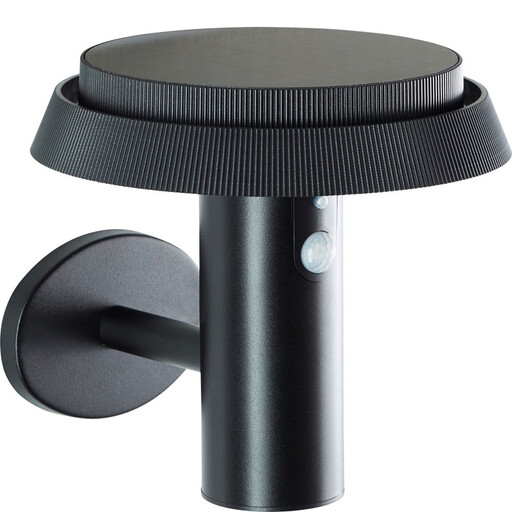
Why it suits this type of user: According to the product specifications, this model is solar-powered and does not need wiring. With 500 lumens, 3000 K and an integrated motion sensor, it’s a good fit for an entrance, patio or garden path where you want an installation that doesn’t require an electrician.
The light source, sensor and solar function are clearly specified. Do make sure it gets enough direct sunlight, and bear in mind that IP44 means splash-resistant, not waterproof.
Integrated LED, 500 lumens, warm white light at 3000 K and no mains connection needed, according to the product description.
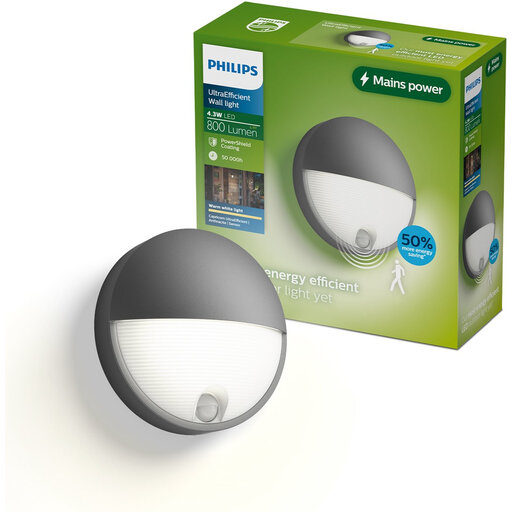
Why it suits this type of user: According to the product specifications, this model has an integrated 800-lumen LED, warm white light at 2700 K, and both a motion and dusk sensor. It’s a good choice if you want fixed exterior lighting by an entrance with automatic activation.
The brightness and colour temperature are clearly stated. The IP44 rating still means it needs to be installed correctly in a suitable outdoor location.
800 lumens, 4.3 W, integrated LED and automatic operation via motion and dusk sensors, according to the stated product specifications.
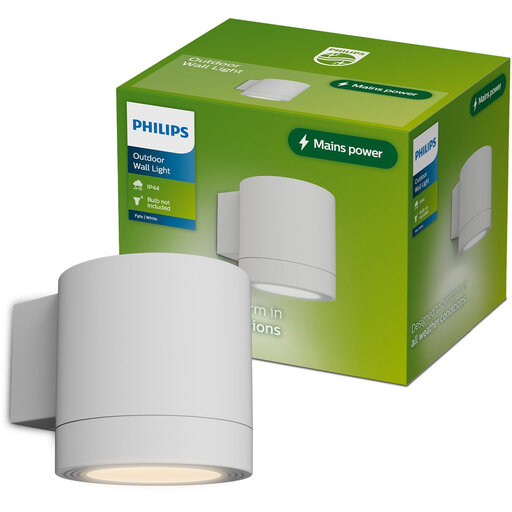
Why it suits this type of user: According to the product details, this compact outdoor wall light has a GU10 fitting and comes without a light source. That’s useful if you want to choose your own light colour and brightness, or select a compatible smart GU10 bulb.
You’re not tied to a non-replaceable integrated LED. You will need to buy a GU10 bulb separately, and check the maximum load and installation requirements.
GU10 fitting, downward-facing beam, aluminium housing and IP44 rating, according to the product description.
We’ve put together a complete, up-to-date list of products that meet these strict selection criteria and the applicable European safety regulations.
A fixed garden wall light or exterior light connected to 230 volt must be wired safely. Switch off the power at the consumer unit, and ask a qualified electrician to make the connection if you’re not confident with electrical installation. Use wall plugs and screws suited to brick, concrete, wood or exterior cladding.
For a portable or magnetic model, the mounting plate is particularly important. Check that the surface is flat, clean and strong enough. For solar lighting, keep the panel clear of leaves and dirt. Clean the light with a soft, dry cloth, following the product instructions; don’t use a jet of water or harsh cleaning products.
IP44 is suitable for many sheltered outdoor locations and protects against splashing water. It does not protect against direct jets of water or submersion. The installation location and a correctly fitted seal are still important.
Consumption depends on the wattage and the number of hours the light is on. A 4.3 W light left on for 1,000 hours uses about 4.3 kWh. A solar outdoor wall light does not use electricity from the mains, but its performance depends on sunlight and the battery.
Lifespan varies depending on the light source, housing, battery and exposure to the weather. Integrated LED models sometimes have an expected operating life listed in the product specifications. With an E27 or GU10 fitting, you can replace the light source when needed. Check the fixings, seals and cables regularly.
