
Vandaag of morgen in huis

Kwaliteit gegarandeerd

Welkomstaanbiedingen ontgrendelen: GRATIS bezorging | Tot 80% korting | Gratis 30 dagen JoyPlus-proefperiode
Download de app
An outdoor wall light can make your entrance, façade, patio, balcony, garage or driveway more practical. However, not every light is suitable for every location. For example, a model with IP44 is splashproof, but that doesn’t automatically make it suitable for a fully exposed wall. A tempting offer can also turn out to be more expensive if you still need to buy a bulb or pay for professional installation.
In this buying guide, you’ll find out what to look for in an outdoor wall light, which marketing claims to treat with caution and which models suit different uses.
In practice, IP44 means protection against solid objects larger than 1 mm and splashing water from different directions. This makes an IP44 outdoor light suitable for many sheltered outdoor areas, such as a balcony, covered patio or façade beneath the eaves. It doesn’t mean the light can withstand direct jets of water, immersion or prolonged exposure to severe weather.
So, for a fully exposed driveway or a wall that takes the full force of wind and rain, check whether a higher IP rating would be more suitable. According to its product specifications, a product with IP65, such as some solar floodlights, offers greater protection against dust and water than an IP44 model.
A black outdoor light or modern outdoor wall lighting may suit your façade, but you should also consider its dimensions, light distribution and installation. A compact downlight directs most of its light downwards. That’s useful by a door or path, but less suitable if you want to light a large patio evenly.
Also check whether the light comes with a bulb. A GU10 or E27 model has a socket, but often doesn’t include a bulb. The colour temperature, brightness and energy consumption will then depend on the LED bulb you choose.
A solar outdoor light with motion sensor doesn’t need a permanent power connection, but its performance depends on where you place it. The solar panel needs plenty of direct sunlight during the day. In winter, on cloudy days or on a shaded north-facing wall, it may not stay lit for as long.
For a rechargeable wall light, check how the battery is charged, how to remove the light and whether the fixing is secure enough. Magnetic mounting is convenient, but the light should be attached to a flat, stable surface.
Start by choosing the location:
Don’t use waterproof outdoor lighting as a catch-all term for any light with IP44. Always check the official IP code in the product specifications.
An LED outdoor wall light with an integrated LED is ready to use straight away, but the light source isn’t replaceable on some models. With a GU10 outdoor light, you can choose a suitable spotlight, as long as you stay within the maximum wattage. A warm colour temperature of around 2700–3000 K usually creates a softer effect by an entrance, patio or in the garden.
Lumens indicate light output:
More lumens don’t automatically mean more comfortable lighting. A directional downlight can cause glare if it’s mounted at eye level.
A wired wall light connected to 220–240 V needs to be connected to the mains. The product information for the Brilliant Jelani and Brilliant Keola states that installation by a qualified electrician is required. These models are a good choice for a permanent location where wiring is already in place.
A solar-powered outdoor light is easier to install because it doesn’t need a mains connection. The position of the panel is therefore important. A rechargeable model with USB-C offers more flexibility, but needs to be charged periodically.
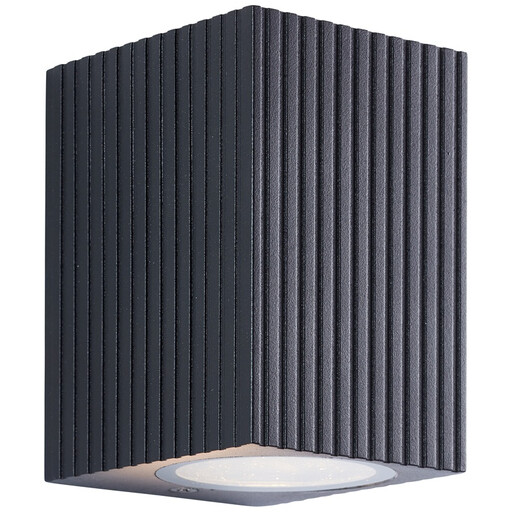
Why it suits this profile: This compact black outdoor light is a good fit for an entrance, fence or sheltered patio where you want to choose your own GU10 LED bulb.
The product information clearly states that the GU10 bulb isn’t included and that IP44 offers splash protection, not complete waterproofing.
Aluminium housing, compact dimensions, GU10 fitting and a maximum of 10 W per light.
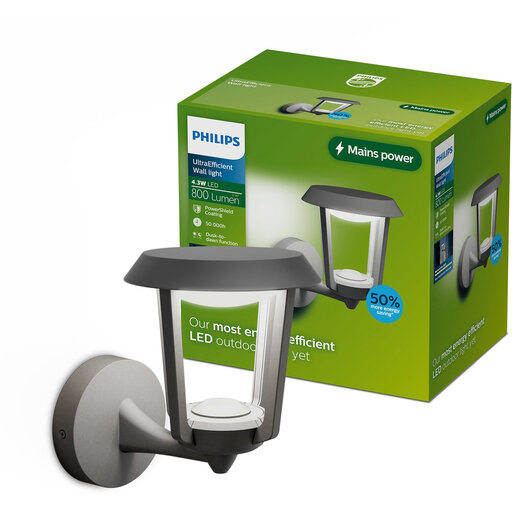
Why it suits this profile: A good choice if you’re looking for a permanent, modern wall light with an integrated LED and warm light for your garden, façade or balcony.
The specifications list the brightness, colour temperature, voltage and IP44 rating separately, so you don’t have to judge the light on appearance alone.
According to the product description: integrated LED, 800 lumens, 2700 K, 230 V and an integrated dusk sensor.

Why it suits this profile: This model is designed for a driveway, garage, garden or larger property where you need wide-area motion-activated lighting without fixed wiring.
The product details specify IP65, the detection range, detection angle and three modes. However, check that the stated performance suits your mounting height and the amount of sunlight the panel will receive.
According to the product description: three adjustable light heads, 3000 lumens, a 180-degree motion detection angle and installation without a mains cable.
We’ve put together a complete, up-to-date list of products that meet these strict selection criteria and current European safety regulations.
IP44 protects against splashing water and is often used in sheltered outdoor areas. Don’t install an IP44 outdoor light where it’s likely to be exposed to direct jets of water, prolonged driving rain or immersion. Always check the installation instructions for your chosen model.
A solar-powered outdoor light doesn’t use electricity from the mains during normal operation. However, how well it works depends on sunlight, battery capacity, temperature and how often the sensor is activated. With little sunlight, the light may stay on for less time or shine less brightly.
For a light connected to 230 V, professional installation is recommended and may be required by the product instructions. Switch off the power and follow local regulations. A solar or rechargeable wall light can usually be installed without fixed wiring, but the fixings must be suitable for the surface and the light’s weight.
