
Vandaag of morgen in huis

Kwaliteit gegarandeerd

Welkomstaanbiedingen ontgrendelen: GRATIS bezorging | Tot 80% korting | Gratis 30 dagen JoyPlus-proefperiode
Download de app
An outdoor wall light can make an entrance feel safer, turn a balcony into a more usable space, or add real character to a facade. Yet it’s all too easy to buy a light that disappoints after just a few months. A stylish design doesn’t tell you much about how well it stands up to rain, how straightforward the installation is, or what the running costs of the bulb will be.
Watch out for these common pitfalls:
The IP code consists of two digits. The first refers to protection against solid objects, the second against water.
An IP44 wall light is protected against objects larger than 1 millimetre and splashing water from any direction. That’s suitable for most sheltered facades, balconies and covered areas. Ideally, don’t place it where rainwater can hit the housing or connection directly.
A higher rating can be useful on an exposed facade, but always read the full product description. “Waterproof” is no substitute for a verifiable IP code.
An integrated LED outdoor wall light often has a fixed light source. That can mean a more compact design, but on some models the LED isn’t replaceable according to the product information. A GU10 or E27 fitting works differently: you can swap the bulb and choose between warm, neutral or cool white light.
Bear in mind:
According to the product specification, the Philips Capricorn, for example, delivers 800 lumens at 2700 K and uses an integrated 4.3-watt LED light source. Those are verifiable details; whether it’s right for you depends on where you want to use it.
A traditional wall light is mounted on a wall and connected to the mains. Before you start, check:
For a rented property or a spot without a power point, a wireless wall light can be more practical. A magnetically mounted light is easy to remove for charging, but the surface needs to be flat, clean and strong enough. A motion sensor is handy near an entrance or patio, but check that it only activates in the dark and how the switch works.

Why it fits the profile: This compact light is ideal if you want extra illumination on a balcony, patio or entrance without any fixed wiring. The motion sensor switches the light on when movement is detected.
The product specification states IP44, an integrated LED and a rechargeable battery. That means no separate GU10 bulb and no new power cable are needed. IP44 does mean splash protection, not full waterproofing.
300 lumens, 3000 K, magnetic mounting, integrated motion sensor and USB-C charging according to the product description.
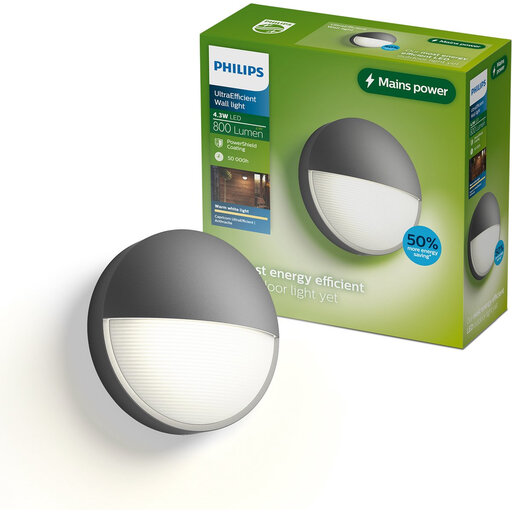
Why it fits the profile: This fixed modern outdoor light suits a facade, entrance or garden wall where even illumination and an aluminium housing are desired.
The IP44 rating and stated dimensions make its outdoor suitability verifiable. Bear in mind that professional installation is required and that the integrated LED is not replaceable according to the description.
800 lumens, warm white light at 2700 K, 4.3 watts and an aluminium and plastic housing.
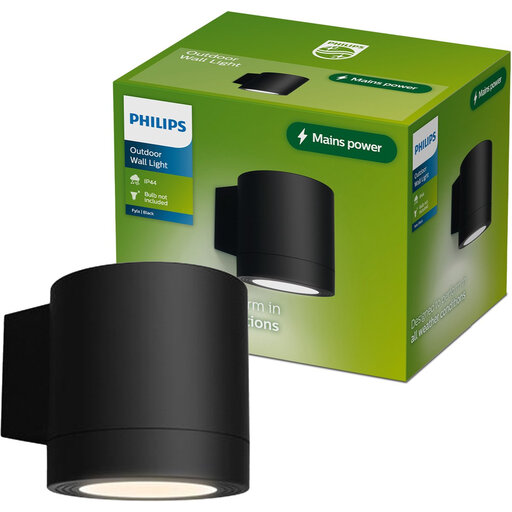
Why it fits the profile: This wall light is ideal if you want to choose your own light colour and brightness, for example on a facade, garden path or balcony.
The GU10 fitting and IP44 rating are clearly stated. Just make sure the GU10 LED you choose is compatible; the light is supplied without a spotlight according to the product information.
Replaceable light source, aluminium housing, black modern design and a choice of standard or smart GU10 bulbs.
We’ve put together a full, up-to-date list of products that fully meet these strict selection criteria and comply with current European safety regulations.
That depends on the exact mounting position and the quality of the seal. IP44 protects against splashing water, but not against submersion or powerful water jets. Fit the light correctly, keep the connections dry and follow the manufacturer’s installation instructions.
A sensor can stop the light from staying on unnecessarily. The actual energy consumption depends on the light source, how often it’s triggered and the set duration. So compare lumens, wattage and sensor settings rather than just relying on the term “energy-efficient”.
With an integrated LED, look at the wattage and the number of hours it’s on. With a GU10 or E27 light, the cost of the separate bulb also counts. A 4.3-watt light that’s on for shorter periods will generally use less electricity than a more powerful model that stays on all evening. Also check whether a wireless light needs regular recharging or new batteries.
