
Vandaag of morgen in huis

Kwaliteit gegarandeerd

Welkomstaanbiedingen ontgrendelen: GRATIS bezorging | Tot 80% korting | Gratis 30 dagen JoyPlus-proefperiode
Download de app
An outdoor wall light can make a dark entrance, façade, balcony or shed more practical straight away. But choosing one based only on an attractive photo or a low price isn’t a good idea. The right light depends on the light source, the position of the wall and how you plan to use the lighting.
Look out for these common pitfalls:
For an outdoor wall light, the IP rating is an important thing to check. Many models in this selection have IP44. That makes them suitable for normal outdoor use, for example on a façade, balcony or sheltered garden wall. Ideally, don’t install an IP44 outdoor light where water constantly runs off a gutter or where a garden hose could spray directly onto the fitting.
A higher level of protection may be preferable on a fully exposed wall. Always check the product information and installation instructions rather than relying on the term ‘weather-resistant’ alone.
An LED outdoor wall light with an integrated LED is ready to use straight away and often has a low stated wattage. For example, according to the product specifications, the Philips Zyra, Capricorn and Nuvy use integrated LEDs rated at 800 lumens, 4.3 watts and a warm colour temperature of 2700 K.
With a fitting, you can choose the light source yourself:
Warm white light of around 2700 to 3000 K often works well on a patio or by an entrance. Cooler light can be more practical for a shed or side path. Check the lumen rating too: more lumens don’t automatically mean more comfortable light or a better spread.
An outdoor light with a motion sensor can be useful by a driveway or front door. As well as checking the sensor, look at the power supply. A 230 V model needs fixed wiring and correct installation. If in doubt, have any work on the mains carried out by a qualified installer.
A solar outdoor wall light avoids the need for mains wiring, but it needs a sunny position. Keep the solar panel clear of leaves, dust and shade. For a light with a battery, the stated operating time depends on the amount of daylight, the mode selected and the temperature.
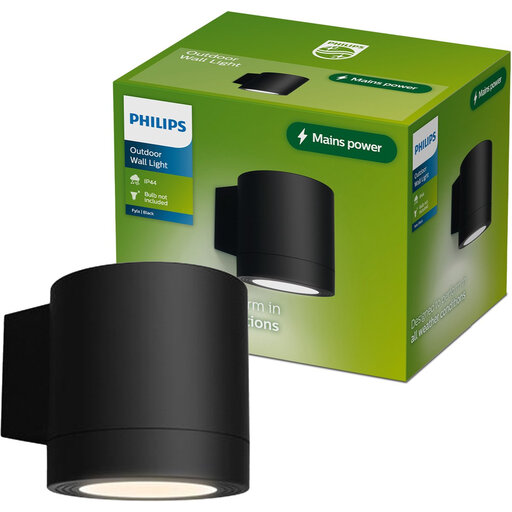
Why it suits this type of buyer: This compact black fitting has a GU10 socket, so you can choose your own LED spotlight. It’s a good fit for an entrance, balcony or small garden wall.
The product description clearly states that the GU10 light source isn’t included. This means you can factor in the cost of both the fitting and bulb in advance.
Aluminium housing, IP44 rating, dimensions of approximately 8,9 × 11,6 × 9 cm and a replaceable GU10 light source.
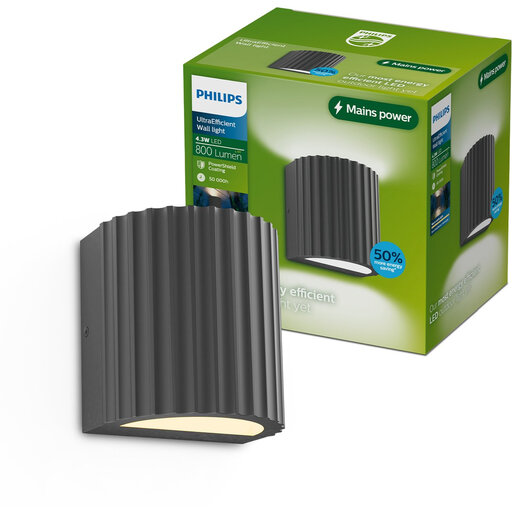
Why it suits this type of buyer: This anthracite aluminium light is designed for anyone looking for fixed, modern outdoor wall lighting with a distinctive light pattern.
The specifications list IP44, 230 V and an integrated LED. So you’ll know in advance that this isn’t a solar or bulb-fitting model.
Two light directions, 800 lumens, 2700 K, 4.3 watts and a manufacturer-stated lifespan of up to 50,000 hours.
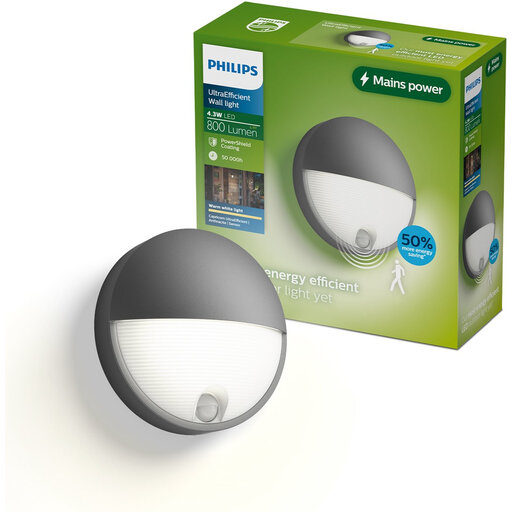
Why it suits this type of buyer: The built-in motion and dusk sensors are useful by a front door, side path or garage where the light doesn’t need to stay on all the time.
The sensor functions and fixed 230V connection are listed separately. This makes it clear that the model isn’t a wireless solar option.
IP44, integrated LED, 800 lumens, warm 2700 K light and a stated power of 4.3 watts.

Why it suits this type of buyer: This solar outdoor wall light is suitable for a garden wall, balcony or shed where running a power cable would be impractical.
The product clearly lists its solar power supply, two lighting modes, dusk sensor and motion sensor. It still needs to be installed where it gets enough direct sunlight.
No connection to the mains needed, IP44, 1000 lumens and warm white 3000 K light according to the product specifications.
We’ve put together a complete, up-to-date list of products that meet these strict selection criteria and the applicable European safety requirements.
IP44 is suitable for many façades, balconies and sheltered garden walls. The rating protects against splashing water, but not submersion or powerful jets of water. Consider where the light will be positioned and follow the installation instructions.
That depends on its wattage and how many hours it’s on. A 4.3-watt light uses approximately 4.3 kWh over 1,000 hours. A motion sensor can reduce the number of hours it’s on. With a solar outdoor wall light, the energy comes from the battery, but the length of time it stays lit depends on sunlight and charging conditions.
Some manufacturers state an expected lifespan, such as 25,000 or 50,000 hours. These are manufacturer product specifications, not a guarantee for every use. Also consider heat, moisture, correct installation and whether the light source can be replaced.
