
Vandaag of morgen in huis

Kwaliteit gegarandeerd

Welkomstaanbiedingen ontgrendelen: GRATIS bezorging | Tot 80% korting | Gratis 30 dagen JoyPlus-proefperiode
Download de app
An outdoor wall light can make an entrance, balcony or patio more welcoming and safer. However, it can be hard to compare the options. A low price tells you little about the light output, and terms such as “weather-resistant” don’t automatically mean a light can withstand every downpour or jet of water.
So, look out for these three common pitfalls:
For many Dutch exterior walls, balconies and sheltered patios, IP44 outdoor lighting is a practical choice. This rating means the housing is protected against solid objects larger than 1 millimetre and splashing water from different directions.
IP44 doesn’t make a light completely waterproof. It’s best to install a water-resistant outdoor light under an eaves or somewhere it won’t be exposed to direct jets of water. For an exposed wall or a location with heavy rainfall, consider a higher protection rating, such as IP65.
Also check that the seal is fitted correctly. On some fittings, IP protection is maintained only when the glass, fitting and housing are properly sealed.
Light output is measured in lumens. A few hundred lumens may be enough for atmospheric lighting by a door or on a patio. For a driveway or somewhere you want to detect movement, a higher light output may be more practical.
Colour temperature is measured in kelvin:
An LED outdoor wall light with an integrated light source is usually straightforward to install. With a fitting such as E27 or GU10, you can choose the light output and colour temperature yourself, but you’ll need to buy a suitable LED bulb separately.
An outdoor light with a motion sensor switches on only when it detects movement. This can be useful by a front door, garage or garden path. Don’t just check whether it has a sensor; look at the detection range and the available lighting modes too.
A solar-powered outdoor wall light is usually easier to install because it doesn’t need to be connected to the mains. However, performance depends on direct sunlight, the season, shade and battery capacity. Clean the solar panel regularly with a soft cloth, and bear in mind that there are fewer hours of daylight for charging during darker periods.
A wired black outdoor wall light often provides more consistent lighting, but needs a permanent mains connection. Switch off the electricity and make sure any electrical work is carried out in accordance with local regulations. If in doubt, use a qualified electrician.

Why it suits this type of buyer: This compact solar-powered outdoor wall light is designed for an entrance, balcony or small patio wall without a permanent mains connection. The integrated sensor and battery keep installation work to a minimum.
The specifications clearly state 180 lumens, 2700 K, IP44 and an integrated battery. This helps you see upfront that it’s mainly for ambient lighting rather than as a powerful floodlight.
Solar power, motion sensor, dimming function and a compact size of 11,5 × 10 × 11 cm.
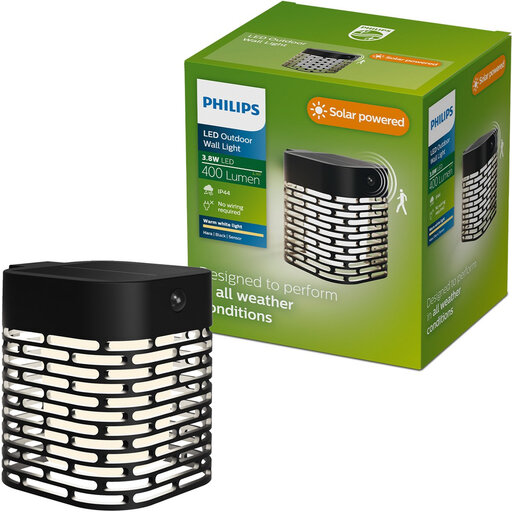
Why it suits this type of buyer: A good choice if you’re looking for a smart-looking black outdoor wall light with two lighting modes and a warm colour temperature for your garden or patio.
The product information lists 400 lumens, 2700 K and IP44. This lets you assess the expected ambience and installation options in practical terms, rather than choosing on the brand name alone.
Solar power, dusk sensor, motion sensor and installation without a mains connection.
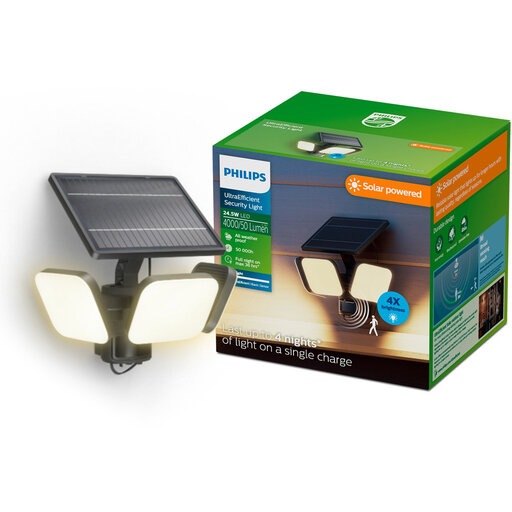
Why it suits this type of buyer: This solar-powered outdoor wall light is designed for large driveways, back gardens or exterior walls where high light output and a wider sensor range are needed.
The specifications list IP65 and 4000 lumens. This makes it clear that this model is designed for a different purpose from a small IP44 mood light, but always check that you’re choosing the right colour temperature variant.
4000 lumens, IP65, integrated LED and a motion sensor with a stated range of 8 metres when approached directly and 16 metres from the side.
A mains-powered wall light for a patio or exterior wall makes sense if you need long-lasting lighting every day and already have a power point available. The Philips Juli, Philips Ulio and Philips Fylx use an E27 or GU10 fitting, so you can choose a suitable LED light source yourself. Remember to factor in the cost of buying the bulb separately and professional installation if needed.
Solar lighting is a better fit for a balcony, garden shed or location without cables. First, check which way the wall faces. A panel in the shade during the day may limit how long the light stays on. Conditions can also be different in winter than in summer.
We’ve put together a complete, up-to-date list of products that meet these strict selection criteria and the applicable European safety regulations.
IP44 is suitable for many sheltered outdoor locations and protects against splashing water. The light must not be submerged and isn’t designed to withstand direct jets of water. Check the installation instructions and choose a higher IP rating for a very exposed location.
Lifespan varies by model and conditions of use. For some models, for example, the manufacturer states a lifespan of 25,000 operating hours. This is a product specification, not a guarantee of a fixed lifespan in every situation. With integrated LED lighting, the light source is generally not designed to be replaced by the user.
A solar-powered outdoor wall light collects energy from the solar panel during the day and stores it in an integrated battery. This means it doesn’t need to be connected to the mains. However, its performance depends on sunlight, shade, temperature, battery condition and the selected lighting mode.
