
Vandaag of morgen in huis

Kwaliteit gegarandeerd

Welkomstaanbiedingen ontgrendelen: GRATIS bezorging | Tot 80% korting | Gratis 30 dagen JoyPlus-proefperiode
Download de app
An outdoor wall light can make an entrance safer, a patio more inviting and your home’s exterior look smarter. But it’s easy to choose a model that disappoints in practice. A stylish light might not be bright enough, a solar light may not charge properly on a shady wall, and a light with a replaceable bulb may be unusable without a suitable bulb.
As a Joybuy Product Recommendation Officer, I focus on verifiable specifications. So don’t just look at the design or brand name: check IP rating, light output, power supply and installation too.
An IP44 outdoor light is protected against solid objects larger than 1 millimetre and water splashes from different directions. This doesn’t mean it’s suitable for direct jets of water, immersion or a completely exposed spot where rain constantly hits the housing.
IP44 may be suitable for a house wall, balcony or covered veranda. Check how the light is installed and make sure the seal is fitted correctly. According to the product information, the Philips Ulio retains its IP44 protection only when installed correctly and with the bulb compartment properly sealed.
A solar outdoor light uses a solar panel to charge its built-in battery during the day. On a north-facing wall, beneath a balcony or behind tall trees, the panel may not get enough direct sunlight. As a result, the running time or brightness may vary from one evening to the next.
When choosing a solar outdoor light, consider:
A cloudy day in the Netherlands doesn’t automatically mean solar lighting won’t work, but there may be less energy available for charging.
A high lumen count tells you about a light’s maximum output, but not how the light is distributed. A directional light, for example, is suitable for a path or doorway, while diffuse lighting can illuminate a larger area more evenly. Colour temperature matters too: 2700 to 3000 K usually gives a warm white light, while 4000 K looks more neutral.
Also check whether the light has an integrated LED or a replaceable bulb fitting. An integrated LED doesn’t need a separate bulb, but the light source usually can’t be replaced by the user. With a wall light that has a GU10 or E27 fitting, you can choose the light source and, if you wish, its colour temperature.
For many house walls, entrances and sheltered patios, IP44 is a practical rating. Don’t install the light somewhere that may be exposed to direct jets of water, prolonged pooling or immersion. Also check that the cable entry, seals and wall fixings are suitable for outdoor use.
A solar wall light doesn’t need to be connected to the mains. This makes installation easier, but performance depends on sunlight and battery capacity. A rechargeable wall light with USB-C offers more flexibility, but needs to be removed and recharged periodically.
A mains-powered light works independently of daylight. However, it does need a fixed connection. Work on a 230-volt connection must be carried out in line with local regulations. If you’re unsure, consult a qualified electrician.
An outdoor light with a motion sensor switches on when it detects movement. This is useful by a front door, shed or garden path. A dusk sensor switches the light on as the ambient light fades. Some models combine both functions.
Be aware of the difference between:

Why it suits this need: This solar outdoor light works without fixed wiring and combines an integrated LED with a motion sensor. It’s a practical choice for an entrance, balcony or garden shed without a power point nearby.
The product information clearly states that it has solar power, an integrated battery and IP44 protection. Its light output is 180 lumens at 2700 K, making it better suited to practical orientation lighting than illuminating a large patio.
No mains connection needed; integrated LED, solar panel, motion sensor and IP44 rating.
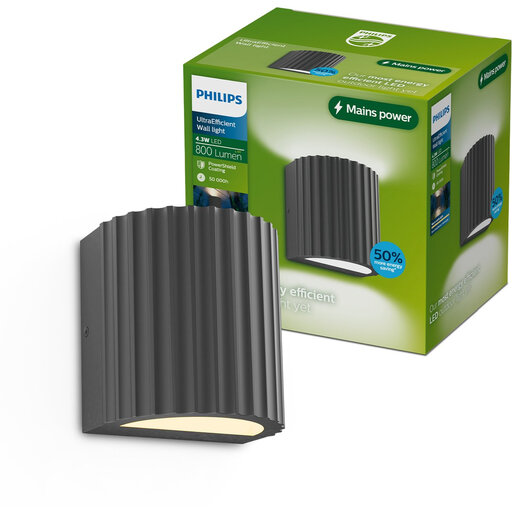
Why it suits this need: Its integrated LED and two-way light output make it a good fit for exterior lighting where both the look of the fitting and the spread of light matter.
The specifications state 800 lumens, 2700 K, 4,3 W and IP44. The light source is integrated, so decide in advance whether the fixed colour temperature and light distribution will suit your needs.
800 lumens, warm white light at 2700 K, integrated LED, with light directed upwards and downwards.
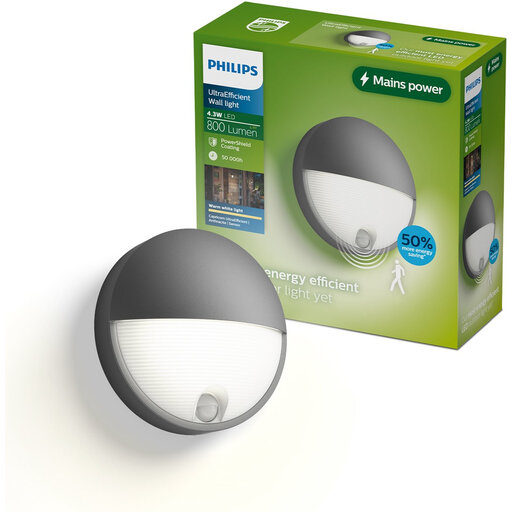
Why it suits this need: For a fixed entrance, driveway or garden path, this LED outdoor wall light combines motion and dusk detection without the need to choose a separate bulb or fitting.
The product details specifically list both a motion sensor and a dusk sensor. With 800 lumens, 2700 K and IP44, its intended use is clearer than that of models with no stated sensor range or light output.
800 lumens, 4,3 W, integrated LED, 2700 K, plus a combination of motion and dusk sensors.
A wall light with a GU10 or E27 fitting gives you more choice. The Philips Fylx uses GU10 and is supplied without a bulb. The Philips Ulio has an E27 fitting and provides diffuse lighting; you’ll also need to buy a suitable LED bulb for this model. Always check the maximum wattage and the dimensions of the bulb.
An outdoor wall light with an integrated LED is quicker to install because the light source is already included. Check the stated colour temperature, brightness and lifespan beforehand. A longer stated lifespan is a manufacturer’s product specification, not a guarantee that the light will perform the same way in every type of weather or use.
For fixed electric lighting, switch off the power before you start. Follow the instructions and, if you’re unsure, have a fixed 230V connection installed by a qualified electrician. Use fixings suited to the surface, whether it’s brick, concrete, wood or cladding.
Clean the housing and solar panel with a soft, dry cloth. Don’t use harsh cleaning products. For solar lighting, regularly check that the panel is clear of leaves and dirt. For magnetic models such as the Brilliant Iseo, make sure the mounting plate is secure on a flat surface. IP44 also means splash protection, not a waterproof construction.
We’ve put together a complete, up-to-date list of products that meet these strict selection criteria and the applicable European safety regulations.
IP44 is suitable for many sheltered and typical outdoor locations, such as an entrance, balcony or veranda. The rating protects against water splashes, but not direct jets of water or immersion. Install the light according to the instructions and make sure the seals are fitted correctly.
It depends on how you’ll use it. A lower lumen output may be enough to help you find your way by a door. A larger exterior wall or garden area needs more light. As well as lumens, consider the light distribution, colour temperature and sensor settings.
A solar outdoor light doesn’t use mains electricity during normal operation. Its built-in battery is charged by the solar panel during the day. Its performance therefore depends on the amount of sunlight, the selected lighting mode and how often the sensor is activated.
