
Vandaag of morgen in huis

Kwaliteit gegarandeerd

Welkomstaanbiedingen ontgrendelen: GRATIS bezorging | Tot 80% korting | Gratis 30 dagen JoyPlus-proefperiode
Download de app
An outdoor wall light can make an entrance, patio, balcony, driveway or exterior wall easier to see. But it’s not always obvious whether a wall light is suitable for outdoor use or likely to disappoint. An attractive design tells you little about its protection from rain, the installation it requires or how much light it actually produces.
Watch out for these common pitfalls:
Below, you’ll find the key things to check, plus a selection of lights for different situations.
An IP code has two digits. The first indicates protection against solid objects; the second relates to water.
Also check that the cable entries, connection points and wall fixings are suitable for outdoor use. For a fixed 230 V connection, it’s sensible – and often necessary under the product instructions – to have the light installed by a qualified electrician.
An LED outdoor wall light with an integrated light source is usually ready to use straight away. You won’t need to buy a separate bulb, but the light source often can’t be replaced by the user.
With a GU10 outdoor light or E27 outdoor light, you can choose the colour temperature and brightness yourself. This gives you more flexibility, but remember to:
An E27 model with a maximum of 60 W may be suitable for creating a welcoming glow on an exterior wall. GU10 fittings often direct light downwards, making them a good choice for an entrance, path or patio.
Lumens indicate light output, but more lumens aren’t always more practical. A moderate light level may be more pleasant on a balcony or by the front door than a powerful floodlight. For a driveway or large garden, you may want a wider area of coverage.
For an outdoor light with a motion sensor, check the stated detection range, detection angle and adjustment options. Sensors can be triggered by passing cyclists, pets, shrubs or traffic. Position the light so the sensor isn’t constantly facing a busy road or moving branches.
For an outdoor solar wall light, direct sunlight is important. A north-facing wall, shade from a canopy or dirt on the panel can reduce charging performance. Solar lighting doesn’t need a fixed power connection, but how long it runs depends on sunlight, the season, the battery and the selected light mode.
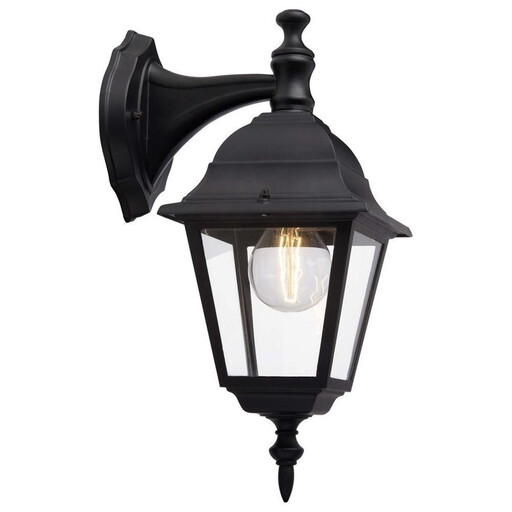
Why it suits this type of buyer: This black E27 fitting has a classic look and lets you choose a suitable LED bulb for an entrance, veranda or sheltered patio.
The product information clearly states that the light is supplied without a bulb and has an IP44 rating. Fit it in a sheltered spot and remember to include the cost of an E27 bulb.
E27 fitting, maximum 60 W, black metal finish and a classic design measuring 34 cm high.
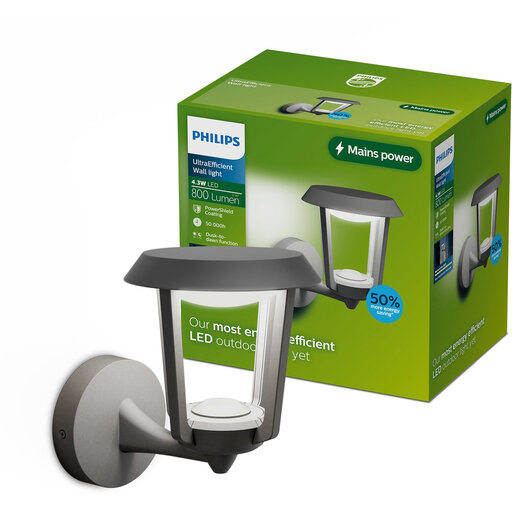
Why it suits this type of buyer: A good choice if you’re looking for a mains-powered LED outdoor wall light with a warm colour temperature, sensor function and a modern anthracite finish.
The specifications list 230 V, an integrated LED, 800 lumens and an IP44 rating. This means the light source and protection rating are clear from the outset, with no need to work out which separate bulb to buy.
Integrated LED, 2700 K, 800 lumens, a stated power rating of 4,3 W and a dusk sensor according to the product information.

Why it suits this type of buyer: A practical option for a driveway, garage, large garden or anywhere else you need wide light coverage and motion detection.
The product details list an IP65 rating, three light modes and a sensor range of 60 feet. Do check that your chosen wall gets enough sunlight.
302 LEDs, a stated light output of 3000 lumens, three adjustable heads and a 180-degree detection angle.

Why it suits this type of buyer: This outdoor solar wall light is a good option if you don’t want to run a cable to a balcony, shed, entrance or garden wall.
The product details list two light modes, a motion sensor, 1000 lumens and an IP44 rating. Position the light in a sheltered spot where its panel will get enough direct sunlight.
Solar-powered, 3000 K, 1000 lumens, dusk sensor and installation without a mains connection.
We’ve put together a complete, up-to-date list of products that meet these strict selection criteria and the applicable European safety requirements.
IP44 protects against splashes and is often suitable for a sheltered exterior wall, veranda, balcony or covered entrance. For a fully exposed spot, a product with a higher level of water protection, such as IP65, may be a better fit. Always check the installation instructions, and don’t install the light somewhere it may be exposed to water jets or submerged.
A fixed 230 V wall light should be mounted on a stable wall and connected in accordance with local regulations. Switch off the power before installation. For models such as GU10 or E27 wall lights without a plug, having the light installed by a qualified electrician is the safest option.
A solar wall light doesn’t use mains electricity during normal operation. How long it runs each night depends on sunlight, battery capacity, temperature, sensor settings and the selected light mode. Keep the solar panel clean and position it where it will receive direct sunlight during the day.
