
Vandaag of morgen in huis

Kwaliteit gegarandeerd

Welkomstaanbiedingen ontgrendelen: GRATIS bezorging | Tot 80% korting | Gratis 30 dagen JoyPlus-proefperiode
Download de app
An outdoor wall light can make your entrance safer and your patio more welcoming. However, not every light is suitable for every exterior wall. A low price, for example, may mean that no bulb is included, while a high lumen rating doesn’t automatically guarantee pleasant light distribution.
The main pitfalls when choosing an outdoor wall light are:
Searching for a waterproof outdoor light IP44 may bring up suitable models for a covered balcony, sheltered exterior wall or veranda, but the term ‘waterproof’ is misleading in this context. Always check the official IP rating and installation instructions.
An IP44-rated light can withstand water splashes from different directions. It’s therefore best not to place one on a completely exposed wall where rain falls directly onto the casing. IP44 may be suitable for a sheltered entrance, garage, patio or balcony.
Also consider the material:
Light output is measured in lumens (lm). A small decorative light doesn’t need a high output. More light is generally more practical by a front door, path or dark passageway.
Colour temperature is measured in kelvin (K):
Also consider the direction of the light beam. An uplight-downlight illuminates the wall in two directions, while a downlight directs light mainly downwards. This difference matters when choosing a wall light for the garden and balcony or when you want to highlight a feature on your exterior wall.
An LED outdoor light with an integrated light source often has a compact casing and a low stated wattage. With a model that has a GU10 or E27 fitting, you choose the bulb yourself. Check the maximum wattage and whether the bulb is included.
A motion sensor switches the light on when it detects movement. A dusk sensor responds to the ambient light. Some models combine both features. Check the direction the sensor faces and whether you can adjust how long the light stays on.
Solar lighting doesn’t need a mains connection, but its output depends on how well it charges during the day. Clean the solar panel regularly. With a mains-powered light, connection costs and installation are more important considerations than with a battery-powered or solar model.

Why it suits this need: This solar model works without fixed wiring and has an integrated motion sensor and dusk sensor. That makes it a practical choice for an entrance, shed or garden wall that gets plenty of direct sunlight.
The specifications list solar power, two lighting modes and IP44. Make sure the chosen wall gets enough sun and is sufficiently sheltered from direct water jets.
1000 lm, warm white light at 3000 K, integrated LED and no mains connection required.
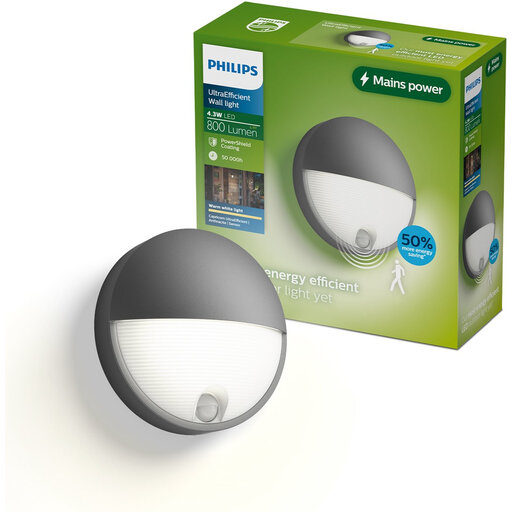
Why it suits this need: A good choice if you’re looking for a fixed, modern outdoor light with sensors for your front door, garage or exterior wall. It runs on 230 V and combines motion detection with a dusk sensor.
The product details specify both IP44 and motion and dusk sensors. So you don’t have to rely solely on a general claim about automatic lighting.
800 lm, 2700 K, integrated LED and an aluminium casing with PowerShield coating, according to the product description.
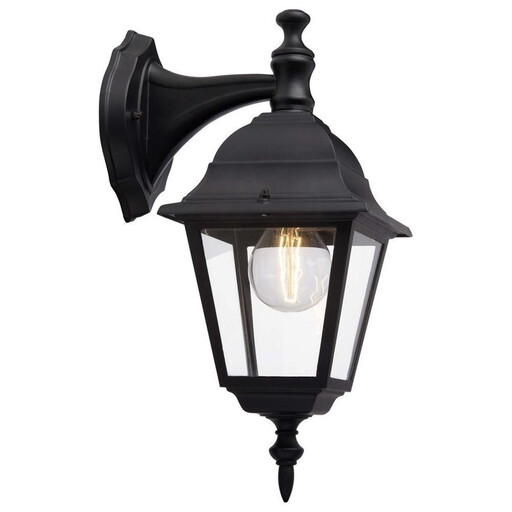
Why it suits this need: This classic black outdoor light suits a veranda, covered entrance or patio where ambience matters more than automatic detection.
The E27 bulb isn’t included. This is clearly stated, so you can choose a suitable LED bulb in advance instead of having to buy one afterwards.
E27 fitting, maximum 60 W, black metal and glass finish, and IP44 for sheltered outdoor locations.
We’ve put together a complete, up-to-date list of products that meet these strict selection criteria and the applicable European safety regulations.
IP44 protects against water splashes and is often suitable for sheltered exterior walls, balconies, verandas and entrances. It doesn’t protect against powerful water jets or immersion. Check where you’ll install the light and follow the manufacturer’s instructions.
A solar wall light doesn’t use electricity from the mains during normal operation. Its battery charges via the solar panel during the day. Actual running time depends on sunlight, the season, positioning and sensor use. Light output may be lower during long periods of cloudy weather.
It depends on the power supply. A solar or rechargeable model can often be installed without fixed wiring. A 230V outdoor light must be connected according to the product instructions; a qualified electrician should handle fixed electrical installations. Always switch off the power before installation or maintenance.
