
Vandaag of morgen in huis

Kwaliteit gegarandeerd

Welkomstaanbiedingen ontgrendelen: GRATIS bezorging | Tot 80% korting | Gratis 30 dagen JoyPlus-proefperiode
Download de app
An outdoor wall light can provide practical lighting for an entrance, patio or balcony while also highlighting the façade. However, the difference between a suitable outdoor wall light and a poor purchase often only becomes clear after installation. A light may turn out to be smaller than expected, be supplied without a bulb or not be suitable for an exposed location.
So don’t just focus on colour and shape. Pay particular attention to the IP rating, fitting, light source, installation and where you intend to use the light.
An IP44 outdoor light is protected against solid objects measuring 1 millimetre or more and against splashing water from different directions. This does not mean that the light can withstand a direct jet of water, immersion or prolonged exposure to heavy rain.
IP44 is generally suitable for a sheltered façade, covered area, veranda or balcony. For a completely exposed location, a higher protection rating such as IP65 may be more practical. Always check the manufacturer’s installation instructions too.
With an E27 outdoor light or GU10 outdoor light, the fitting is sometimes supplied without a bulb. This gives you the freedom to choose the brightness and colour temperature yourself, but it also involves additional costs.
An integrated LED outdoor wall light is ready to use straight away, but the light source usually cannot be replaced separately. With a fitting for a separate bulb, you can switch more easily later between warm white light, functional white light or a smart light source.
A solar outdoor light does not need a fixed power connection, but its solar panel must receive enough daylight. Beneath a balcony, close to a tall fence or on a north-facing wall, the battery may not charge sufficiently. In winter and during overcast weather, the operating time may also be shorter.
A motion sensor helps to reduce energy consumption, but before buying, also check the sensor range, brightness and available lighting modes.
First, consider where you want to install the garden wall light or façade lighting:
IP protection does not automatically indicate corrosion resistance. Aluminium, plastic and glass react differently to moisture, dirt and salty air. In coastal areas or locations exposed to a lot of splashing dirt, regular cleaning is advisable.
An E27 fitting is suitable for many standard LED bulbs. The Aigostar Wall Light E27 A-02, for example, has an E27 fitting and a maximum power of 60 W, but is supplied without a light source. The Brilliant Newport also uses E27, with a maximum of one 60 W bulb.
A GU10 fitting is often used for a directional spotlight. The Philips Fylx is a compact GU10 outdoor light supplied without a spotlight bulb. This means you can choose the colour and brightness yourself, but you will need to purchase a suitable GU10 LED bulb.
For integrated LED lights, look at the lumen output and colour temperature. Warm white light of around 2700 to 3000 K generally creates a softer effect by a front door or patio. For functional lighting, the number of lumens is particularly important. A higher light output is not automatically more comfortable: too much light can cause glare or disturb neighbours.
A wall light with a motion sensor is useful by a back door, garage or driveway. Pay attention to the difference between:
A 230 V light requires a fixed connection. If in doubt, have work on the electrical installation carried out by a qualified installer. Solar lighting does not require a mains connection, but a secure fixing and clear exposure to sunlight are essential.
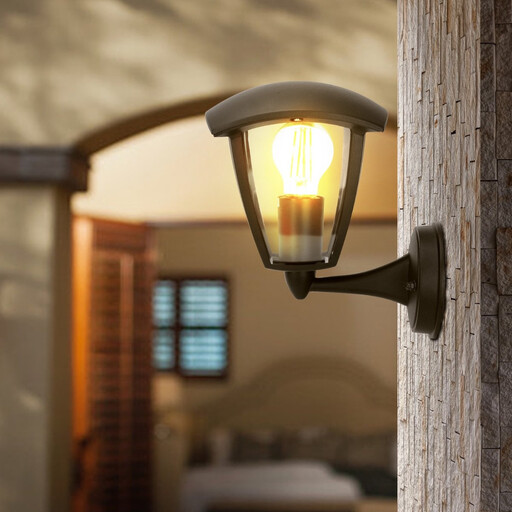
Why it suits this profile: A simple black outdoor wall light for a balcony, covered area or sheltered façade, allowing you to choose your own E27 LED bulb.
The IP44 rating is clearly stated. Bear in mind that the light source is not included and that installation in a sheltered location is recommended.
E27 fitting, aluminium and PMMA construction, black finish and a maximum power of 60 W.
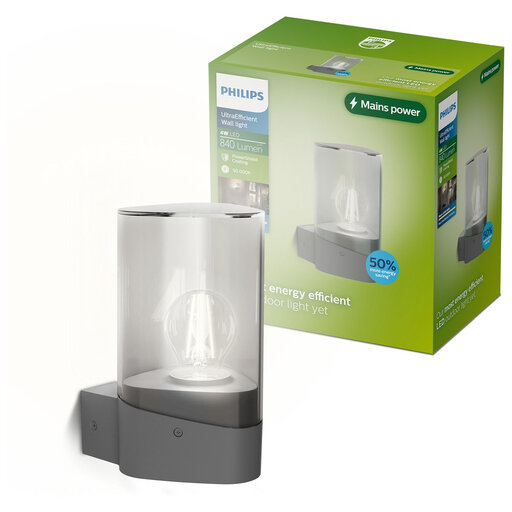
Why it suits this profile: Ideal if you want a modern, permanently installed outdoor wall light with warm light and an included light source.
The product information specifies an E27 fitting, 840 lumens and warm white light at 2700 K, so there is less guesswork when choosing a bulb.
Aluminium and plastic construction, 230 V, IP44 and a stated lifespan of up to 50,000 hours.
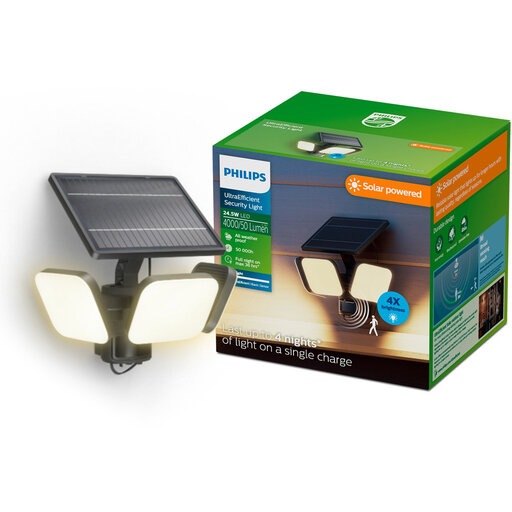
Why it suits this profile: For a driveway, back garden or large façade where a broad, powerful beam and motion detection are required.
The stated IP65 rating is higher than IP44. The light runs on solar power, but the panel does need direct sunlight.
4000 lumens, motion detection up to 8 metres when approached directly and 16 metres when approached from the side, according to the product specifications.
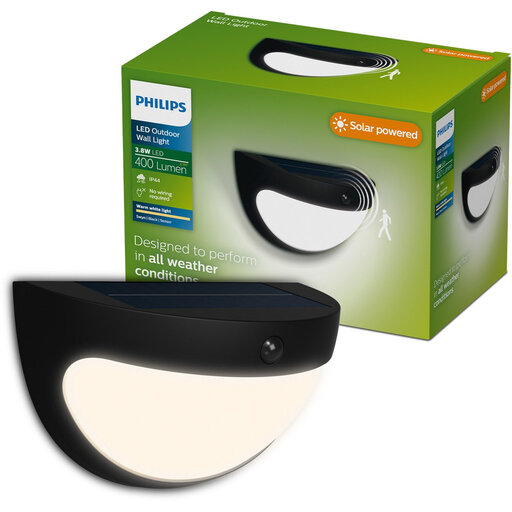
Why it suits this profile: A practical choice for a balcony, garden or shed where it is not possible to run a cable to a socket.
The light has two lighting modes and a motion sensor. Positioning remains important: the solar panel must receive direct daylight.
Integrated LED, 400 lumens, 2700 K, solar power and IP44 rating.
We have put together a complete, up-to-date list of products that fully meet these strict selection criteria and the applicable European safety regulations.
That depends on the installation location. IP44 protects against splashing water and is often suitable for a sheltered façade, veranda, balcony or covered area. It is not a guarantee against direct jets of water or immersion. For a completely exposed location, a higher IP rating may be more suitable.
For atmospheric lighting by a patio or front door, a moderate light output may be sufficient. A brighter light is preferable for a driveway or side path. As well as lumens, consider the direction of the beam, the installation height and any sensor. A 4000-lumen light, for example, is designed to provide much more functional lighting than a compact 400-lumen light.
During normal use, a solar outdoor light does not draw electricity from the mains. Its practical performance does, however, depend on sunlight, panel position, battery capacity and lighting mode. Keep the panel clean and choose a location where trees, walls and roof edges create as little shade as possible.
