
Vandaag of morgen in huis

Kwaliteit gegarandeerd

Welkomstaanbiedingen ontgrendelen: GRATIS bezorging | Tot 80% korting | Gratis 30 dagen JoyPlus-proefperiode
Download de app
An outdoor wall light can provide practical lighting for an entrance, façade, balcony or patio. However, not every outdoor wall light is suitable for the same location. A light that works perfectly well under a canopy may be less suitable on an unprotected façade. Attractive product claims can also conceal important details, such as a missing light bulb, limited battery life or a sensor that is not properly adjusted to your situation.
Pay particular attention to these three common pitfalls:
The IP code consists of two digits. The first digit indicates protection against solid particles, while the second indicates protection against water. For IP44, this means protection against solid objects larger than 1 millimetre and against splashing water from various directions.
This makes IP44 suitable for many covered or sheltered outdoor locations, such as:
For a completely exposed location, it is advisable to check the installation instructions and recommended application. A higher IP rating, such as IP65, offers greater protection against dust and water jets according to the classification. The construction of the housing and correct installation remain important too.
Brightness is measured in lumens. For atmospheric garden lighting on a wall, a lower lumen count may be sufficient. More light is often preferable around a front door or driveway. Colour temperature is measured in kelvin:
A lamp holder such as E27 or GU10 allows you to choose a different LED bulb later. Always check the maximum wattage of the fitting. An integrated LED is compact and ready to use straight away, but if it develops a fault, it generally cannot be replaced separately.
A mains-powered light requires wiring and a safe connection. Have a fixed connection to 230 volts installed by a qualified professional, especially if you are not familiar with electrical work.
A rechargeable outdoor light with a USB connection avoids fixed cabling. However, pay attention to how often it needs charging and how it is mounted. A magnetic light is flexible, but the mounting plate must be securely attached to a flat, suitable surface.
With a solar outdoor light, check:
According to Philips product information, some solar models have two lighting modes, a dusk sensor and a motion sensor. In practice, performance depends partly on sunlight, positioning and panel maintenance.
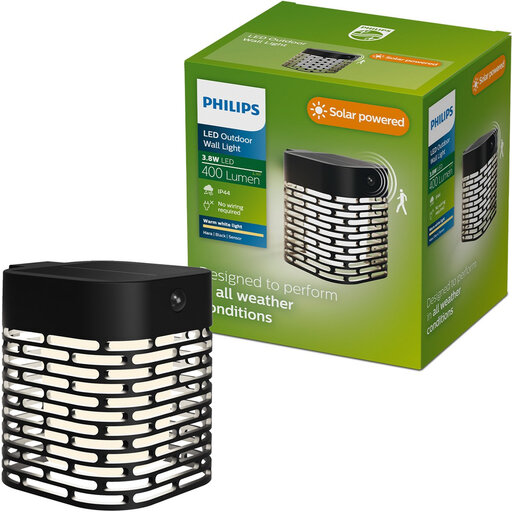
Why it suits this profile: This solar outdoor light works without a mains connection and provides warm white light at 2700K. That makes it practical as a first light for a shed, balcony or sheltered entrance.
The specifications state 400 lumens per light point, two modes, a dusk sensor and IP44 protection. However, check that the installation location receives enough direct sunlight.
Integrated LED, 2700K, two lighting modes and installation without wiring.
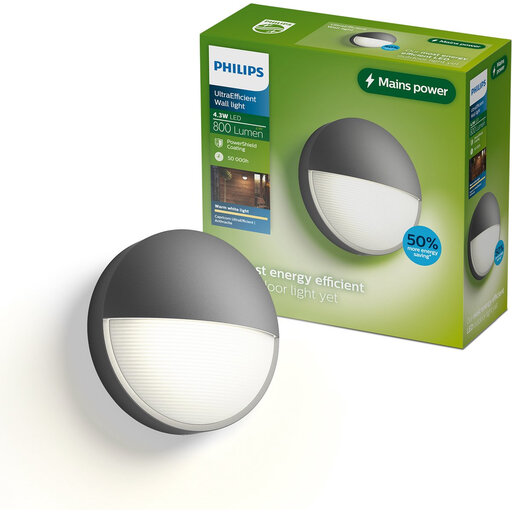
Why it suits this profile: For anyone looking for a fixed LED outdoor wall light with a modern look for a façade, patio or balcony.
The product information clearly states that the integrated LED is not replaceable. This allows you to factor in the complete fitting as a future replacement item.
800 lumens, 2700K, aluminium housing and IP44 protection. According to Philips product information, a lifespan of up to 50,000 operating hours is specified.

Why it suits this profile: The combination of 1000 lumens, a motion sensor and solar power is well suited to a driveway, back door or dark passageway where automatic lighting is desirable.
The motion sensor and dusk function are listed separately in the product specifications. Check the detection direction and position the light so that the panel receives direct sunlight.
1000 lumens, 3000K, integrated LED, two modes and no mains connection required.

Why it suits this profile: This rechargeable outdoor light works without fixed wiring and uses magnetic mounting. That is useful on a balcony, patio or in a rented property where drilling and wiring need to be kept to a minimum.
The light charges via USB-C and has a motion sensor. IP44 means protection against splashing water, so do not place it in an area exposed to direct water jets.
300 lumens according to the product specifications, 3000K, integrated battery, USB-C charging and magnetic mounting.
We have put together a complete, up-to-date list of products that fully meet these strict selection criteria and the applicable European safety regulations.
IP44 is suitable for splashing water and many sheltered outdoor locations. The light is not waterproof and must not be immersed or exposed to strong, direct water jets. Therefore, check the installation location and follow the manufacturer’s safety instructions.
A solar outdoor light does not use mains electricity during normal operation. However, costs or maintenance may arise when a battery loses capacity over time, the solar panel needs cleaning or the complete light needs replacing. The amount of light depends on the available sunlight and the selected lighting mode.
It can be practical, as the light only comes on when movement is detected. Pay attention to the detection angle, range and positioning. A sensor aimed at a busy pavement or moving branches may switch on more often than desired. Adjust the light so that it is focused on the path or door you want to illuminate.
