
Vandaag of morgen in huis

Kwaliteit gegarandeerd

Welkomstaanbiedingen ontgrendelen: GRATIS bezorging | Tot 80% korting | Gratis 30 dagen JoyPlus-proefperiode
Download de app
An outdoor wall light can make an entrance feel safer, illuminate a patio or give a façade more presence. Even so, buying one is not always as straightforward as the product photo suggests. A light that looks modern may provide too little light, be difficult to install or be unsuitable for the place where you want to hang it.
So pay particular attention to these three common pitfalls:
Light output is measured in lumens (lm). For a small entrance or balcony, 180 to 400 lumens may be enough for orientation and ambience. For a driveway, garage or wider façade, a higher light output is more practical.
Colour temperature is measured in kelvin (K):
An integrated LED outdoor wall light is compact and ready to use straight away. A GU10 outdoor light or E27 outdoor light offers greater flexibility: you can adjust the colour and brightness later by replacing the light source.
For many sheltered outdoor locations, an IP44 outdoor light is suitable. Think of a covered entrance, balcony, veranda or façade where the light is not constantly exposed to heavy rain. IP44 does not mean that the fitting is waterproof.
For a more exposed location, such as a façade that is directly exposed to rain and dust, higher protection such as IP65 is worth considering. Also check whether the manufacturer allows installation in the position you want. A light designed for wall mounting is not automatically suitable for upside-down installation or for mounting close to the ground.
A solar-powered outdoor light does not need to be connected to the mains. This makes installation easier, but the location must receive enough direct sunlight. Also bear in mind that the operating time may vary during dark or cloudy periods.
A light with a USB-rechargeable battery can be positioned flexibly, but it needs to be recharged regularly. A fixed outdoor wall light with a 230V connection provides a stable power supply, but the installation must be carried out by a qualified electrician in accordance with the product information.
A motion sensor is useful by a front door, garage or garden path. Check the detection direction and position the light so that passing traffic or moving branches do not trigger it unnecessarily.
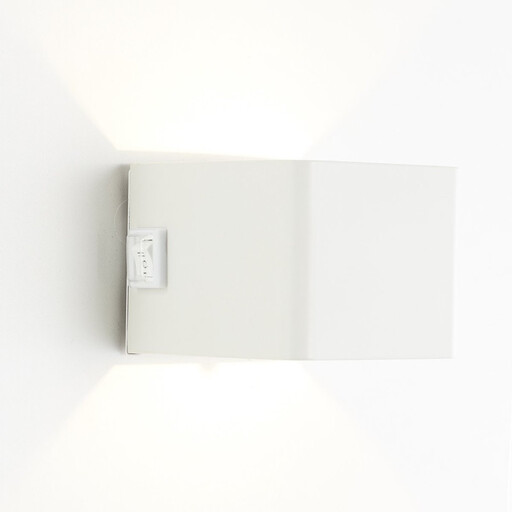
Why it suits this profile: This compact light runs on batteries, has an integrated 300-lumen LED and can be attached using magnets. That makes it practical for a balcony, hallway, veranda or any other location without an existing power point.
The product information clearly states that it has an integrated LED, battery power and IP44 splash protection. This means you know in advance that no wiring is required, but that the light should not be exposed to a powerful jet of water.
300 lumens, 3000 K, motion sensor and magnetic attachment. The light is recharged via USB and does not require a fixed connection.
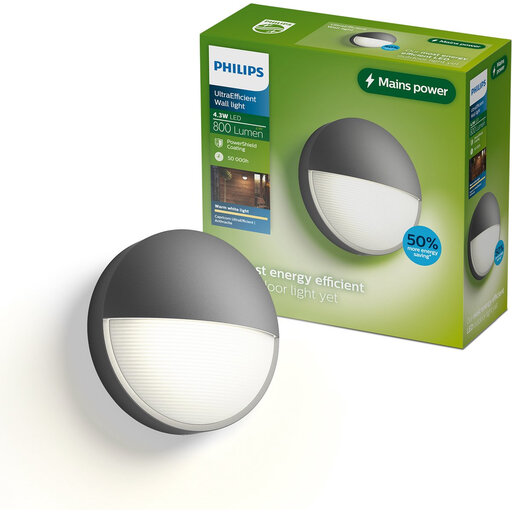
Why it suits this profile: This fixed exterior light combines an aluminium housing with integrated LED, 800 lumens and warm 2700 K light. It is a good choice for anyone looking for a fully finished fitting for an entrance, garden wall or balcony.
The specifications state both the light output and the colour temperature. They also explain that the integrated LED cannot be replaced by the user, which helps avoid incorrect expectations about maintenance.
800 lumens, 2700 K, aluminium and IP44. The fitting is designed for a fixed connection and installation by a qualified electrician.

Why it suits this profile: For a driveway, garage or large outdoor area, the product information states that a light output of 4000 lumens is available. The adjustable fitting, motion sensor and solar power are designed for broad, functional illumination.
The product details specify IP65 rather than just IP44 and state the sensor’s detection range. Positioning in direct sunlight is still essential to charge the battery.
4000 lumens, 5000 K, IP65 and an adjustable light head. The light runs on solar power and has motion and dusk sensors.
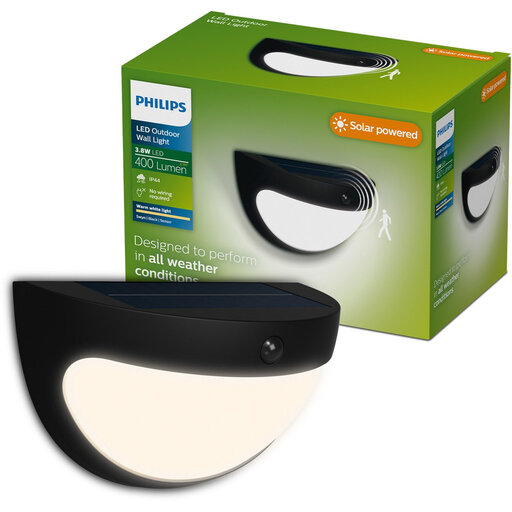
Why it suits this profile: This solar outdoor light is designed for anyone who does not want to run a cable to a garden wall, patio or balcony. According to the product information, it has two lighting modes, a dusk sensor and a motion sensor.
The requirement for direct sunlight is clearly stated in the product information. This allows you to assess in advance whether the installation location is suitable or whether a fixed connection would be a better option.
400 lumens per light point, warm 2700 K light, two lighting modes and IP44. No mains cable required.
We have compiled a complete, up-to-date list of products that fully meet these strict selection criteria and the applicable European safety regulations.
That depends on the installation location. IP44 is suitable for splashing water and sheltered outdoor locations, such as a covered entrance or patio. The light must not be immersed or exposed directly to powerful jets of water. For a completely exposed façade, a higher IP rating may be more practical.
Lifespan varies by model and usage conditions. Some product descriptions, for example, state 20,000, 25,000 or 50,000 operating hours, but these values are product specifications provided by the brand and are not a guarantee for every situation. With integrated LED, you usually cannot replace just the light source. So check in advance whether a replaceable GU10 or E27 fitting would better suit your maintenance preferences.
No, a solar-powered outdoor light uses a built-in battery that is charged via the solar panel during the day. Performance depends on the amount of direct sunlight, positioning, the season and sensor usage. Clean the panel regularly and do not place the light behind glass or in a permanently shaded location.
