
Vandaag of morgen in huis

Kwaliteit gegarandeerd

Welkomstaanbiedingen ontgrendelen: GRATIS bezorging | Tot 80% korting | Gratis 30 dagen JoyPlus-proefperiode
Download de app
An outdoor wall light can make your entrance, balcony, patio or garage more practical. However, good looks alone are not a good enough reason to buy a particular model. Some lights are sold as weather-resistant even though they are only suitable for a sheltered location. Others have a motion sensor that does not suit the intended use, or run on solar power without receiving enough direct sunlight.
Pay particular attention to these three common pitfalls:
For an outdoor wall light, the IP code is a practical starting point. IP44 is suitable for many sheltered or semi-sheltered applications, such as a veranda, balcony, covered entrance or façade that is not exposed to direct jets of water. For an exposed façade, garage drive or unsheltered garden wall, check whether a higher IP rating would be more suitable.
Also consider the installation location. An IP44 light must be securely mounted and should not be placed in a puddle or somewhere water will run against the housing for extended periods.
An LED outdoor wall light with an integrated LED is ready to use straight away, but the light source is usually not replaceable. With a GU10 or E27 fitting, you choose the light source yourself. This gives you more flexibility when it comes to colour temperature, dimming and brightness.
A higher lumen count does not automatically mean the light will be more pleasant. Also consider the light distribution. A downlight directs light downwards, while a fitting with a diffuse shade spreads the light more widely.
A wireless outdoor light powered by a rechargeable battery or disposable batteries is useful when there is no mains connection available. Check how often it needs charging, how the battery is charged and whether the light can be easily removed. A magnetic mount is flexible, but the mounting plate must be firmly screwed to a flat, suitable surface.
A solar outdoor light does not require a mains connection, but it does need to be positioned well in relation to the sun. A fixed 230V light, such as various GU10 and E27 models, must be installed by a qualified electrician. Take the cables, wall type and position of the switch into account.

Why it suits this profile: This compact black LED outdoor wall light runs on a rechargeable battery and requires no permanent wiring. It is therefore well suited to tenants or beginners who want to install lighting quickly by a balcony, patio or entrance.
The specifications state 300 lm, 3000 K, a motion sensor and IP44. The light is splash-resistant, but is not suitable for immersion or direct water jets.
Integrated 4W LED, USB charging, magnetic mounting and automatic activation when movement is detected.
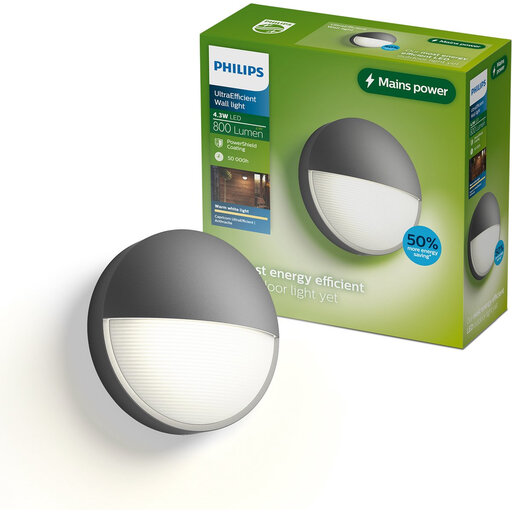
Why it suits this profile: If you are looking for a fixed, powerful outdoor wall light, this model offers integrated LED lighting with 800 lm and an aluminium and plastic housing.
The product information clearly states IP44, 800 lm and a fixed mains connection. There is no uncertainty about a battery, solar charging or a missing fitting.
2700 K warm white light, 800 lm, an aluminium housing and a stated lifespan of up to 50,000 hours according to the product description.

Why it suits this profile: This model is suitable for a driveway, garage or garden wall without a mains connection, provided the solar panel receives direct daylight.
The charging requirement is clear: position the light where the panel receives direct sunlight. IP44 means protection against splashing water, not complete waterproofing.
1000 lm, 3000 K, two lighting modes, solar power and an integrated motion sensor according to the product specifications.
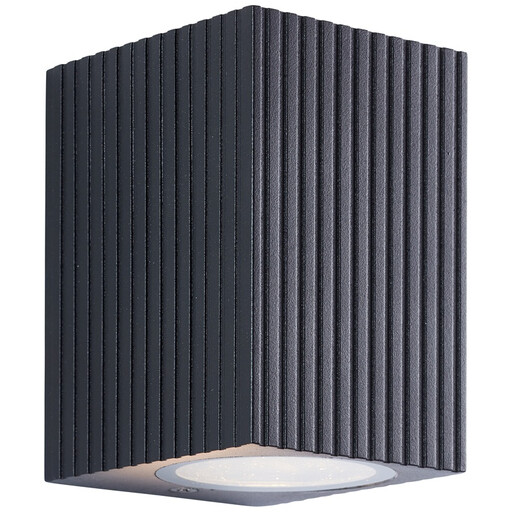
Why it suits this profile: This black outdoor light has a GU10 fitting, allowing you to choose the colour temperature and brightness yourself with a suitable LED bulb.
The light is supplied without a light source. This is stated explicitly, so you can order a suitable GU10 LED bulb at the same time.
Aluminium, glass and plastic construction, up to 10 W, downward light distribution and external dimming when used with a suitable bulb.
We have put together a complete, up-to-date list of products that fully meet these strict selection criteria and the applicable European safety regulations.
For an entrance, a height of around 1.7 to 2 metres is often recommended, depending on the façade and the shape of the light. Position a light with a motion sensor so that people walk within its detection range, while avoiding direct glare into windows. Always check the installation instructions for the model you have chosen.
IP44 is suitable for many sheltered outdoor locations, such as beneath a canopy or on a balcony. The code protects against splashing water, but not against immersion or powerful water jets. For a completely exposed façade, a higher IP rating may be more appropriate.
A solar outdoor light uses energy from the solar panel during the day and stores it in a battery. It does not need to be connected to the mains. Operating time depends on factors including sunlight, season, temperature, battery capacity and the selected lighting mode. Keep the solar panel clean and position it as far as possible from shade.
