
Vandaag of morgen in huis

Kwaliteit gegarandeerd

Welkomstaanbiedingen ontgrendelen: GRATIS bezorging | Tot 80% korting | Gratis 30 dagen JoyPlus-proefperiode
Download de app
An outdoor wall light can make an entrance safer and a patio more inviting. However, it is easy to choose a light that disappoints in practice. For example, an attractive design says little about light output, installation or suitability for an exposed façade.
So look out for these three common pitfalls:
An LED outdoor light with an integrated light source is ready to use straight away and often has a low stated wattage. Philips models such as the Nuvy, Fira, Capricorn and Zyra use an integrated 4.3-watt LED, providing 800 lumens and warm white light at 2700 K.
A fitting with a socket offers greater flexibility:
For a front door, warm white light of around 2700 to 3000 K usually has a softer appearance. For functional façade lighting or a driveway, a higher light output may be more useful. Do not look only at wattage: lumens indicate how much light the lamp produces.
An outdoor wall light with a motion sensor switches on when movement is detected. This is useful by a gate, back door or dark passageway. A dusk sensor switches the light on as soon as the ambient light level drops. Some models combine both functions.
Check the following before buying:
The Brilliant Todd runs on 230 volts and has an E27 fitting with a maximum power of 60 watts. The Philips Fyns, Diara, Swyn and Hara combine a solar panel with a sensor. With a solar outdoor wall light, bear in mind that the panel needs sufficient direct daylight. A north-facing façade, covered area or position beneath a tree can limit charging performance.
For many Dutch entrances, balconies and sheltered patios, IP44 is a common classification. The light is resistant to splashing water, but should not be exposed to a direct jet of water. For a very exposed façade or a location that receives a lot of rain, a higher IP rating, such as IP65 on the Philips UltraEfficient Zyren, may be more practical.
Also consider the installation:
Aluminium and metal create a sturdy appearance. Plastic can be lighter and is practical for solar- or battery-powered models. A black outdoor wall light or anthracite outdoor wall light often complements modern window frames, doors and façades.
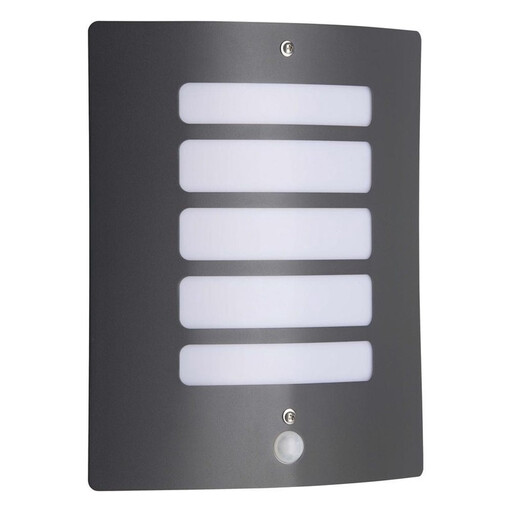
Why it suits this profile: This anthracite outdoor wall light combines a classic fitting with an E27 socket and motion sensor. You can choose your own LED bulb, allowing you to decide on the colour temperature and brightness.
The fitting is clearly specified and the light is supplied without a light source. This means you know in advance that you will need a suitable E27 LED bulb.
E27 fitting, motion sensor, IP44 and dimensions of 29 × 23 × 9 cm. Installation on 230 volts requires connection by a qualified electrician.
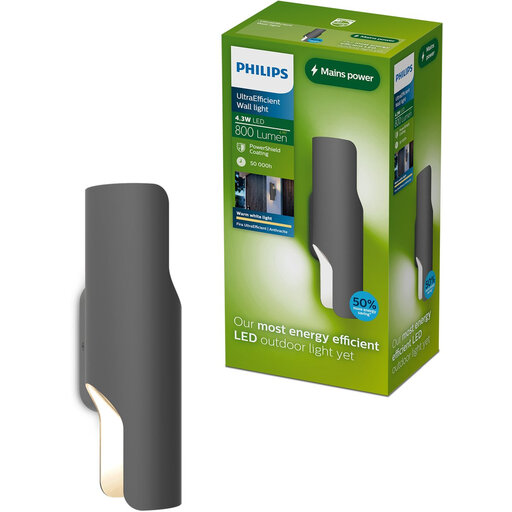
Why it suits this profile: The Fira is designed for fixed façade lighting, with an aluminium housing, integrated LED and light emitted in two directions.
The specifications state both the light output and the power consumption: 800 lumens and 4.3 watts. This makes it easier to assess the size and energy use.
Warm white light at 2700 K, integrated LED, aluminium and plastic construction, 800 lumens and IP44 protection.

Why it suits this profile: This solar outdoor wall light is suitable for locations without a power connection, such as a shed, garden path or side façade where the solar panel can receive direct light.
Choosing solar power means you do not need to worry about a forgotten mains connection. However, installation still depends on sufficient direct sunlight, and the panel needs to be cleaned regularly.
1000 lumens, 3000 K, integrated motion and dusk sensors, two lighting modes and IP44. According to Philips, the stated lifespan is 25,000 operating hours.
We have put together a complete, up-to-date list of products that fully meet these strict selection criteria and the applicable European safety regulations.
With a fixed outdoor wall light, switch off the power at the consumer unit before you begin. Check that the wall can support the weight and use fixings suitable for the surface. If you rent your home, first check whether alterations to the façade are permitted.
Clean the housing and, for solar lighting, the solar panel with a soft, dry cloth. Do not use harsh cleaning products. Also check from time to time that the light is securely attached and that there is no visible build-up of moisture.
IP44 is suitable for splashing water and many sheltered outdoor applications, such as an entrance, balcony or patio. This classification does not mean that the light is waterproof. Choose a higher IP rating if the light is completely exposed or regularly subjected to heavy rain and jets of water.
That depends on the wattage and how long the light is on. A 4.3-watt light that operates for 1,000 hours uses approximately 4.3 kWh. A motion sensor can reduce the operating time. A solar outdoor light does not use electricity from the mains, but its performance depends on sunlight and the battery charge.
You can generally install a battery- or USB-powered model without fixed wiring. A 230V outdoor light requires an electrical connection. Have this carried out by a qualified electrician if you are unsure about the connection or the applicable installation regulations.
