
Vandaag of morgen in huis

Kwaliteit gegarandeerd

Welkomstaanbiedingen ontgrendelen: GRATIS bezorging | Tot 80% korting | Gratis 30 dagen JoyPlus-proefperiode
Download de app
An outdoor wall light may seem simple to choose: select a shape, colour and light source. In practice, the mounting location, IP protection and light output are the main factors determining whether a garden wall light remains practical and pleasant to use. A light that works well on a covered balcony is not automatically suitable for an exposed façade or garden path.
Joybuy Product Recommendation Officer filters the most important product specifications and common pitfalls, so you can compare products effectively without relying on marketing copy as your starting point.
Not every wall light is an outdoor wall light. The Atmosphera Lio, for example, has a metal base, adjustable spotlight and an FSC-certified bamboo shade, but the product information clearly states for indoor use only. This type of light is therefore not designed for rain, moisture or temperature fluctuations on an exterior wall.
Always check whether the product description mentions outdoor use. A decorative wall light for a hallway or living room is not automatically suitable for a garden, balcony or patio.
An IP44 outdoor light is protected against solid objects and splashing water from different directions. This makes IP44 suitable for many sheltered or standard outdoor locations, such as an entrance, balcony or façade beneath an overhang. However, IP44 does not mean that the light can withstand a direct jet of water, immersion or prolonged exposure to heavy rain.
Install the light according to the mounting instructions and avoid locations where water can collect around the housing.
Wattage indicates energy consumption, not the amount of light directly. With an LED outdoor wall light, pay particular attention to lumens. A light producing 800 lumens will illuminate an entrance very differently from a model producing 180 lumens, even if both use little energy.
Also consider the colour temperature:
IP44 may be sufficient for a sheltered location. For a façade directly exposed to rain and wind, it is wise to check that the selected protection rating is suitable for the location. Also look at the protection class, fixing materials and surface. Brick, concrete and cladding do not always require the same wall plugs.
For mains-powered lights, installation must be carried out safely. If in doubt, have a fixed 230-volt connection installed by a qualified electrician.
An integrated LED is ready to use straight away, but if it develops a fault, the light source generally cannot be replaced separately. The Philips Fira and Philips Zyra, for example, have integrated LED lighting. According to the product information, both models provide 800 lumens, 2700 K and 4.3 watts.
With a GU10 or E27 fitting, you can choose the bulb yourself. This gives you flexibility in terms of colour temperature, dimming and light output. However, check whether the light is supplied without a bulb. The Philips Fylx models have a GU10 fitting and are supplied without a GU10 spotlight. The Philips Juli uses an E27 fitting and is also supplied without an LED bulb.
An outdoor solar wall light is useful in locations without a mains cable. Its performance depends on the amount of direct sunlight, the position of the panel and the condition of the battery. In a dark corner or on a north-facing wall, the operating time may be shorter.
A wall light with a motion sensor switches on only when movement is detected. This can save energy and is practical near a driveway, back door or garden path. Check the detection angle, adjustment options and whether the light can also remain on continuously.

Why it suits this profile: This compact black outdoor light runs on solar power and does not require a fixed mains connection. That is practical for a balcony, shed or entrance where wiring is difficult.
The product information states that it is suitable for outdoor use and includes IP44 protection, solar power and a motion sensor. However, check that the chosen wall receives enough sunlight.
180 lumens, warm white light at 2700 K, an integrated battery and compact dimensions of 11.5 × 10 × 11 cm.
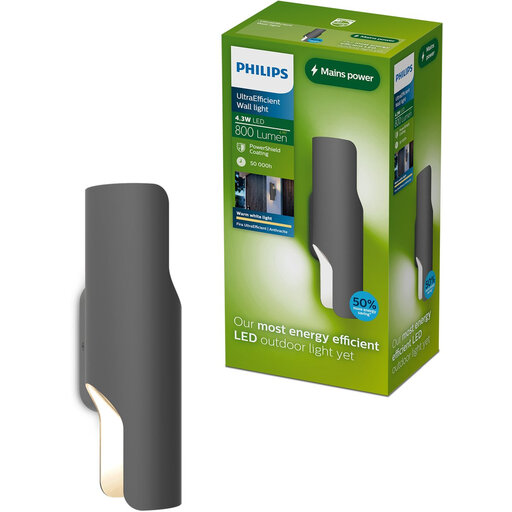
Why it suits this profile: The anthracite aluminium housing and two-way lighting are well suited to a fixed façade, patio or balcony where design and even light distribution are important.
The product specifications state IP44 protection, 230 volts and integrated LED lighting. You therefore do not need to look for a separate fitting or bulb afterwards.
800 lumens, 2700 K, 4.3 watts and light directed upwards and downwards. Philips states a lifespan of up to 50,000 operating hours.

Why it suits this profile: For a driveway, back garden or garden path where extra light is needed without running a cable to the façade, this model offers a higher stated light output and several operating modes.
The listing states that it has a dusk sensor, motion sensor, two lighting modes and IP44 protection. The light is therefore not dependent solely on manual activation.
1,000 lumens, warm white light at 3000 K, solar power and an integrated battery. Position the panel where direct sunlight is available.
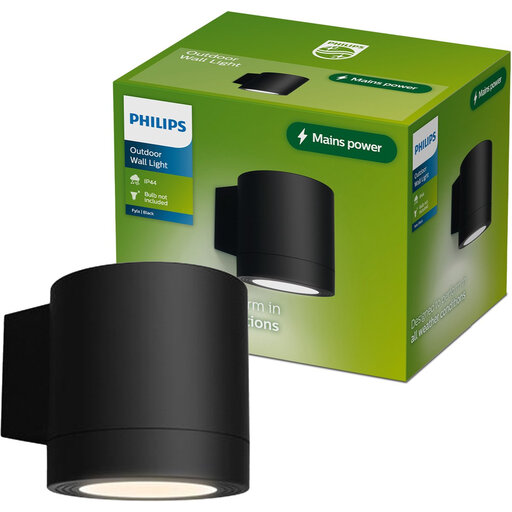
Why it suits this profile: If you want to choose your own light source, a GU10 fitting gives you the option of using a warm, neutral, dimmable or smart LED spotlight.
The fitting can be replaced, but the GU10 bulb is not included. This avoids any misunderstanding at the time of purchase: remember to allow for the additional light source.
Aluminium housing, IP44 protection, compact dimensions of 8.9 × 11.6 × 9 cm and the freedom to choose your GU10 LED lighting.
We have put together a complete, up-to-date list of products that fully meet these strict selection criteria and the applicable European safety regulations.
Before mounting the light, check its height, how the light falls and the cable route. A light by the front door should illuminate the lock without shining directly into your eyes. A motion sensor is practical along a garden path, while a fixed LED light is often more suitable for long-lasting mood lighting near a patio.
For an outdoor solar wall light, the panel needs an unobstructed view of the sky. Clean the panel and shade with a soft, dry cloth. For a mains-powered light, switch off the electricity before mounting or cleaning it. Use fixing materials suitable for the wall and follow the instructions.
For many sheltered outdoor locations, IP44 is a common choice. The light is then protected against splashing water, but not against immersion or direct jets of water. For a completely open and heavily exposed location, check the product specifications and installation advice particularly carefully.
An outdoor solar wall light does not use mains electricity during normal operation. Electricity costs are therefore limited, but the light depends on sunlight and battery capacity. During dark winter periods, the operating time may be shorter. A mains-powered LED light generally uses little energy, but it does continue to consume electricity when left on for long periods.
Lifespan varies depending on the model, operating conditions and power supply. According to the product information, some Philips models state a lifespan of up to 50,000 operating hours; other models specify 20,000 or 25,000 hours. Treat this as a stated product specification, not a guarantee of a particular number of years. Also check whether the LED source can be replaced.
