
Vandaag of morgen in huis

Kwaliteit gegarandeerd

Welkomstaanbiedingen ontgrendelen: GRATIS bezorging | Tot 80% korting | Gratis 30 dagen JoyPlus-proefperiode
Download de app
An outdoor wall light can make a dark entrance, shed or patio more usable. However, an attractive design is not automatically suitable for every exterior wall. A light beside a covered front door has different requirements from lighting on an exposed façade or along a garden path.
The main pitfalls are usually not related to appearance, but to details such as the light source, IP rating and installation method. With this guide, you can compare an outdoor wall-mounted light based on verifiable features and make a more informed choice.
Some fittings are supplied without a bulb. This gives you the freedom to choose your own colour temperature, dimmable bulb or smart bulb, but the total purchase then consists of:
Always check whether a light source is included. According to the product information, the Philips Ulio and Philips Fylx have replaceable light sources, but are supplied without a bulb. This is useful if you want to choose your own bulb, but less convenient if you want to install the light straight away.
A product description may mention weather resistance, but the precise IP code is more important. An IP44 outdoor light is protected against solid objects from 1 millimetre upwards and splashing water from different directions. This makes IP44 suitable for many sheltered façades, balconies and verandas, but not for immersion or powerful water jets.
For an exposed location with greater exposure to rain, a higher protection rating such as IP65 may be more appropriate. Also check that the seal is fitted correctly. According to the product information, the Philips Ulio only retains its IP44 protection when the fitting and bulb compartment are properly sealed.
A bright light beside a front door can cause glare or shine into the house. For atmospheric lighting on a patio, 2700K warm white is often a better choice. Brighter white light may be more practical for a shed, side path or driveway.
As well as colour temperature, pay attention to the light output in lumens. An integrated LED outdoor wall light producing 800 lumens is different from a solar security light that claims to deliver 4000 lumens according to its product description. Choose the brightness based on the location, not just on a large number in the advert.
The IP code consists of two digits. The first refers to protection against solid particles and the second to water.
IP44 may be sufficient for a covered entrance. On an exposed shed wall or in a location where the light receives a lot of rain, IP65 is a feature worth taking seriously.
An E27 outdoor wall light uses a standard screw socket. You can replace the light source and choose between warm white, cool white, dimmable or smart bulbs. A GU10 outdoor wall light uses a spotlight bulb and often produces a more directional beam.
With an LED outdoor wall light with integrated LED, you do not need to buy a separate bulb. According to the stated product specifications, the Philips Zyra and Philips Fira have integrated LED, 800 lumens and 2700K warm white light. However, check whether the LED can be replaced. With some fittings, the entire product must be replaced when the light source reaches the end of its stated lifespan.
Measure the available space before ordering. The Philips Ulio, for example, is 20 cm long, 25,2 cm wide and 22,7 cm high. A compact model fits better beside a narrow door frame, while a larger lantern makes more of an impression on a broad façade.
Also consider:
Switch off the power before carrying out fixed electrical installation. If you are unsure about the wiring, you can engage a qualified installer.
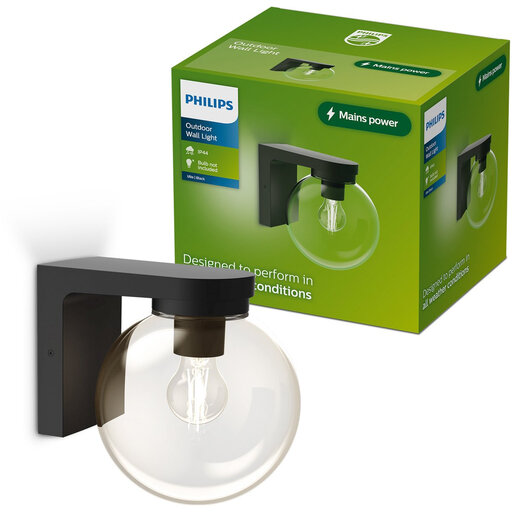
Why it suits this profile: This black aluminium and glass fitting has one E27 socket. You are buying a basic fitting and choosing the light source yourself, for example warm white for the entrance.
The E27 socket is clearly specified and the light source is replaceable. Do bear in mind that you will need to buy an E27 bulb separately.
IP44, one E27 light point and diffuse light distribution according to the product details.
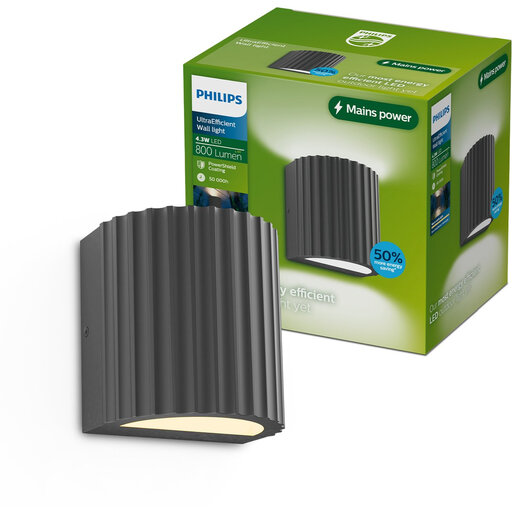
Why it suits this profile: This modern outdoor wall light has integrated LED, an anthracite finish and light directed in two directions. According to the product details, the colour temperature is 2700K.
The light colour and output are set in advance. You do not need to choose a separate bulb, but replacement options are less flexible.
800 lumens, 4,3 W, IP44 and a two-sided lighting effect according to the product specifications.

Why it suits this profile: This solar wall light with motion sensor is designed for locations without a fixed power connection, such as a shed, driveway or side path. The panel needs direct sunlight to charge.
The IP65 rating is more specific than simply saying ‘weatherproof’. Do not place the light in the shade and keep the solar panel clean.
According to the product details: 4000 lumens, IP65, integrated LED, motion detection and a range of 8 metres with direct approach.
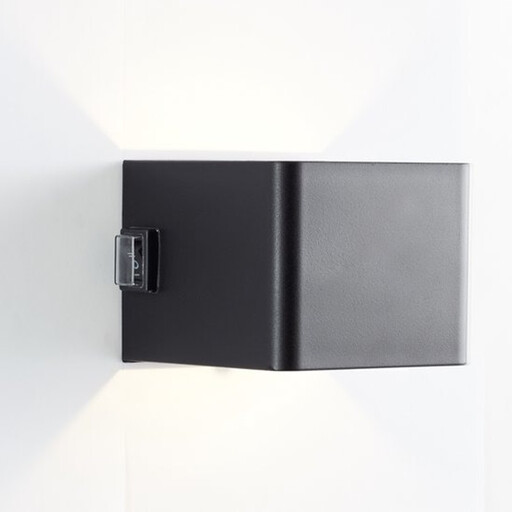
Why it suits this profile: This compact black light runs on a rechargeable battery and uses magnetic mounting. This can be useful on a balcony or in a rented property where permanent wiring is not wanted.
You do not need a fixed power connection. However, IP44 means protection against splashing water, not immersion or powerful water jets.
300 lumens, 3000K, motion sensor, USB charging and integrated LED according to the product information.
An outdoor light with a motion sensor is practical by a front door, garage or shed. The light only comes on when movement is detected, so you do not have to keep using a switch. Pay attention to the detection range and mounting height. A sensor aimed at a busy street may activate more often than you would like.
A solar version works without a fixed cable, but its performance depends on sunlight, the season and the battery’s charge level. For consistent lighting, a fixed LED outdoor wall light is more predictable.
We have put together a complete, up-to-date list of products that fully meet these strict selection criteria and the applicable European safety regulations.
IP44 is suitable for many sheltered outdoor locations and protects against splashing water. For a completely exposed wall or a location subject to heavy water exposure, IP65 may offer greater protection. Always check the installation instructions.
This depends on the wattage and the number of hours it is switched on. A 4,3 W light that is on for 1000 hours uses approximately 4,3 kWh. A motion sensor or dusk switch can limit the number of hours the light is on. Solar lighting does not require a fixed mains connection, but you do need to allow for charging and battery ageing.
Battery-powered lights or solar lighting can usually be mounted without wiring. For a fitting connected to 230 V, the power must be switched off and local electrical regulations must be followed. If you are unsure about the connection, getting help from a qualified installer is the safest option.
