
Vandaag of morgen in huis

Kwaliteit gegarandeerd

Welkomstaanbiedingen ontgrendelen: GRATIS bezorging | Tot 80% korting | Gratis 30 dagen JoyPlus-proefperiode
Download de app
An outdoor wall light can make an entrance, balcony, patio or driveway more practical. However, an attractive design is not automatically suitable for outdoor use. Many disappointing purchases happen because buyers only consider the colour of the light or the price. The practical details are often further down the product page: the IP rating, power supply and installation method.
A light with IP44 is protected against solid particles from 1 mm in size and splashing water. This makes the rating suitable for many sheltered outdoor locations, such as a balcony, covered patio or façade. However, IP44 does not mean that the light can withstand a powerful jet of water or be submerged.
For an exposed location that receives a lot of rain, a higher protection rating such as IP65 may be worth considering. Also check the installation instructions: a good IP rating offers little protection if the cable entries have not been sealed correctly.
An atmospheric wall-mounted garden light does not need to produce the same amount of light as illumination for a driveway. That is why you should check the number of lumens:
A high light output is not always desirable. Bright, cool light can be intrusive next to a window or seating area. For a warm appearance, 2,700 to 3,000 kelvin is usually suitable; 5,000 kelvin produces noticeably whiter light.
A fixed wall light running on 230 V will generally need to be connected by a qualified installer. This applies, for example, to a model with integrated LED lighting or a GU10 fitting. A solar-powered or rechargeable wall light is easier to install, but it needs direct sunlight or must be recharged regularly.
Before buying, check:
For a solar outdoor light, a shaded north-facing wall is often less suitable. Leaves, dirt and prolonged cloudy weather can affect charging performance.
The IP code consists of two numbers. The first refers to protection against solid objects and dust; the second refers to moisture. IP44 is often offered for general outdoor garden lighting. For a more exposed location, IP65 may be more suitable.
Read the description carefully. Terms such as “weather-resistant” are broad. The verifiable information is the stated IP rating and the installation instructions.
A solar outdoor light with a motion sensor switches on when movement is detected. An outdoor light with a dusk sensor responds to ambient light and can switch on automatically around sunset. Some lights combine both functions.
Pay attention to the difference between detection range and lighting duration. A motion sensor does not prevent a battery from running down quickly if the light is activated frequently. With solar products, positioning and the amount of sunlight are at least as important as the sensor.
An integrated LED light requires little maintenance, but if it develops a fault, the light source cannot always be replaced separately. A GU10 or E27 fitting gives you more freedom to choose a suitable LED bulb yourself.
For mains-powered lighting, consumption in watts is relevant. With battery and solar lighting, you should focus primarily on the charging method, battery type, operating time and replaceability. Also check whether a USB cable, batteries or adapter are included.
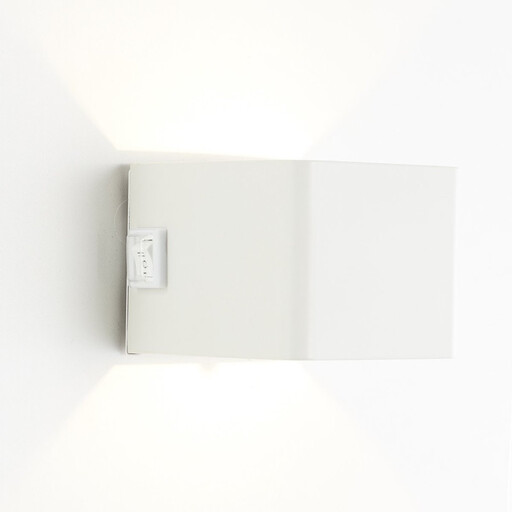
Why it suits this profile: This compact white wall light works wirelessly, has a magnetic mount and provides 300 lumens of warm white light. It is practical for a balcony, veranda or small entrance without an existing power connection.
The specifications state IP44 and make it clear that the light is splash-resistant, not waterproof. No fixed wiring is required either.
Integrated 4W LED, 3000K, motion sensor and USB-C charging. The magnetic mount makes it easy to remove the light for charging.
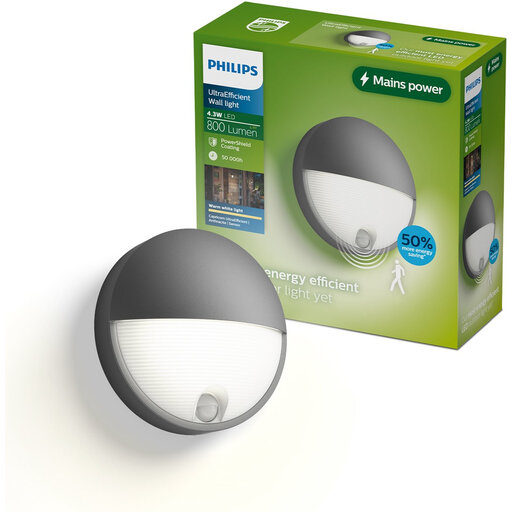
Why it suits this profile: If you are looking for a fixed light by the front door or garage, this model offers 800 lumens, 2700K light and an integrated motion and dusk sensor.
The product details state IP44 and 230V. This makes it clear that it is a fixed, splash-resistant light and that the electrical installation requires attention.
Aluminium housing, PowerShield coating according to Philips and integrated LED with a stated lifespan of up to 50,000 operating hours.
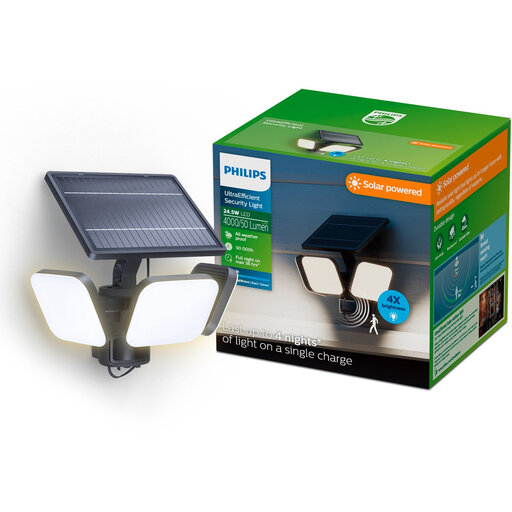
Why it suits this profile: This solar outdoor light is designed for a driveway, back garden or another location where a broad, powerful beam is wanted without a connection to the mains electricity supply.
With IP65, the stated protection is higher than that of IP44 models. However, the light must be positioned so that the solar panel receives direct sunlight.
According to the product specifications: 4,000 lumens, 5,000K, a motion detection range of up to 8 metres when approached directly and up to 16 metres from the side.

Why it suits this profile: The Fyns combines 1,000 lumens, warm white 3000K light, two lighting modes and an integrated motion sensor. The light is suitable for a garden wall, shed or entrance with sufficient sunlight.
The product description states IP44 and explains that direct sunlight is required. This makes the main limitations of solar lighting clear in advance.
No fixed wiring, integrated LED, dusk and motion functions according to the product information, and a stated light output of 1,000 lumens.
We have put together a complete, up-to-date list of products that fully meet these strict selection criteria and the applicable European safety regulations.
For a sheltered façade, balcony or patio, IP44 is often suitable for protection against splashing water. For direct exposure to rain or water, a higher rating such as IP65 may be worth considering. Always check the complete installation instructions.
The lifespan varies from model to model and depends on the conditions of use. Manufacturers sometimes state an estimated lifespan, such as up to 25,000 or 50,000 operating hours. This is a product specification, not a guarantee of a particular service life. With integrated LED lighting, the entire light often needs to be replaced when the light source reaches the end of its lifespan.
A sensor can ensure that the light only comes on when movement is detected. Actual consumption depends on the wattage, how long the light stays on and the number of activations. A solar outdoor light does not use mains electricity, but its performance depends on sunlight, battery capacity and maintenance of the solar panel.
