
Vandaag of morgen in huis

Kwaliteit gegarandeerd

Welkomstaanbiedingen ontgrendelen: GRATIS bezorging | Tot 80% korting | Gratis 30 dagen JoyPlus-proefperiode
Download de app
An outdoor wall light can make a dark entrance, driveway or patio far more practical. However, it is unwise to base your choice solely on appearance or a high lumen rating. A light that looks completely waterproof in a product photo may, in practice, only be suitable for a sheltered wall. Solar outdoor lights are also sometimes marketed as though they deliver the same brightness every night.
With this buying guide, you can check the most important features of an outdoor wall light. This helps you avoid a poor purchase and choose more deliberately between mains-powered facade lighting, a solar outdoor light and outdoor lighting with a motion sensor.
IP44 outdoor lighting is protected against solid objects larger than 1 millimetre and splashing water from various directions. This does not mean that the light can withstand immersion, high-pressure water jets or prolonged exposure to heavy rain.
An IP44 light is generally suitable for an entrance, balcony, patio or facade beneath an overhang. If you install it on a completely exposed wall, also consider a higher protection rating, such as IP65. Always check the complete installation instructions as well.
Lumens indicate how much light a lamp produces according to its product specifications. The way that light is distributed is at least as important. A compact garden wall light with 300 lumens may be ideal beside a front door, while a wide driveway may require several more directional light sources.
Also consider the colour temperature:
A solar-powered outdoor light does not require a fixed electrical connection, but its performance depends on its placement, the season and the amount of direct sunlight. In autumn and winter, charging performance may be lower. Shade from trees, a north-facing facade or dirt on the panel can also reduce operating time.
Check whether the light includes a motion sensor, dusk sensor and multiple lighting modes. A light that switches on briefly only when movement is detected generally demands less from the battery than a model that remains lit throughout the evening.
Choose a weather-resistant outdoor light that suits the location where you intend to install it. IP44 is suitable for splashing water, but not for direct water jets. IP65 provides greater protection against dust and water jets, as found in certain floodlights.
Pay attention to the mounting surface. A heavy aluminium light mounted on a brick facade requires different wall plugs than one installed on wood or insulation. A mains-powered light must be installed in accordance with local regulations. If in doubt, have the wiring connected by a qualified electrician.
An integrated LED has a compact design and does not require a separate bulb. However, check whether the LED can be replaced. If a non-replaceable light source fails, the entire fixture will eventually need to be replaced.
A fixture with an E27 or GU10 fitting offers greater flexibility. You can choose the colour temperature, brightness and, in some cases, a dimmable or smart LED bulb yourself. Take the maximum wattage into account. A fitting also does not automatically mean that the light source is included.
A motion sensor is useful beside a front door or driveway, but check its detection direction and range. A sensor may also respond to pets, passers-by or traffic. With a solar outdoor light, the battery, charging method and lighting modes are important. With a USB-rechargeable light, remember that it will need to be charged periodically.
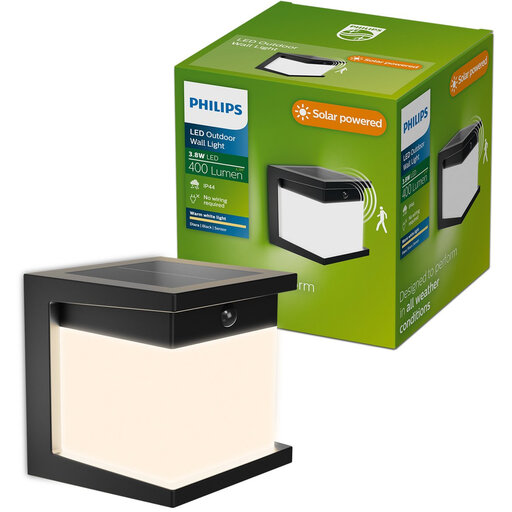
Why it fits: A practical choice for a balcony, garden path or entrance without an existing electrical connection.
The product specifications list solar power, a motion sensor and two lighting modes. No wiring is therefore required, although direct sunlight remains important.
Integrated LED, 400 lumens, 2700K, IP44 and a compact size of 12 × 11 × 12 cm.
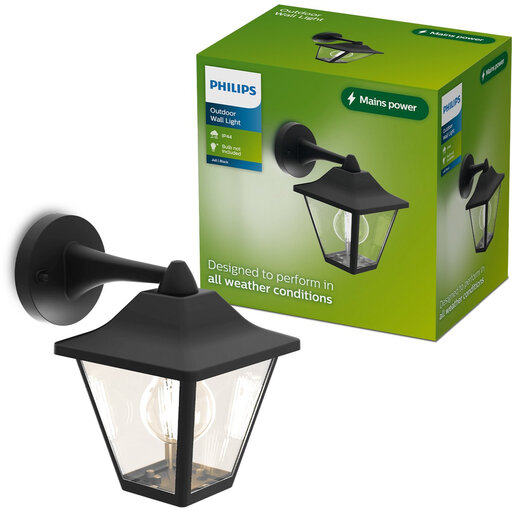
Why it fits: Ideal if you want a classic black outdoor light with a replaceable E27 light source beside the front door or on the veranda.
The light is supplied without an E27 LED bulb. You can therefore see in advance which light source is still required and choose the colour temperature yourself.
Aluminium housing, E27 fitting, IP44 and dimensions of approximately 15 × 21.7 × 22.2 cm.

Why it fits: For users who need plenty of light beside a driveway, garage or large property and are looking for a solar solution.
The stated 4000 lumens and IP65 rating make it clear that this is not a small ambient light. Check beforehand whether its powerful beam is suitable for the location.
Solar power, motion and dusk sensors, an adjustable light head and, according to the product description, a range of up to 8 metres with direct approach.
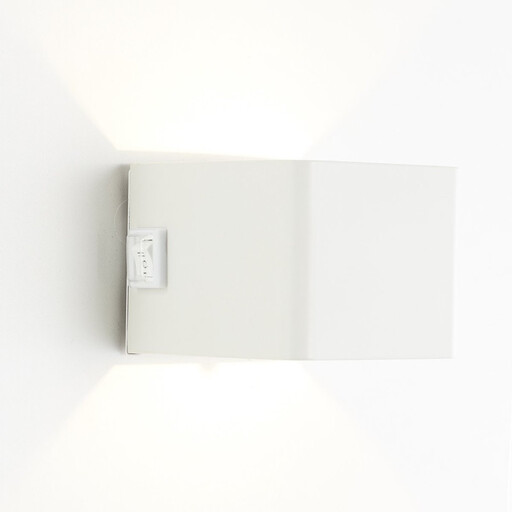
Why it fits: A convenient option when you do not want to drill or do not have a fixed electrical connection on a balcony, patio or temporary home.
The light uses an integrated rechargeable battery and charges via USB. You are not dependent on a small solar panel, but it will need to be recharged regularly.
Magnetic mounting, integrated LED, 300 lumens, 3000K, motion sensor and IP44.
Browse a current selection of outdoor LED wall lights with different light sources, designs, sensors and protection ratings.
IP44 is suitable for splashing water and is often used at sheltered entrances, balconies and patios. For a fully exposed facade or a location subject to direct water jets, a higher IP rating may be the better choice. Always check the manufacturer's installation instructions.
A solar outdoor light does not use mains electricity during normal charging. Its running costs are therefore limited to maintenance and, in the longer term, possible battery replacement. Operating time depends on sunlight exposure, battery capacity, temperature and the selected lighting mode.
The stated lifespan varies from product to product. Some models, for example, specify 25,000 or 50,000 operating hours, but this is a product specification rather than a guarantee of an exact number of years in your situation. Installation location, moisture, temperature and usage duration all affect practical service life. A replaceable E27 or GU10 bulb can also be replaced more easily than an integrated LED.
