
Vandaag of morgen in huis

Kwaliteit gegarandeerd

Welkomstaanbiedingen ontgrendelen: GRATIS bezorging | Tot 80% korting | Gratis 30 dagen JoyPlus-proefperiode
Download de app
An outdoor wall light may seem straightforward to choose, but differences in installation, light output and weather resistance can have a major impact on everyday use. A light that looks attractive in the product photo may provide too little light in practice, get dirty quickly or be unsuitable for the place where you want to install it.
For an entrance, balcony, patio, veranda or garden wall, these three pitfalls are particularly important:
The IP code indicates the extent to which a light fitting is protected against solid particles and moisture. For many sheltered façades, balconies and covered patios, IP44 is a practical choice. The light is then protected against splashing water from different directions.
An IP65 outdoor light offers greater protection against dust and water jets. This may be relevant for an exposed façade, a garden wall without a canopy or a location where the light is exposed to a lot of rain. Always check the product information: a higher IP rating does not automatically mean that every component may be submerged in water.
Also pay attention to the manufacturer’s instructions. According to the product descriptions of various Brilliant models, IP44 lights are splash-resistant but are not suitable for direct water jets.
A fixed LED outdoor wall light has an integrated light source. This is practical, but check whether the LED can be replaced. With an integrated LED, the complete light fitting usually needs to be replaced when the light source reaches the end of its service life.
A fitting with a lamp holder gives you more choice:
Do not look only at wattage. The number of lumens tells you more about the amount of light. For atmospheric lighting on a patio, a lower light output may be sufficient. For an entrance or back door, you will generally want more directional and clearer light. A warm colour temperature of around 2700 to 3000 K creates a softer effect; 5000 K looks much cooler and brighter.
A wall light with a motion sensor can be useful by a front door, garage or garden path. Check the detection range, adjustability and whether the light can also be operated manually. A sensor does not automatically prevent every dark moment: the positioning and viewing direction determine how effectively movement is detected.
A mains-powered light requires a fixed connection of 220-240 or 230 volts. Have this work carried out by a qualified electrician. A solar outdoor light or solar-powered outdoor light does not require a mains connection, but it must be securely attached to a suitable wall. Solar is practical on a sunny façade; on a north-facing wall or in a heavily shaded location, a mains-powered model is often more predictable.
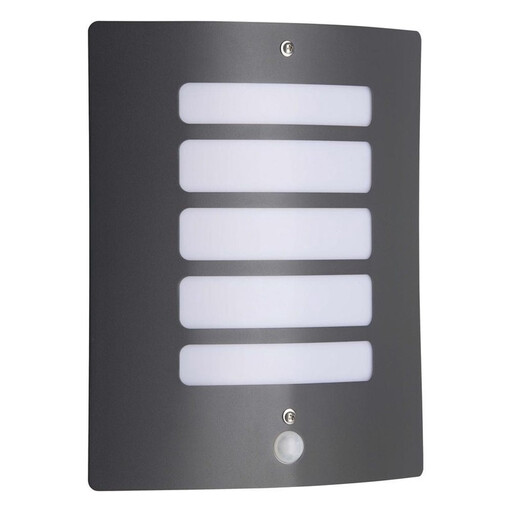
Why it suits this profile: This outdoor wall light has an E27 fitting, a motion sensor and a maximum load of 60 W. You can therefore choose a suitable LED bulb for your entrance, façade or garden.
The light source is clearly stated as not included. With IP44, the light is suitable for splashing water but not for direct water jets.
E27 fitting, integrated motion sensor and compact dimensions of 29 x 23 x 9 cm.
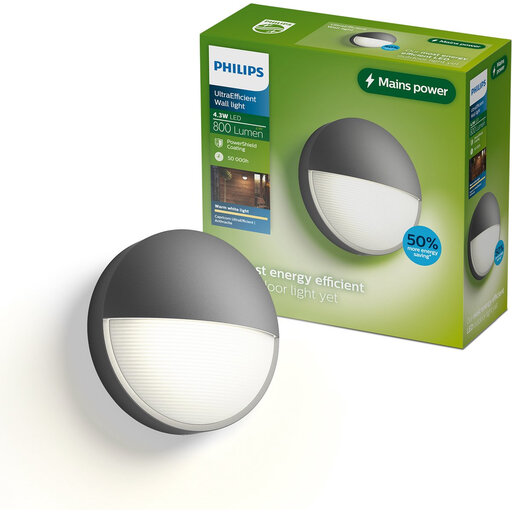
Why it suits this profile: For anyone looking for a fixed LED solution with a understated appearance. The stated specifications include 800 lumens, 2700 K and an aluminium housing.
The light output and colour temperature are clearly specified. Bear in mind that, according to the product information, the integrated LED cannot be replaced.
800 lumens, 2700 K, aluminium and IP44 for outdoor use.

Why it suits this profile: This solar outdoor light is designed for spacious outdoor areas where plenty of light and a higher protection rating are required, such as an open driveway or large garden wall.
The IP65 rating is clearly stated. However, position the solar panel somewhere with direct sunlight; shade can limit charging performance.
4000 lumens, IP65, motion sensor and an adjustable light head according to the product description.
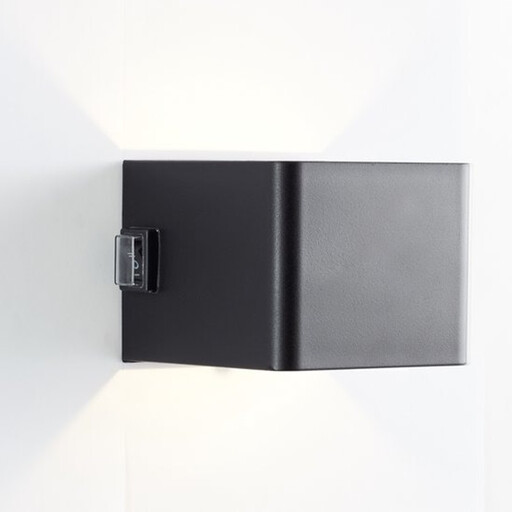
Why it suits this profile: This wireless wall light runs on a rechargeable battery and uses magnetic mounting. That is useful if you do not want to have a permanent connection installed.
No fixed mains installation is required. However, check that the mounting plate is flat and secure; IP44 means protection against splashing water, not a waterproof housing.
300 lumens, 3000 K, motion sensor, USB charging and flexible positioning.
We have put together a complete, up-to-date list of products that fully meet these strict selection criteria and the applicable European safety regulations.
That depends on the location. Under a canopy or on a sheltered balcony, an IP44 outdoor light is often suitable. On a completely exposed façade, IP65 may offer greater protection. Also check that water cannot collect around the wall mount or cable entry.
A solar-powered outdoor light does not use electricity from the mains during normal operation. The battery is charged via the solar panel during the day. Performance depends on sunlight, positioning, the season and the condition of the battery. Keep the panel free from dirt and leaves.
You can usually install a solar or battery-powered model yourself if the wall and mounting surface are suitable. For a wired 230-volt outdoor wall light, having it connected by a qualified electrician is the safe option. Switch off the power and always follow the installation instructions for the relevant model.
