
Vandaag of morgen in huis

Kwaliteit gegarandeerd

Welkomstaanbiedingen ontgrendelen: GRATIS bezorging | Tot 80% korting | Gratis 30 dagen JoyPlus-proefperiode
Download de app
An outdoor wall light can provide practical illumination for a dark entrance, façade or shed. However, it is not wise to choose one based solely on appearance or an impressive lumen count. An outdoor light mounted on the wall may be unsuitable for the installation location, provide too little light or require more maintenance than expected.
Pay particular attention to the IP rating, light source and connection method. Below, you can read what to look out for and which options suit different situations.
An IP44 outdoor light is protected against solid objects and splashing water from different directions. This does not mean that the light is suitable for immersion, direct jets of water or a completely exposed location where rainwater remains on it for long periods.
IP44 can be suitable for a covered entrance, balcony or patio. For a façade exposed to a lot of wind and rain, it is worth considering a higher level of protection, such as IP65. Also check that the light is installed correctly, as an improper seal can reduce its level of protection.
A light with a high output can be useful for a driveway or rear path, but unpleasantly bright next to a front door or on a small balcony. In addition to lumens, consider the colour temperature:
For example, an LED outdoor wall light with 300 lumens is mainly suitable for orientation and ambience. For a larger area, a model with 800 lumens or more may be the more logical choice.
With a fixed wall light, you need to know in advance whether a power point is already available. A fitting with an E27 or GU10 socket gives you flexibility, but the light source is not always included. With integrated LED, the light is ready to use straight away, but the light source usually cannot be replaced.
An outdoor light with a motion sensor can save energy because it only switches on when movement is detected. However, pay attention to where it is installed: a sensor may also respond to pets, passing pedestrians or moving branches. Therefore, check the detection range and whether a dusk-to-dawn function is available.
The IP code consists of two digits. The first digit indicates protection against solid particles, while the second refers to water. For much water-resistant outdoor lighting, IP44 is a practical minimum, provided the light is installed in a sheltered position. According to the product specification, IP65 offers greater protection against dust and water jets, but even then the light must not be immersed.
Also check:
A replaceable E27 bulb is useful if you want to adjust the light colour or brightness at a later date. GU10 is suitable for a focused beam, for example directed downwards along a façade. Integrated LED is compact and ready to use, but cannot be replaced by the user.
Compare the wattage and stated energy values. A model that uses 4.3 watts may consume less electricity than a fitting with a more powerful light source, but the lumen output remains the deciding factor for the application.
A fixed wall light works reliably as long as a power connection is available. A wireless light with a USB-rechargeable battery is more flexible and can be installed without an electrician. The trade-off is that you will need to recharge the light regularly.
A solar outdoor light needs sufficient direct sunlight. Do not place the panel beneath a canopy or in the shade of a tree. In winter or after several cloudy days, the operating time may be shorter than in sunny conditions.

Why it suits this profile: This wireless black outdoor wall light runs on a rechargeable battery and does not need a fixed power connection. The magnetic mounting makes it easy to position beside a balcony, patio or shed.
The product details specify 300 lumens, 3000 K and IP44. This makes the brightness and protection rating easier to assess than relying on a general marketing claim alone.
Integrated LED, motion sensor, USB charging and a compact size of approximately 10 × 10 cm.
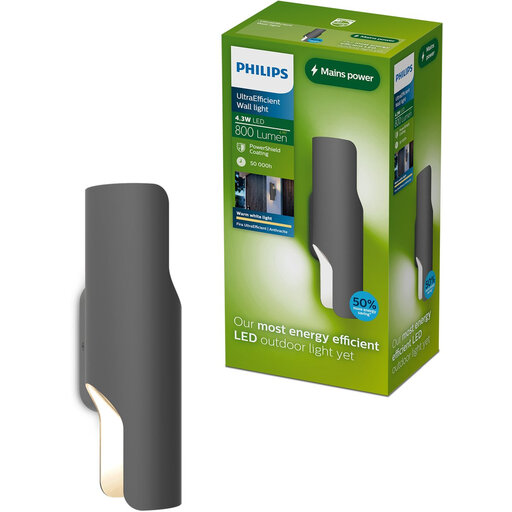
Why it suits this profile: This fixed Philips outdoor light is designed for anyone looking for a clearly defined lighting arrangement and an aluminium fitting. The light shines in two directions along the façade.
The product information specifies 800 lumens, 2700 K, 4.3 watts and IP44. This allows you to match the light to an entrance or patio without relying on design alone.
Integrated LED, warm white light and a two-way lighting effect. According to the product information, professional installation is required for connection to 230 volts.
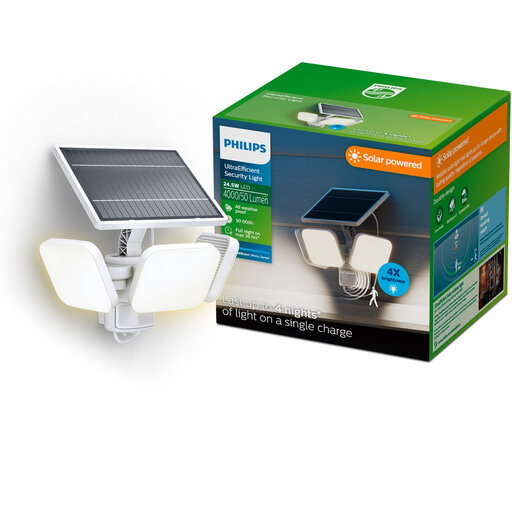
Why it suits this profile: This solar outdoor light is aimed at driveways, rear paths or larger outdoor spaces without an electricity cable, where additional light output is desirable.
The specifications state IP65, a dusk sensor and a motion detection range. Direct sunlight is still essential for charging.
According to the product details, 4000 lumens, 5000 K, two lighting modes and a detection range of 8 metres when approached directly.
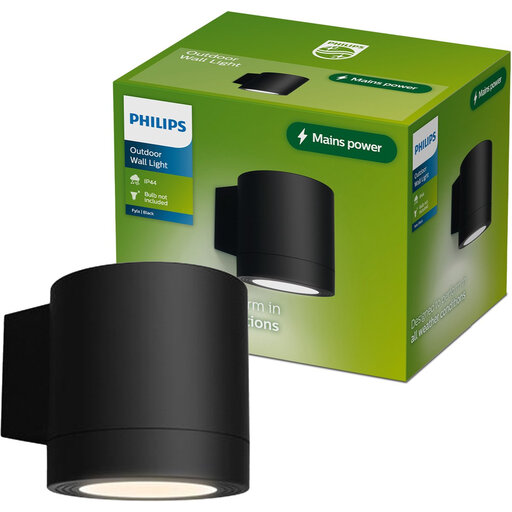
Why it suits this profile: This black outdoor wall light is ideal if you want to choose your own GU10 LED spotlight for ambient lighting, focused illumination or a smart light source.
The GU10 fitting is explicitly stated and the light source is replaceable. Bear in mind that the GU10 bulb must be purchased separately.
Compact size, downward-facing light beam and IP44 protection according to the product details.
We have put together a complete, up-to-date list of products that fully meet these strict selection criteria and the applicable European safety regulations.
IP44 is suitable for splashing water and is often used on a sheltered façade, entrance, balcony or patio. It does not indicate that a light is fully waterproof. Choose a location where the light will not be exposed to direct jets of water or standing rainwater for long periods.
For a small entrance or balcony, around 300 lumens may be sufficient for orientation. For a driveway, rear path or larger façade, 800 lumens or more is more practical. The desired brightness also depends on the installation height, beam angle and colour of the façade.
Consumption depends on the wattage and the number of hours the light is switched on. A 4-watt light that operates for 1000 hours uses approximately 4 kWh. A motion sensor or dusk sensor can reduce the number of hours the light is on. With a solar outdoor light, you do not pay for electricity used by the light, but performance depends on sunlight, battery capacity and how well the panel is maintained.
