
Vandaag of morgen in huis

Kwaliteit gegarandeerd

Welkomstaanbiedingen ontgrendelen: GRATIS bezorging | Tot 80% korting | Gratis 30 dagen JoyPlus-proefperiode
Download de app
An outdoor wall light may seem simple to choose, until you discover that many models are designed for different situations. A solar-powered outdoor wall light, for example, can be convenient without wiring, but it performs less predictably on a shaded façade. A classic wall-mounted outdoor light may suit your home perfectly, but it often requires connection to the mains.
Terms such as “water-resistant”, “powerful sensor” and “energy-efficient” do not always tell the whole story either. Pay particular attention to verifiable specifications and the location where you plan to use the light.
An IP44 outdoor light is protected against solid objects larger than 1 millimetre and splashing water from different directions. This makes it suitable for many covered entrances, balconies, verandas and sheltered façades. However, IP44 does not mean that the light can withstand a direct jet of water or immersion.
For a façade exposed to a lot of rain and wind, an IP65 outdoor light may be the more logical choice. IP65 provides protection against dust and low-pressure water jets. Always check the installation instructions and positioning requirements as well.
A high lumen count means more light, but not necessarily a more pleasant result. For a front door or patio, warm white light of 2700 to 3000 K may be suitable. For a driveway or garage, a higher light output and more neutral light may be more practical.
A small LED outdoor wall light with 180 lumens is intended for orientation and ambience. A powerful solar-powered floodlight with 4000 lumens is more suitable for a large driveway or back garden. So start by identifying the purpose: mood lighting, functional lighting or broad area lighting.
A solar-powered outdoor wall light does not need a fixed power connection, but the solar panel must receive enough direct light during the day. A north-facing façade, overhanging roof or tall fence can limit charging time. In winter and during overcast weather, the operating time may also decrease.
For models with a motion sensor, the detection direction is also important. A sensor that primarily detects movement directly towards the light works differently from one with broad lateral detection.
A light with integrated LED does not require a separate light source. With a fitting such as E27 or GU10, you can choose a suitable LED bulb yourself, but check the maximum wattage and compatibility with a dimmer.
Lumens (lm) indicate the total light output. As a practical guide:
Kelvin (K) describes the colour of the light. 2700 K looks warm and soft, while 3000 K is still warm but slightly brighter. 5000 K produces cooler, whiter light. For cosy patio lighting, a lower colour temperature is generally more pleasant than bright white light.
Aluminium, glass and plastic are commonly used for outdoor lighting. Do not just consider the material; look at the mounting method too. A magnetic light should be placed on a flat, suitable surface. For a fixed wall-mounted outdoor light, you need suitable wall plugs and screws for brick, concrete or another type of façade.
Clean the solar panel regularly with a soft cloth. When cleaning a water-resistant outdoor light, do not use aggressive cleaning products and do not direct a high-pressure jet at the housing.
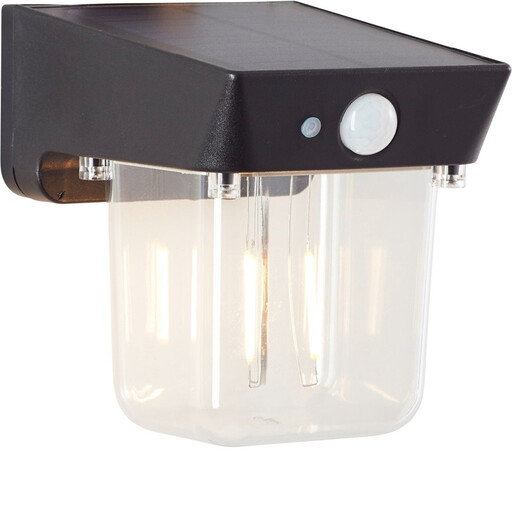
Why it suits this profile: This compact black light works without mains power and combines solar power, integrated LED and a motion sensor. That makes installation easier at an entrance, on a balcony or in a small garden.
The specifications clearly state 180 lumens, 2700 K and IP44. This tells you that it is intended for orientation and mood lighting, rather than as a broad floodlight.
2 W integrated LED, built-in 18650 Li-ion battery, dimming function and dimensions of 11.5 × 10 × 11 cm.
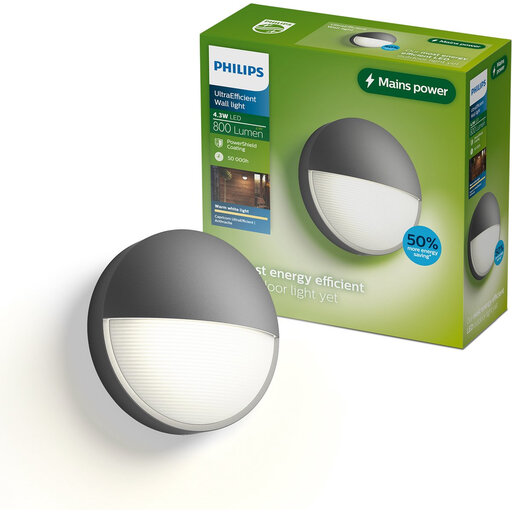
Why it suits this profile: This fixed LED outdoor wall light is designed for anyone looking for a neat façade or balcony solution connected to the mains, without having to replace a separate bulb.
The product information states 800 lumens, 2700 K and IP44. This means you can compare the light output and protection level with your installation plan in advance.
Integrated 4.3 W LED, aluminium and plastic construction, warm white light and a stated lifespan of up to 50,000 operating hours according to the product information.
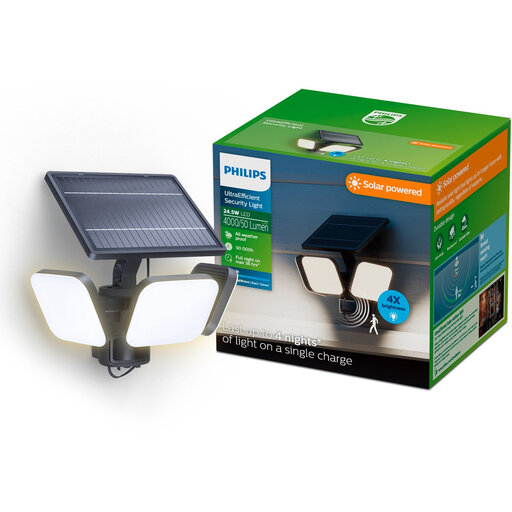
Why it suits this profile: For a driveway, garage or large garden, high light output is more relevant than a subtle beam. The adjustable head helps direct the light towards the desired area.
With IP65, this model is better suited according to the product specification to an exposed location than an IP44 outdoor light. However, make sure you position the panel in direct sunlight.
4000 lumens, 5000 K, two lighting modes, motion detection and a stated detection range of up to 8 metres directly ahead and 16 metres to the sides.
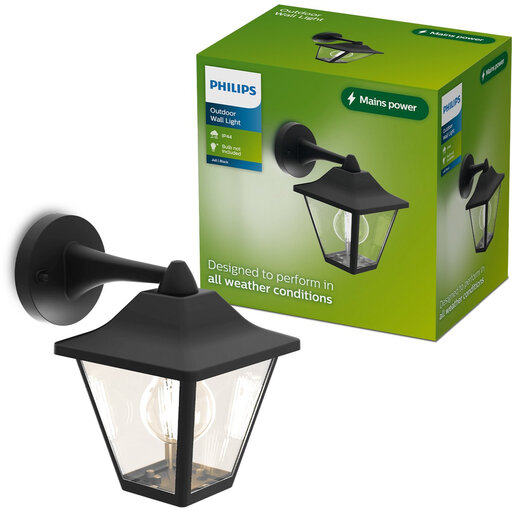
Why it suits this profile: This black outdoor light complements a nostalgic entrance, veranda or patio, and lets you choose an E27 LED bulb with your preferred colour and light output.
The light is supplied without a bulb. This means you are not tied to a preselected light colour, but you will need to choose a suitable E27 LED bulb separately.
E27 fitting, aluminium housing, IP44 and dimensions of 15 × 21.7 × 22.2 cm.
We have put together a complete, up-to-date list of products that fully meet these strict selection criteria and the applicable European safety regulations.
That depends on the location. An IP44 outdoor light is suitable for splashing water and many sheltered outdoor locations, such as a covered front door, balcony or veranda. For a façade directly exposed to rain and water jets, IP65 offers a more suitable level of protection. Neither classification means that you can immerse the light.
The lifespan varies depending on the model, operating time, temperature and power supply. With integrated LED, the light source is generally not designed to be replaced; at the end of its lifespan, you replace the entire fitting. According to the Philips Capricorn product information, a lifespan of up to 50,000 operating hours is stated. Treat this as a product specification from the brand, not a guarantee for every real-world situation.
During normal use, a solar-powered outdoor wall light does not draw power from the mains. The battery is charged by the solar panel during the day. Actual operating time depends on sunlight, season, temperature, battery status and the selected lighting mode. For consistent lighting throughout the night, a mains-powered model may be more predictable.
