
Vandaag of morgen in huis

Kwaliteit gegarandeerd

Welkomstaanbiedingen ontgrendelen: GRATIS bezorging | Tot 80% korting | Gratis 30 dagen JoyPlus-proefperiode
Download de app
An outdoor wall light can make an entrance feel safer, create an inviting atmosphere on a patio or make a dark driveway more practical. However, there are potential pitfalls to consider. A light that looks sturdy in the product photo may be less suitable for an exposed wall, provide too little light or be difficult to install in practice.
The Joybuy Product Recommendation Officer sets out the key points to check. This makes it easier to compare an outdoor wall light based on objective specifications rather than design or marketing copy alone.
An IP44 outdoor light is protected against solid objects larger than 1 millimetre and splashing water from different directions. This does not mean that the light is suitable for immersion, high-pressure water jets or locations where water remains for long periods.
You should therefore also check the installation position. IP44 is often practical beneath a canopy, while a completely exposed wall may be subject to more rain and wind.
A solar outdoor light does not need a fixed power connection, but its solar panel must receive enough direct daylight during the day. Shade from a balcony, tree or overhang can limit charging performance. During the darker months, the operating time may also vary.
Pay attention to the combination of light output in lumens, battery and operating mode. A light that only switches on briefly when movement is detected will generally provide a different experience from one that gives off a gentle glow throughout the evening.
Lumens indicate how much light the lamp produces according to the product specifications. Light distribution is just as important. A compact outdoor light with 300 lumens may be sufficient by a front door but less suitable for a wide driveway. A focused downlight mainly illuminates the wall or ground below the lamp, while a light with a wider beam reaches a larger area.
An LED outdoor wall light with an integrated LED is usually compact and ready to use straight away. With these models, the light source often cannot be replaced by the user. Therefore, check the stated service life and consider whether you may want to choose a different colour temperature later.
A fitting with an E27 or GU10 socket offers greater flexibility. You can choose the LED bulb, the number of lumens and, if required, a dimmable version yourself. For example, the Philips Ulio and Philips Juli have an E27 socket and are supplied without a light source. The Brilliant Jelani uses a GU10 socket.
An outdoor light with a motion sensor switches on when movement is detected. Do not just check whether a sensor is included; also consider the detection angle and the direction in which people will approach. The Brilliant Magua is listed with a detection angle of 120 degrees. According to its product specifications, the UME light has a detection angle of 180 degrees and a range of approximately 18 metres.
A sensor is useful by a front door, shed or driveway, but it can also react unintentionally to passing pedestrians or branches. Check whether the sensitivity, operating time or lighting mode can be adjusted.
A solar outdoor wall light or rechargeable outdoor wall light is suitable if you do not want to run a cable. With a fixed 230V connection, safe installation is important. If in doubt, have the wiring installed by a qualified electrician and use fixings suitable for brick, concrete or exterior cladding.
Also check the dimensions. A light approximately 20 centimetres wide may look large on a narrow pillar, while a compact model of around 10 centimetres may be less noticeable.

Why it suits this profile: This compact model runs on solar power and does not need a fixed power connection. With 180 lumens, 2700 K and a motion sensor, it is suitable for a small entrance, balcony or garden path.
The light output and colour temperature are clearly specified. However, bear in mind that limited sunlight can affect charging.
Solar power, integrated LED, motion sensor and IP44 rating.
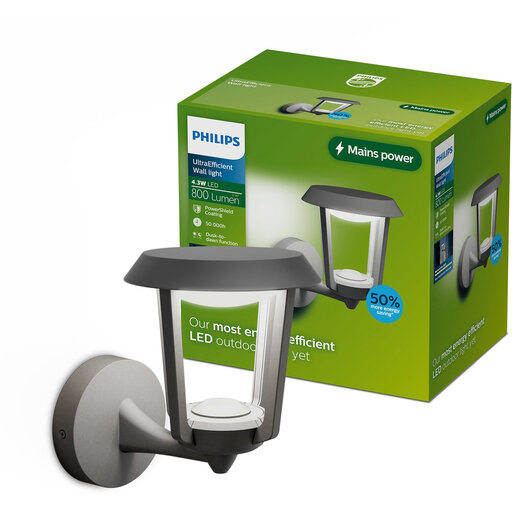
Why it suits this profile: This fixed 230V light is designed for anyone looking for a permanent lighting solution by a wall, in a garden or on a balcony. According to the product specifications, the integrated LED provides 800 lumens at 2700 K.
The light source, colour temperature, voltage and light output can all be checked in advance. IP44 still depends on correct installation.
800 lumens, 2700 K, integrated LED and aluminium housing according to the product details.

Why it suits this profile: With three adjustable light heads, 3000 lumens and a wide detection angle, this model is designed for larger areas such as a driveway, garden or the side of a garage.
The stated 3000 lumens and IP65 rating make the choice more concrete than a general claim about brightness or weather resistance.
302 LEDs, three lighting modes, three light heads and a stated IP65 rating.

Why it suits this profile: The magnetic mounting and rechargeable battery offer flexibility without fixed wiring. With 300 lumens and 3000 K, the light is suitable for a balcony, veranda or temporary workspace.
There is no need to install a fixed connection. However, check that the magnetic mounting plate is secure and flat enough, and recharge the light regularly.
USB-C charging, magnetic mounting, motion sensor and IP44.
We have compiled a complete, up-to-date list of products that fully meet these strict selection criteria and the applicable European safety regulations.
IP44 means protection against solid objects larger than 1 millimetre and splashing water. It is not a guarantee that the light is waterproof. Install the light according to the instructions, avoid direct water jets and check that the seals have been fitted correctly.
An outdoor solar light does not use mains electricity during normal operation. The solar panel charges an internal battery. The actual operating time depends on sunlight, the season, battery condition and the selected lighting mode.
The stated service life varies from model to model. The product specifications may state, for example, 10,000, 20,000 or 50,000 operating hours. This is a product specification, not a guarantee of a specific number of calendar years. With integrated LEDs, replacing just the light source is usually not предусмотрed; check this before buying.
A solar or USB model generally does not need fixed wiring. A 230-volt light must be connected safely to the mains. If in doubt, have this carried out by a qualified electrician and always follow the local installation regulations.
