
Vandaag of morgen in huis

Kwaliteit gegarandeerd

Welkomstaanbiedingen ontgrendelen: GRATIS bezorging | Tot 80% korting | Gratis 30 dagen JoyPlus-proefperiode
Download de app
An outdoor wall light can make a dark entrance, façade or patio more practical. However, it is easy to buy a model that disappoints later. The fitting may not be compatible with the available bulb, the solar panel may not receive enough light, or an IP44 light may be exposed to heavy rain in a completely unprotected location.
That is why the Joybuy Product Recommendation Officer filters the most important product specifications and links them to specific usage scenarios. This allows you to compare an outdoor wall light based not only on appearance, but also on installation, light source and protection against moisture.
IP44 outdoor lighting is protected against solid objects measuring 1 millimetre or more and splashing water from different directions. This does not mean that the light is suitable for immersion, direct water jets or a location where water remains for long periods. Always check the installation location carefully.
IP44 can be suitable for a sheltered entrance, balcony or covered patio. For a façade directly exposed to wind and driving rain, a higher protection rating such as IP65 may be more appropriate.
A black metal garden wall light or classic lantern may suit the façade perfectly, but you should also consider the dimensions. A light more than 30 centimetres high will look different next to a narrow door than a compact model measuring approximately 10 to 20 centimetres. Also measure the available space and check where the power cable comes out of the wall.
Many models are supplied without a bulb. With an E27 outdoor wall light or GU10 outdoor wall light, you can choose the brightness and colour temperature yourself, but you will need to purchase a suitable light source separately. Integrated LED is easier to use, although the light source generally cannot be replaced separately.
The IP code consists of two digits. The first digit refers to protection against solid particles, while the second refers to moisture. The product information should clearly state which IP classification applies.
A water-resistant outdoor light must be installed correctly to maintain its specified protection. Check the seal, fit the glass or cover properly and follow the installation instructions.
An E27 fitting is compatible with many standard LED bulbs. This makes it easy to change the light colour or brightness later. GU10 is commonly used for compact spotlights and often produces a more focused beam.
Integrated LED outdoor lighting has a fixed light source. This can create a sleek design and means you do not need to buy a separate bulb straight away. Pay attention to the stated lumen output and colour temperature:
A wired outdoor wall light works independently of sunlight, but requires a safe connection to the mains. Have a permanent connection installed in accordance with local regulations and switch off the power before installation.
A solar outdoor wall light does not require a mains connection. However, the solar panel must receive enough direct daylight. In winter, in shaded locations or during prolonged periods of cloudy weather, the operating time may vary. Keep the panel free from dirt and leaves.
A wall light with a motion sensor is useful by an entrance or shed. Check that the sensor settings suit the installation height and direction of movement. A sensor aimed at a busy footpath may switch on more often than desired.

Why it suits this profile: This solar outdoor wall light works without permanent wiring and features an integrated 400-lumen LED, two lighting modes and a motion sensor.
You do not need to order an E27 or GU10 bulb separately. However, check that the chosen wall receives enough direct sunlight; IP44 is designed to protect against splashing water, not immersion.
Solar power, two lighting modes, a motion sensor and 400 lumens. The stated IP44 classification makes this model suitable for general sheltered outdoor use.
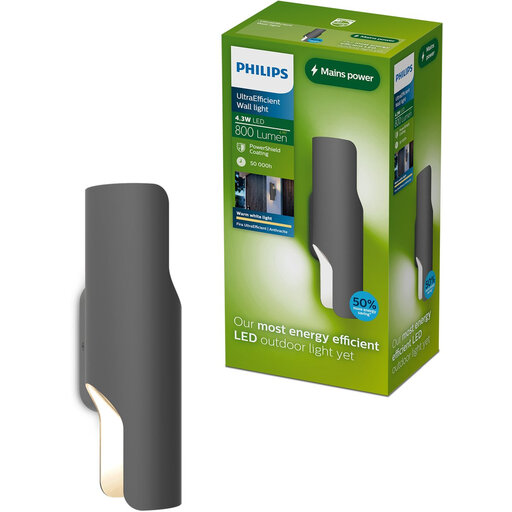
Why it suits this profile: According to the product specifications, this permanently wired LED outdoor wall light provides light in two directions and has an aluminium and plastic housing.
The specifications clearly state 800 lumens, 2700 K, 4.3 W and 230 V. This makes it easier to assess the light distribution and installation requirements in advance.
Integrated LED, 800 lumens, warm white light and a two-sided lighting effect. The stated IP44 classification is suitable for general outdoor use.

Why it suits this profile: According to the product specifications, this solar security model is designed to illuminate a large area, with 4000 lumens, a PIR sensor and IP65 protection.
The higher IP65 classification is better suited to a more exposed position than IP44. Position the sensor carefully to minimise unnecessary activation and glare.
4000 lumens, solar power, motion and dusk sensors, an adjustable light head and a stated detection range of 8 metres when approached directly.
For an adjustable lighting atmosphere, the Philips Ulio with E27 fitting and the Philips Fylx with GU10 fitting are useful options. Both are supplied without a light source, allowing you to choose a warm or cooler LED bulb yourself. The Ulio provides diffuse light distribution, while the Fylx is more compact and suits focused façade lighting.
For a classic appearance, consider the Philips Juli or the Brilliant Newport. With these E27 models, check the maximum wattage, dimensions and whether the installation location is sufficiently sheltered. For a front door where automatic lighting is preferred, models such as the Philips Capricorn or a Brilliant wall light with sensor are more practical.
We have compiled a complete, up-to-date list of products that fully meet these strict selection criteria and the applicable European safety regulations.
IP44 is suitable for splashing water and general outdoor use, for example by a sheltered front door, balcony or covered patio. It does not protect against immersion or direct water jets. Choose the installation location carefully and follow the manufacturer’s instructions.
A solar outdoor wall light does not use electricity from the mains during normal operation. However, its performance depends on the amount of daylight, battery capacity, temperature and the selected lighting programme. In dark winter periods, the operating time may be shorter.
Lifespan varies depending on the product and conditions of use. Some product descriptions, for example, state 25,000 or 50,000 hours of operation. According to Philips’ own specifications, certain models offer the stated lifespans; this is not a guarantee for every installation. With integrated LED, you will generally need to replace the complete fitting when the light source reaches the end of its lifespan.
