
Vandaag of morgen in huis

Kwaliteit gegarandeerd

Welkomstaanbiedingen ontgrendelen: GRATIS bezorging | Tot 80% korting | Gratis 30 dagen JoyPlus-proefperiode
Download de app
An outdoor wall light can make your entrance, patio, balcony or façade more practical. However, you often only discover after buying one whether a light is genuinely suitable for its location. For example, a lampholder may not be compatible with your chosen bulb, a motion sensor may respond to traffic on the public road, or a solar outdoor light may not receive enough sunlight.
The main pitfalls are usually not related to appearance, but to the specifications. So pay attention to these three points:
For an outdoor wall light, the IP rating is a useful practical checkpoint. An IP44 outdoor light is suitable for splashing water and many sheltered outdoor applications, such as a façade, veranda, balcony or entrance. Ideally, do not position the light where rainwater collects or where a garden hose can spray directly onto the housing.
Also check the material. Aluminium, metal, glass and plastic are all commonly used. Your choice depends on the look you want, the weight and the mounting surface. A black outdoor light can complement dark window frames or façade details, while anthracite often has a slightly softer appearance.
A light with an E27 lampholder gives you the flexibility to choose a suitable LED bulb yourself. Check the maximum wattage of the fitting. For example, the Brilliant Todd and Brilliant Newport are suitable for an E27 bulb of up to 60 watts; the bulb is not included.
A GU10 outdoor light is more compact and works with a GU10 spotlight. The Brilliant Jelani and Keola are specified for a maximum of 10 watts. With the Philips Fylx, the GU10 light source is also chosen separately. This is useful if you want to select the colour temperature, beam angle or, where applicable, dimming capability yourself.
With integrated LEDs, focus mainly on:
An outdoor light with a motion sensor switches on when movement is detected. This is practical by a front door, shed or driveway. However, check that the sensor will not accidentally detect passing traffic, pets or movement on the pavement.
An outdoor light with a dusk sensor switches on according to the level of ambient light. Solar models sometimes combine this with a motion sensor and different lighting modes. The performance of a solar outdoor light depends on its position, the season, shade and the amount of direct sunlight.
A fixed light operating at 220–240 or 230 volts must be connected to the mains. Have this carried out by a qualified electrician in accordance with the product information. A rechargeable light with a USB connection or a wireless outdoor light offers more flexibility, but you should then check the charging method, battery life and mounting system. For magnetic mounting, the wall plate must be secure and flat.
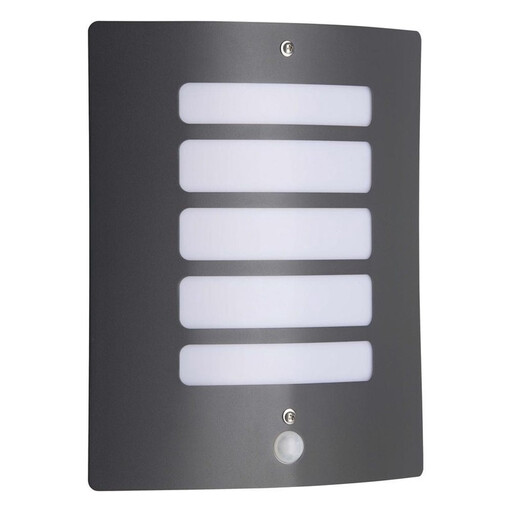
Why it suits this profile: This fixed anthracite outdoor wall light combines an E27 lampholder with a motion sensor. You can choose the light source yourself and use the light, for example, by the front door or on a façade.
The lampholder and maximum load are clearly specified: E27 and up to 60 W. The light is supplied without a bulb, so you will not accidentally use an unsuitable bulb included with the product.
IP44, integrated motion sensor and dimensions of 29 × 23 × 9 cm. Suitable for a standard 230V connection.
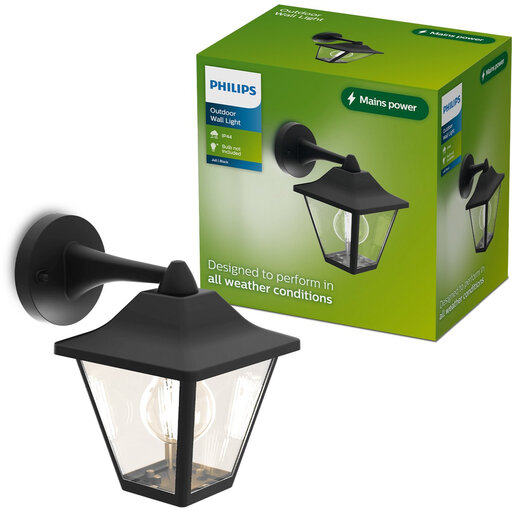
Why it suits this profile: The classic lantern shape works well on a house façade, veranda or as a wall-mounted garden light. The E27 lampholder lets you choose an LED bulb with the right colour temperature.
The light is supplied without an E27 bulb. This leaves the choice up to you, allowing you to adjust the brightness and colour temperature to suit the location.
Aluminium housing, black finish, E27 lampholder and IP44 rating. According to the product information, the statutory warranty is at least two years.

Why it suits this profile: This solar outdoor light is designed for an entrance, shed or driveway without existing wiring. Its stated light output is 1000 lumens, and it has both a motion sensor and a dusk sensor.
The power supply is clearly specified: integrated LEDs, solar power and a built-in battery. However, positioning in direct sunlight is still necessary for charging.
1000 lumens, 3000 K, two lighting modes, motion sensor and IP44 rating. No connection to the mains is required.

Why it suits this profile: This wireless outdoor light uses a rechargeable battery and magnetic mounting. That is practical on a balcony, in a rented property or in a location without a power socket.
No fixed wiring is required. The product information specifies USB-C charging, a motion sensor and IP44 splash protection; the light must not be immersed.
Integrated LEDs, 300 lumens, 3000 K, motion sensor and magnetic mounting. The battery is rechargeable.
We have put together a complete, up-to-date list of products that fully meet these strict selection criteria and the applicable European safety regulations.
An IP44 fitting is splash-resistant and can be used outdoors when positioned appropriately. It is not a completely waterproof wall light. Avoid direct water jets, prolonged water accumulation and immersion. Always follow the safety information for the specific model.
For atmospheric lighting on a patio or balcony, 180 to 400 lumens may be sufficient. For an entrance, shed or driveway, 800 to 1000 lumens is more practical if you want to illuminate a larger area. The beam angle and mounting height also affect the result. A bright light with a narrow beam does not automatically illuminate a large surface.
During normal use, a solar outdoor light does not draw electricity from the mains. Its battery is charged via the solar panel during the day. The available operating time depends on sunlight, the season, temperature, battery condition and sensor usage. So check that the panel receives direct daylight and keep it clean.
