
Vandaag of morgen in huis

Kwaliteit gegarandeerd

Welkomstaanbiedingen ontgrendelen: GRATIS bezorging | Tot 80% korting | Gratis 30 dagen JoyPlus-proefperiode
Download de app
An outdoor wall light may seem like a simple purchase, until you discover that not every light is suitable for the place where you want to install it. A solar outdoor light may receive little charge on a shaded façade, an IP44 wall light is not automatically suitable for an exposed wall, and an attractive light can prove inconvenient if its light source cannot be replaced.
The Joybuy Product Recommendation Officer therefore filters the most important specifications and usage scenarios. This makes it quicker to see which outdoor wall light suits your home, garden, balcony or patio.
The IP rating indicates how well a product is protected against solid particles and moisture. In practice, IP44 means protection against splashing water from different directions. This makes a light suitable for many sheltered outdoor locations, such as a covered entrance, balcony or patio. It does not mean that the light is waterproof or resistant to direct jets of water.
An IP65 outdoor light offers greater protection against dust and water jets. It is a more logical choice for a façade exposed to heavy rain or for a powerful solar security light. Always check the full product description and installation instructions. A marketing term such as “weather-resistant” does not replace the IP classification.
A solar outdoor light works without mains electricity, but its solar panel still needs enough direct daylight. Under a balcony, on a north-facing wall or behind a tall fence, the battery may not charge fully. As a result, the operating time and brightness may vary in practice.
When choosing a solar outdoor wall light, pay attention to:
According to Philips’ own product information, the Swyn, Fyns and Diara models run on solar power and have a motion or dusk sensor. This information describes the product specifications; actual performance depends, among other things, on sunlight, temperature and usage duration.
A black aluminium light can complement modern exterior lighting beautifully, but also check the connection, lamp holder and installation requirements. A light with a GU10 lamp holder or E27 lamp holder is sometimes supplied without a bulb. You will then need to purchase a suitable LED bulb yourself.
An integrated LED outdoor wall light is generally ready to use straight away, but the light source cannot be replaced on some models. With a separate lamp holder, you can adjust the light colour or brightness more easily in the future. So do not look only at the design; consider maintenance and future flexibility too.
For an entrance, balcony or patio, warm white outdoor lighting of around 2700 to 3000 kelvin creates a softer look. According to the product information, Philips Swyn and Philips Capricorn use 2700 kelvin, while Philips Fyns and Brilliant Iseo use 3000 kelvin.
Brightness is expressed in lumens:
More lumens are not always better. A very powerful light can be dazzling on a small balcony. Adjustable models are useful when you want to illuminate a wall, door or path in a specific direction.
Choose between four practical options:
For a fixed 230V connection, the product information for various models recommends installation by a qualified electrician. Switch off the power before installation or maintenance and use fixings suitable for the mounting surface.
A wall light with a motion sensor is practical by a front door, garage or garden path. Check the detection direction and position the light so that people do not pass the sensor only from the side if that is not the intention. With solar models, you should also avoid pointing the sensor towards a busy road or moving tree branches.
A wireless outdoor wall light with magnetic mounting is useful for rented properties or locations where you do not want to install wiring. Make sure that the mounting plate is securely fixed. On these models too, IP44 only means protection against splashing water, not immersion.

Why it suits this profile: This solar outdoor light is ideal for anyone who wants to illuminate an entrance, balcony or patio without installing wiring. It has two lighting modes and an integrated motion sensor.
The product information states IP44, two modes and installation without wiring. However, choose a location with direct sunlight; IP44 is not intended for immersion or powerful water jets.
Integrated LED, warm white light at 2700 K, 400 lumens per light point and a daylight sensor.
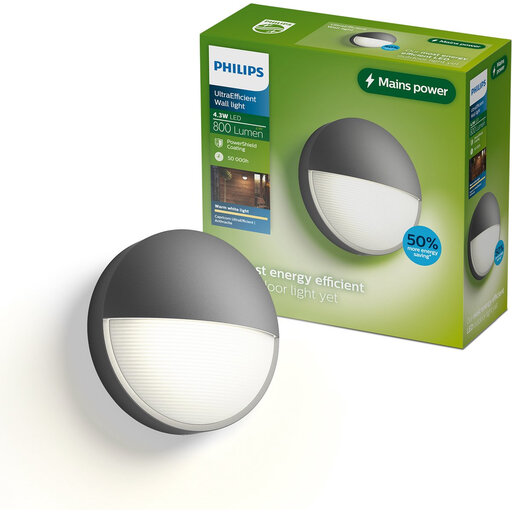
Why it suits this profile: A fixed LED outdoor wall light for anyone looking for sleek façade lighting with a warm glow and an aluminium housing.
The specifications explicitly state IP44, 800 lumens and 2700 K. Bear in mind that it requires a fixed connection and has an integrated, non-replaceable LED.
Aluminium and plastic construction, 800 lumens and warm white light for the garden, balcony or façade.

Why it suits this profile: For a driveway, large façade or spacious garden where a powerful solar security light with a motion sensor is needed.
With IP65, the stated protection is higher than that of IP44 models. The light must still be installed where the solar panel receives direct light.
According to the product details, 4000 lumens, a detection range of up to 8 metres when approached directly and an adjustable light head.
We have put together a complete, up-to-date list of products that fully meet these strict selection criteria and the applicable European safety regulations.
IP44 is suitable for many sheltered outdoor locations, such as a balcony, covered patio or entrance. The classification protects against splashing water, but not against immersion or direct water jets. For a completely exposed façade, a model with a higher level of protection, such as IP65, may be more suitable.
For ambient lighting by a small door, around 300 to 500 lumens is often sufficient. For a driveway or larger façade, 800 to 1000 lumens is more practical. A powerful light with several thousand lumens is mainly intended for broad area lighting. Also consider the light colour: 2700 to 3000 K generally creates warmer lighting.
During normal use, a solar outdoor light does not draw power from the mains. Its battery is charged by the solar panel during the day. Performance depends on direct sunlight, the season, temperature and how often the motion sensor is activated. Clean the panel regularly and choose an unobstructed installation location.
