
Vandaag of morgen in huis

Kwaliteit gegarandeerd

Welkomstaanbiedingen ontgrendelen: GRATIS bezorging | Tot 80% korting | Gratis 30 dagen JoyPlus-proefperiode
Download de app
An outdoor wall light can make an entrance feel safer, create a more inviting atmosphere on a patio or provide functional illumination for a dark garden wall. However, an attractive product photo does not guarantee that an outdoor wall light is suitable for your situation. Three purchasing pitfalls come up particularly often: insufficient IP protection, unclear power requirements and a light source that is less flexible than expected.
As a Joybuy Product Recommendation Officer, I therefore focus primarily on verifiable details such as IP rating, light output, socket type, dimensions and installation requirements. This allows you to compare outdoor lighting based on practical considerations rather than design or marketing claims alone.
An IP44 outdoor light is protected against splashing water from different directions. This does not mean that it can withstand immersion, high-pressure jets or prolonged exposure to driving rain. The product information for the models mentioned here therefore primarily lists IP44 for sheltered or standard outdoor locations.
For example, install a garden wall light beneath an overhang, on a sheltered facade or under a veranda. For a completely exposed wall, it is wise to check the installation location and the manufacturer’s instructions carefully.
An outdoor solar wall light does not require a fixed power cable, but its solar panel must receive sufficient direct daylight. Shade from a balcony, tree or tall fence can affect charging performance. In winter, the days are shorter, which may also change the operating time per charge.
Before purchasing, check where the panel will be positioned. A solar outdoor wall light is practical in locations without a power outlet, but less suitable for a permanently shaded, north-facing wall.
With fixtures featuring an E27 or GU10 socket, the light source is sometimes not included. This provides greater choice, but it does increase the total purchase price and requires a separate check of wattage, size and colour temperature.
An integrated LED outdoor wall light works immediately with its built-in light source. However, the LED generally cannot be replaced by the user. So do not focus solely on appearance; also consider how you intend to maintain the light in the future.
For many facades, balconies and covered patios, IP44 is a common rating. The first 4 indicates protection against solid particles larger than 1 millimetre; the second 4 indicates protection against splashing water. Use an IP44 light in accordance with the installation instructions and avoid direct water jets.
Light output is measured in lumens (lm). A light producing 180 to 400 lumens is often suitable for ambient lighting or a small entrance. For a wider driveway or an area where you want movement to be clearly visible, a model producing 800 to 1,000 lumens may be more practical.
Colour temperature is measured in kelvin (K):
Also consider the light distribution. A downlight directs illumination downwards, while a light with a diffuser spreads it more broadly around the fixture.
A fixed outdoor wall light with 220-240 V or 230 V requires a mains connection. Have this type of fixture installed by a qualified electrician in accordance with the product information. A solar or rechargeable model can usually be mounted without fixed wiring, but the wall and mounting points must be suitable for its weight.
A GU10 outdoor wall light is an appealing option if you want to choose the light source yourself. An E27 light also offers flexibility, for example when using a decorative LED bulb. Always check the fixture’s maximum wattage.
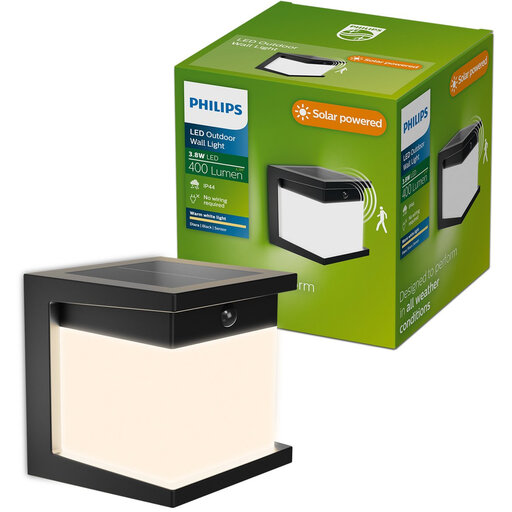
Why This Fits Their Persona: A practical choice for a balcony, garden path or entrance without an existing power outlet. The black housing and compact dimensions of 12 × 11 × 12 cm suit smaller outdoor spaces.
The product information specifies solar power, a motion sensor and IP44 protection. No fixed cable is required, but the light should be positioned where the panel receives direct daylight.
Integrated LED, 400 lumens, 2700 K, two lighting modes and a built-in battery.
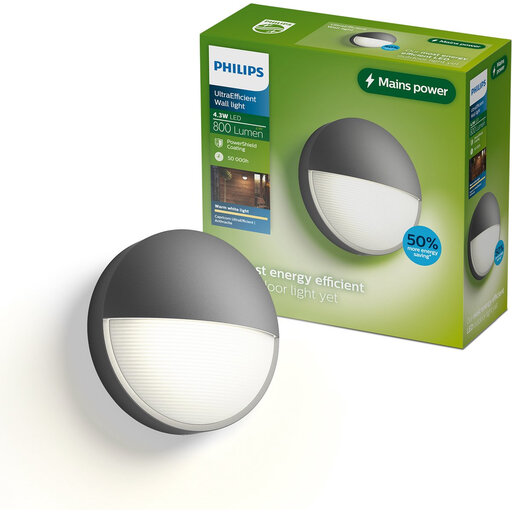
Why This Fits Their Persona: Ideal for anyone seeking a fixed LED outdoor light for a facade, patio or balcony, with a preference for a compact, modern aluminium fixture.
The specifications state IP44 protection, an aluminium construction and a fixed mains connection. This makes it clear that the fixture is not wireless and requires installation by an electrician.
800 lumens, warm white light at 2700 K and a stated lifespan of up to 50,000 operating hours according to the product description.
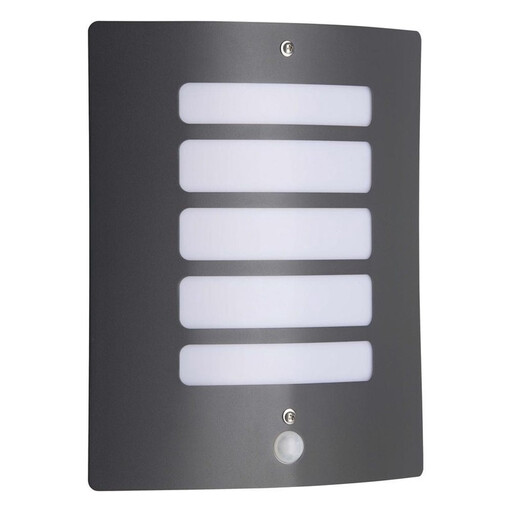
Why This Fits Their Persona: A logical choice for a front door, garage or side path where automatic lighting is desirable. Measuring 29 × 23 × 9 cm, the larger fixture makes a clear statement on a facade and accommodates your choice of E27 bulb.
The motion sensor is explicitly listed in the product specifications. The light is supplied without a bulb, allowing you to choose a suitable LED bulb of up to 60 W.
E27 socket, IP44 protection, fixed 230V connection and automatic switching via the sensor.

Why This Fits Their Persona: Convenient for renters, balconies and locations where you do not want to install cabling. The light features a magnetic mounting system and can be recharged via USB-C.
Installation requires no fixed wiring. However, check that the surface is flat, clean and suitable for magnetic mounting; IP44 means protection against splashing water, not complete waterproofing.
Integrated 4W LED, 300 lumens, 3000 K, motion sensor and compact dimensions of approximately 10 × 10 × 8 cm.
Explore a current selection of LED outdoor wall lights in a range of designs, light sources, IP ratings and mounting options.
IP44 protects against splashing water and, according to the product specifications of many of the models mentioned, is suitable for standard, sheltered outdoor locations. It is not the same as being completely waterproof. Choose the installation location carefully and follow the manufacturer’s instructions.
During normal operation, an outdoor solar wall light uses energy from its integrated battery, which is charged by the solar panel during the day. This means that no connection to the mains is required. Performance does depend on the amount of direct daylight and the battery’s charge level.
A wireless solar or USB model can usually be mounted using suitable fixings. A fixed outdoor wall light operating at 220-240 V or 230 V must be connected by a qualified electrician according to the product information. Always check the local installation requirements and confirm that the wall is suitable.
