
Vandaag of morgen in huis

Kwaliteit gegarandeerd

Welkomstaanbiedingen ontgrendelen: GRATIS bezorging | Tot 80% korting | Gratis 30 dagen JoyPlus-proefperiode
Download de app
An outdoor wall light can make an entrance feel safer, create a welcoming atmosphere on a patio or make a dark driveway easier to see. However, the cheapest option is not always the most practical. Some lights provide little illumination in winter, while others have a motion sensor but no suitable place for installation. An IP rating is also often interpreted as a guarantee that a light can withstand every type of weather.
This buying guide compares wall-mounted outdoor lighting based on verifiable specifications. That way, you can make a more informed choice between an outdoor solar wall light, a fixed outdoor LED wall light or a light with a separate GU10 or E27 bulb.
The number of lumens indicates how much light a lamp produces according to its product specification. Light distribution is just as important. A 300-lumen light may be suitable for a balcony or front door, but not bright enough for a wide driveway. A compact light with a focused beam can also appear brighter than one that spreads light in all directions.
Pay attention to the colour temperature too:
Solar outdoor lighting does not require a power cable, but the solar panel needs to receive enough direct light during the day. A north-facing façade, a position beneath a canopy or shade from trees can limit charging time. In winter, the days are shorter, meaning an outdoor solar wall light may not stay on for as long.
Before buying, therefore check:
Claims about operating time, battery performance or several nights of illumination should be regarded as brand or product claims. According to Philips’ product description, the Zyren series can provide lighting for up to four nights when the battery is fully charged. Actual operating time depends, among other things, on sunlight, temperature, sensor activity and the selected lighting mode.
The IP protection rating consists of two digits. The first relates to protection against solid particles, while the second concerns water. An IP44 wall light is protected against solid objects larger than 1 millimetre and against splashing water from different directions. This makes IP44 suitable for many façades, balconies and sheltered garden walls, but not for immersion or powerful water jets.
An IP65 wall light offers greater protection against dust and water jets. This may be relevant for an exposed façade or a frequently used driveway. The installation location remains important: always check the complete installation instructions and make sure that water cannot collect around the connection.
An outdoor solar wall light is useful for tenants, balconies and walls without an existing power connection. A rechargeable wall light with USB-C, such as the Brilliant Iseo, can be positioned flexibly and recharged when needed. However, bear in mind that you will need to remove the light or connect it regularly.
A fixed 220-240V wall light provides a stable power supply, but requires safe installation and connection. With models featuring an E27 or GU10 fitting, you choose the bulb yourself. This gives you greater flexibility in terms of brightness, colour temperature and, in some cases, dimming.
A wall light with a motion sensor switches on when movement is detected. This is practical by a front door, garden path or driveway. Pay attention to the positioning: a sensor behaves differently when someone approaches the light directly than when someone passes it from the side.
A dusk sensor switches the light on when it gets dark. Some solar models combine both functions. Also check whether the light has different modes, such as switching on automatically when movement is detected or staying on continuously at a lower intensity.
With an integrated LED light, you do not need to buy a separate bulb. The light is compact, but the LED is often not replaceable. With a GU10 or E27 light, you can fit a different LED bulb later. Check the maximum wattage and fitting before doing so.
Clean solar panels and light fittings with a soft cloth. Do not use harsh cleaning products, and do not spray an IP44 light directly with a powerful water jet.

Why it suits this profile: This outdoor solar wall light works without fixed wiring and, according to the product specification, provides warm white 2700K light, two lighting modes, a daylight sensor and a motion sensor.
The specifications clearly state the power supply, light colour and IP44 rating. However, install the light somewhere with direct sunlight and do not expose it to immersion or powerful water jets.
Integrated LED with 400 lumens per light point, automatic operation and installation without a power cable.
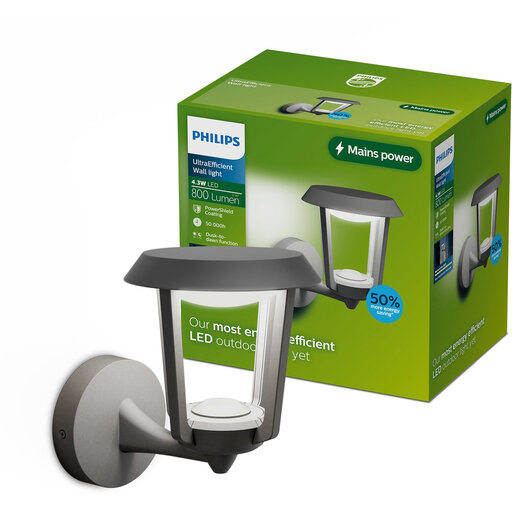
Why it suits this profile: This fixed outdoor LED wall light is designed for anyone looking for a stable 230V connection, an aluminium fitting and clearly defined light output for a garden, balcony or façade.
The combination of 800 lumens, 2700K and an integrated LED makes the lighting choice clear. The IP44 specification indicates splash protection, not suitability for immersion or direct water jets.
800 lumens, warm white 2700K light and an aluminium housing with PowerShield coating, according to the product description.

Why it suits this profile: For a driveway, large façade or dark back garden, the stated light output of 4000 lumens may be particularly appealing. The light has a motion sensor, dusk sensor and adjustable light head.
Choosing between 3000K and 5000K prevents you from selecting based on appearance alone. The IP65 rating is also higher than IP44; nevertheless, check the installation and the panel’s charging location.
According to the product specification: 4000 lumens, IP65, with a detection range of 8 metres when approached directly and 16 metres from the side.
We have put together a complete, up-to-date list of products that fully meet these strict selection criteria and the applicable European safety regulations.
It can be, but performance depends on the amount of direct sunlight and the battery capacity. Charging conditions are often less favourable in winter. Choose a location without shade, keep the solar panel clean and use an energy-saving sensor mode where possible.
For a sheltered façade, balcony or covered area, IP44 is often a practical choice. For a more exposed location, IP65 can provide additional protection against dust and water jets. Always check that the complete light and electrical connection are suitable for the intended location.
A sensor can limit the time the light is on because it only switches on when movement is detected. Actual consumption depends on the wattage, the number of activations and the set operating time. With solar outdoor lighting, energy comes from the battery; with a fixed light, consumption is determined by the mains supply and the LED or separate bulb.
