
Vandaag of morgen in huis

Kwaliteit gegarandeerd

Welkomstaanbiedingen ontgrendelen: GRATIS bezorging | Tot 80% korting | Gratis 30 dagen JoyPlus-proefperiode
Download de app
An outdoor wall light can instantly make a dark entrance, façade or patio more practical. However, not every light marketed as outdoor lighting is suitable for a Dutch wall. An attractive housing says little about protection against rain, while a built-in sensor or solar function may work differently in practice than you expect.
Pay particular attention to the technical specifications. The right choice depends on the installation location, the desired brightness, the power supply and the level of protection against moisture.
A light beneath a canopy may stay dry, but it will still be exposed to humid air, condensation and splashing water. A product intended exclusively for indoor use, such as the Atmosphera Lio Wall Lamp, should therefore not be installed on a façade or shed wall. The product information explicitly states: for indoor use only.
A modern outdoor wall light or classic outdoor wall light should complement your home, but the design does not automatically determine its durability. Always check the material, fitting, maximum wattage and IP rating. Also pay attention to the dimensions: a wide light, for example, could clash with a door, downpipe or external awning.
An outdoor light with a sensor does not always switch on at the same distance or for the same length of time. Check whether it has a motion sensor, dusk sensor or both. With an outdoor solar wall light, direct sunlight is also important. A north-facing wall, a balcony beneath a deep canopy or shade from trees can limit charging time.
The IP code indicates how well a light fitting is protected against solid particles and moisture. In practice, IP44 means protection against solid objects larger than 1 millimetre and splashing water from different directions. This makes an IP44 wall light suitable for many sheltered façades, balconies and entrances, provided it is installed correctly.
IP65 offers a higher level of protection against dust and water jets. This can be useful on a more exposed façade or for intensive outdoor use. The IP rating remains valid only when the seals, cable entry and cover have been fitted correctly. No rating means that the light can be used underwater.
With a GU10 outdoor wall light, you can choose a suitable GU10 LED spotlight yourself. This allows you to adjust the colour temperature and brightness later. An E27 outdoor wall light accommodates a standard E27 LED bulb, often giving you more choice in terms of shape and light distribution.
Some fittings have integrated LED lighting. The Philips Zyra, for example, has an integrated light source with 800 lumens, 2700 K and a power consumption of 4.3 watts, according to the product specifications. With an integrated LED module, you cannot replace the light in the same way as a separate GU10 or E27 bulb. Therefore, check the expected lifespan and warranty conditions.
Lumens indicate the amount of light produced. A lower light output is often sufficient for an atmospheric garden wall light, while an entrance, garage path or security function may require more light. Kelvin indicates the colour of the light:
For a mains-powered light, check whether professional installation is required. A portable USB-rechargeable light avoids fixed wiring, but it does need to be recharged regularly.
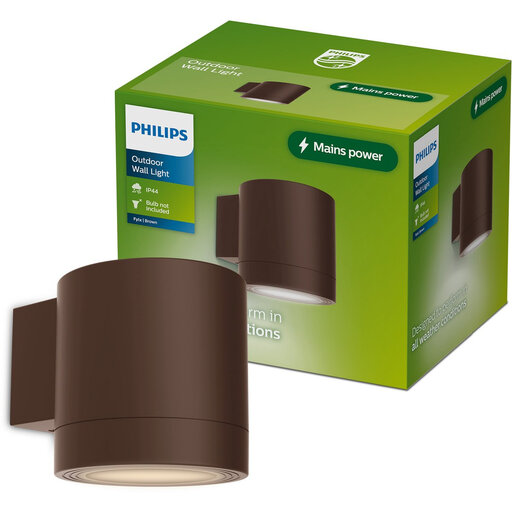
Why it suits this profile: A compact outdoor wall light with a replaceable GU10 fitting, allowing you to choose a suitable LED spotlight yourself.
The product specifications state that it is suitable for outdoor use and has IP44 protection. The light is supplied without a GU10 light source, so remember to purchase one separately.
Aluminium housing, compact dimensions of 8.9 × 11.6 × 9 cm and the freedom to choose your GU10 LED bulb.
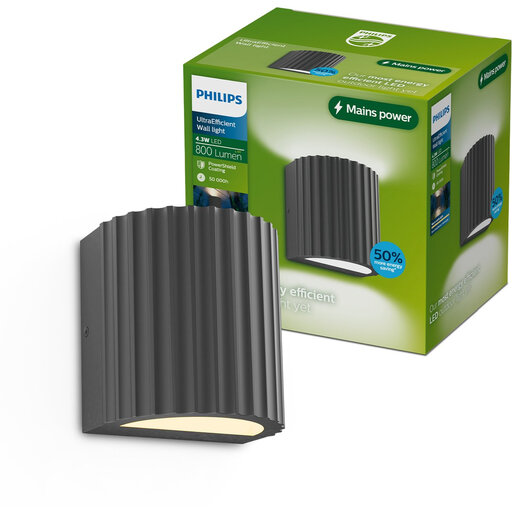
Why it suits this profile: For anyone looking for a permanent, modern outdoor wall light with warm light and a clean light distribution.
The specifications list integrated LED lighting, 800 lumens, 2700 K and IP44 protection. Check beforehand that a fixed 230 V connection is suitable for the installation location.
Two light outputs, warm white light, 4.3 W power and an aluminium and plastic housing.

Why it suits this profile: For a large, highly exposed façade where powerful solar lighting with a sensor is required.
The product specifications list IP65, a dusk and motion sensor, and direct connection to sunlight. Do not position the panel in permanent shade.
4000 lumens, 5000 K, adjustable light head and, according to the product information, up to four nights of illumination after a full charge.
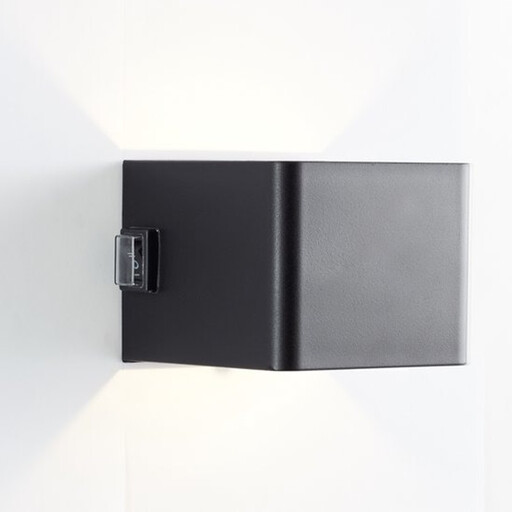
Why it suits this profile: A cordless solution for a balcony, patio, shed or rental property where you do not want to install fixed wiring.
The light runs on a rechargeable battery and has a magnetic mounting system. With IP44 protection, it is splash-resistant but not designed for direct water jets.
Integrated LED, 300 lumens, 3000 K, motion sensor and USB-C charging according to the product details.
We have put together a complete, up-to-date list of products that fully meet these strict selection criteria and the applicable European safety regulations.
A fixed outdoor wall light usually operates at 220–240 V. Switch off the circuit before you start and, if in doubt, have the mains connection carried out by a qualified electrician. Use wall plugs suitable for brick, concrete or wood, and check that the wall can support the weight of the light.
For a portable light, the magnetic mounting plate must be attached firmly and level. Position an outdoor solar wall light where the panel receives sufficient daylight. Clean sensors, light windows and solar panels with a soft, dry cloth. Also check the cables, seals and mounting screws regularly.
For many sheltered façades, balconies and entrances, IP44 is a practical choice. The light is protected against splashing water, but not against powerful water jets or immersion. On a completely exposed site, a model with IP65 may be the more logical choice.
That depends on its purpose. For atmospheric lighting on a patio, you will generally need less light than for an entrance or driveway. As well as lumens, consider the beam angle, colour temperature and installation height. A light rated at 800 lumens may provide broad illumination, while a GU10 spotlight directs the light more precisely downwards.
A solar wall light does not use mains electricity during normal operation, but its performance depends on sunlight, battery capacity and sensor usage. A light that switches on only when movement is detected may run for longer than a model that stays on continuously throughout the evening. In periods of limited sunshine, allow for a shorter operating time.
