
Vandaag of morgen in huis

Kwaliteit gegarandeerd

Welkomstaanbiedingen ontgrendelen: GRATIS bezorging | Tot 80% korting | Gratis 30 dagen JoyPlus-proefperiode
Download de app
An outdoor wall light can illuminate a dark entrance, exterior wall, shed or terrace effectively. Yet many people buy a light that is not suitable for the place where it will be installed. A wall-mounted outdoor light may look sturdy in photographs, but disappoint in practice because of an unsuitable IP rating, a light source that is difficult to replace or a sensor positioned in the wrong place.
With this guide, you can easily compare an outdoor wall light, a solar outdoor light and a wired version. You will also see which specifications matter and which models are suited to different uses.
An IP44 outdoor light is protected against water splashes from different directions. This makes the rating suitable for many exterior walls, balconies, entrances and sheltered terraces. However, IP44 does not mean that the light can withstand a direct jet of water or immersion.
Are you installing the light in a position that catches a lot of rain, such as an open shed wall or an exterior wall without an overhang? Then also consider an IP65 outdoor light. IP65 provides greater protection against dust and water jets. Always check the product description and installation instructions.
An outdoor light with an E27 fitting or GU10 fitting is not always supplied with a light source. With an E27 outdoor light, you can choose a suitable LED bulb yourself, for example with warm white light for a cosy atmosphere or a higher light output for the entrance. A GU10 outdoor light works with a separately available spotlight bulb.
Before buying, check the following:
An outdoor light with a motion sensor is useful by a front door, along a garden path or beside a garage. However, the light will only switch on correctly when the sensor detects movement within its intended range. Branches, passing cars or pets can sometimes trigger unwanted activations.
Also consider the difference between a mains-powered sensor light, a battery model and a solar outdoor light. A solar light needs direct sunlight to charge its battery. A wired outdoor wall light works more reliably in dark locations, but must be connected by a qualified installer.
The IP code consists of two digits. The first digit concerns protection against solid particles, while the second relates to water. For outdoor use, IP44 and IP65 are common ratings.
The IP rating does not automatically indicate the quality of the installation. Use fixing materials suitable for the wall and make sure that cable entries are sealed correctly.
An integrated LED outdoor light is compact and ready to use straight away, but the light source is often not replaceable. A fitting with E27 or GU10 gives you more freedom to choose a different colour temperature or light output later.
As a guide:
A wired outdoor wall light operating at 220–240 or 230 volts requires a connection to the mains. Have this carried out by a qualified electrician and switch off the power before carrying out maintenance.
A solar outdoor light works without fixed wiring. Installation is simpler, but the solar panel must receive enough direct daylight. A portable battery-powered wall light offers a different type of flexibility. Check how the light is charged, how secure the magnetic attachment is and whether the battery needs regular recharging.
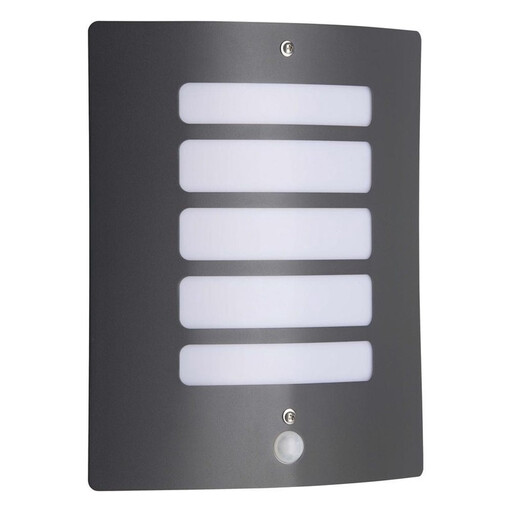
Why it suits this profile: This wired anthracite outdoor light has an E27 fitting and an integrated motion sensor. You can choose the light source yourself, allowing you to start with a suitable LED bulb.
The fitting and maximum power of 60 W are clearly stated. The light is supplied without a light source, so you do not accidentally pay for a bulb you do not want.
E27 fitting, motion sensor, 230V connection and IP44 protection. Dimensions: 29 × 23 × 9 cm.
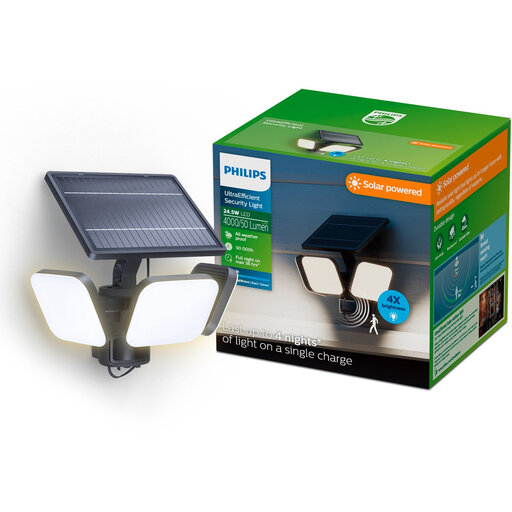
Why it suits this profile: This solar model is designed for anyone who wants plenty of light by an entrance, driveway or larger exterior wall without a fixed power connection.
The stated IP65 rating is more suitable for a more exposed position than IP44. However, position the panel away from shade so that it can charge effectively.
Integrated LED, 4000 lumens, 5000 K, adjustable light head and PIR sensor. The model is solar-powered.

Why it suits this profile: A practical choice for a garden, shed or side wall without existing cabling, where automatic lighting is preferred.
The light has an integrated light source and two lighting modes. This means you do not need to select a separate fitting or bulb, but you should bear in mind that the LED cannot be replaced.
1000 lumens, 3000 K, motion sensor, dusk sensor and IP44. No fixed wiring required.
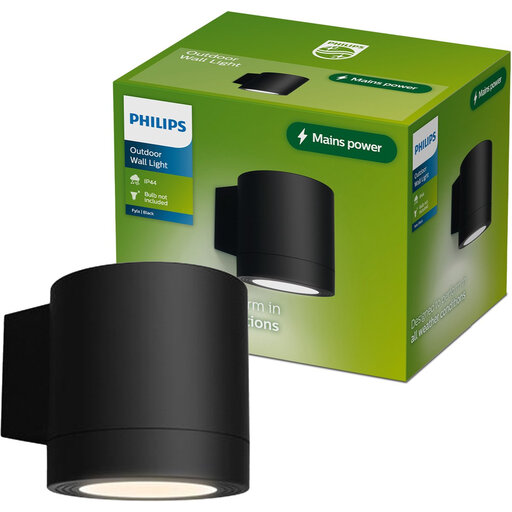
Why it suits this profile: This compact black outdoor wall light complements a modern exterior wall, balcony wall or terrace where you want to choose the GU10 light source yourself.
The replaceable GU10 fitting means you are not tied to a single fixed colour temperature. The light is IP44, making it particularly suitable for sheltered outdoor locations.
Aluminium housing, GU10 fitting, downward light distribution and compact dimensions of approximately 8.9 × 11.6 × 9 cm.
We have compiled a complete, up-to-date list of products that fully meet these strict selection criteria and the applicable European safety regulations.
That depends on the installation location. IP44 protects against splashing water and is often suitable for an entrance, balcony or covered terrace. For an exterior wall directly exposed to rain and water jets, IP65 may offer a more suitable level of protection. Also check the manufacturer’s instructions.
A solar outdoor light does not need to be connected to the mains. During the day, the panel charges the integrated battery. Performance therefore depends on sunlight, positioning, the season and sensor usage. Clean the panel regularly and do not position it beneath an overhang or tree that creates significant shade.
First switch off the power. A wired 230-volt light must be installed and connected in accordance with local regulations, preferably by a qualified electrician. A battery-powered or solar wall light does not require fixed wiring, but it must still be securely attached to a suitable wall.
