
Vandaag of morgen in huis

Kwaliteit gegarandeerd

Welkomstaanbiedingen ontgrendelen: GRATIS bezorging | Tot 80% korting | Gratis 30 dagen JoyPlus-proefperiode
Download de app
An outdoor wall light may seem like a simple purchase, but the wrong choice often only becomes apparent after a few weeks. The light may not be bright enough, the sensor may respond to passing cars, or the fitting may prove less resistant to rain than expected. By comparing your options carefully, you can avoid unnecessary costs and choose lighting that suits the location, power supply and atmosphere you want to create.
IP44 outdoor lighting is protected against solid objects larger than 1 millimetre and splashing water from various directions. This does not mean the light can be exposed to a powerful jet of water or standing water for long periods. An IP44 fitting is generally well suited to a sheltered façade, covered area, balcony or entrance.
Looking for a waterproof outdoor light for an exposed location? Choose a higher IP rating, such as IP65. Also check that the installation position prevents water from collecting around the connections.
Lumens indicate the total light output, but they do not tell you everything. A 300-lumen light may be sufficient by a front door or on a balcony, while a driveway or large garden requires more light. Colour temperature is also important:
A powerful light is not automatically more comfortable. In a narrow passage, too much light can cause glare.
An outdoor wall light with motion sensor only works properly when the sensor has a clear view. Do not install the light directly behind a drainpipe, bush or projecting roof edge. Also consider windows and road traffic: movement outside your own property may trigger the light unnecessarily.
An outdoor light with dusk sensor switches on when the ambient light level falls. With solar lighting, the dusk and motion sensors often work together. Check whether the desired mode provides continuous light, switches on only when movement is detected or can be selected manually.
A solar outdoor wall light is convenient when you do not want to run a cable. However, the light must receive direct sunlight, or enough sunlight for long enough. Installing it on a north-facing wall, beneath a deep overhang or next to tall trees can limit charging performance. Keep the solar panel clean and check the mounting regularly.
A rechargeable wall light with a USB connection is more flexible to position. On the other hand, you will need to remove the light periodically to recharge the battery. For a fixed outdoor wall light, professional installation by a qualified electrician is required when the light is connected to 230 volts.
An integrated LED is compact and ready to use straight away. On many models, the light source cannot be replaced by the user. A GU10 outdoor wall light or fitting with an E27 socket is usually supplied without a bulb, but gives you more choice when it comes to colour temperature, dimming and light output.
Check the following before buying:
A black outdoor light made from aluminium, plastic or glass can have a different appearance. Aluminium and glass often create a sleek look on the façade, while plastic is generally lightweight and practical. As well as the design, consider the dimensions and weight. A magnetic light requires a flat, sturdy surface and a securely fastened mounting plate.

Why it suits this profile: This solar outdoor wall light works without fixed wiring and, according to the product specification, has an integrated 400-lumen LED, warm white 2700 K light, a motion sensor and two lighting modes.
The stated IP44 rating makes it clear that this light offers protection against splashing water, not immersion. It should be positioned where the panel receives direct sunlight.
No mains connection required; automatic operation via dusk and motion sensors; black plastic design.

Why it suits this profile: For a driveway, large garden or garage, the stated light output of 4000 lumens is particularly relevant. The light has an IP65 rating, an integrated LED, an adjustable head and solar power.
The higher IP rating is more suitable for a more exposed location than IP44. Direct sunlight is still needed for charging.
4000 lumens; IP65; detection range according to the product description of up to 8 metres when approached directly and 16 metres laterally.
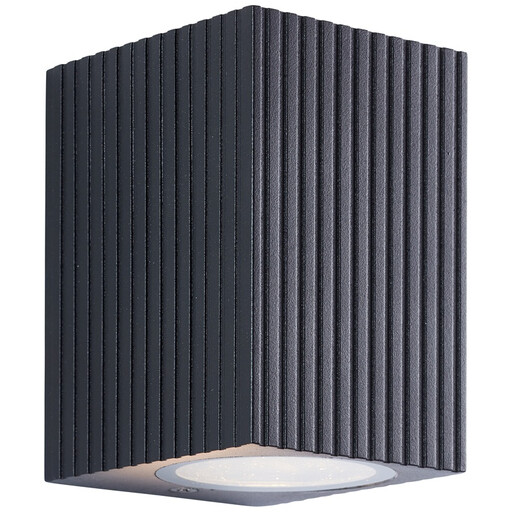
Why it suits this profile: This fixed fitting is intended for anyone who wants to choose their own GU10 LED bulb. The combination of black aluminium, plastic and glass complements a modern façade, patio or entrance.
The fitting and maximum load of 1x10 W are specified. Bear in mind that professional installation is required and that the light source is not supplied as standard.
GU10 fitting; compact dimensions of approximately 10 x 6,9 x 7,8 cm; IP44 for sheltered outdoor locations.
We have put together a complete, up-to-date list of products that fully meet these strict selection criteria and the applicable European safety regulations.
For a front door, balcony or small patio, around 200 to 500 lumens may be practical. A driveway, garage or large garden will often require more. Also choose a suitable colour temperature and avoid looking directly into the light source.
Yes, IP44 is designed to protect against splashing water and is widely used for sheltered outdoor lighting. The fitting is not intended for immersion or direct jets of water. For a completely exposed location, IP65 may be a more suitable choice.
A solar outdoor wall light does not use mains electricity while it is lit. Its practical performance does, however, depend on sunlight, battery capacity, temperature and the selected lighting mode. A light that only switches on when movement is detected will generally run for longer than a model that stays on continuously throughout the evening.
