
Vandaag of morgen in huis

Kwaliteit gegarandeerd

Welkomstaanbiedingen ontgrendelen: GRATIS bezorging | Tot 80% korting | Gratis 30 dagen JoyPlus-proefperiode
Download de app
An outdoor wall light can make an entrance feel safer, create a more welcoming atmosphere on a patio or provide practical lighting for a dark garden wall. However, not every wall-mounted outdoor light is suitable for every location. A light that works well under a covered area may be exposed to moisture, dirt and wind more quickly on an unprotected façade.
The biggest purchasing mistakes usually stem from three misunderstandings:
The IP rating indicates how well a product is protected against solid particles and moisture. In practice, an IP44 outdoor light is protected against solid objects larger than 1 millimetre and against splashing water from different directions.
IP44 is often suitable for a sheltered façade, balcony, veranda or garden wall. For a completely exposed location where the light is frequently subjected to rain and splashing dirt, a higher rating such as IP65 may be more appropriate. Also check the installation instructions: even a higher IP rating does not make a fitting suitable for immersion.
An LED outdoor wall light with an integrated LED is ready to use straight away and generally requires little maintenance. The downside is that the light source is not always replaceable. Therefore, check the stated lifespan and lumen output.
With a wall light with an E27 fitting or wall light with a GU10 fitting, you can choose a suitable LED bulb yourself. This gives you greater freedom when it comes to brightness, dimming and colour temperature:
Bear in mind that lumens indicate light output, while watts indicate energy consumption. A higher wattage does not automatically mean a better-lit wall.
A solar outdoor wall light does not require a fixed electrical connection. This is useful for tenants, balconies and garden walls where running cables is difficult. Performance does, however, depend on the amount of direct sunlight, battery capacity and the selected lighting mode.
A wall light with a motion sensor switches on when movement is detected. Check the detection angle, range and whether the light also has a dusk sensor. Fixed 230 V lighting requires connection to the mains. Switch off the relevant circuit and have any installation work you are unsure about carried out by a qualified electrician.

Why it suits this profile: This solar outdoor wall light works without fixed wiring and, according to the product details, features an integrated motion and dusk sensor, two lighting modes and warm white light at 3000 K.
You do not need to run cables, but make sure you position the light where the solar panel receives direct light. IP44 means protection against splashing water, not immersion.
1000 lm according to the product specification, 3000 K, an integrated battery and an IP44 rating.
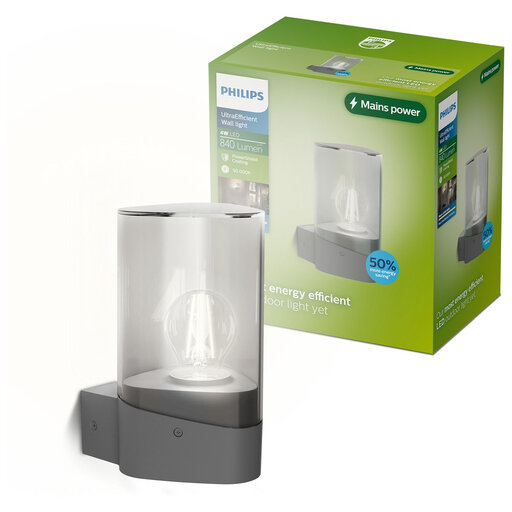
Why it suits this profile: This fixed outdoor light has an aluminium housing, an E27 fitting and a warm white colour temperature of 2700 K. This means you can choose the LED bulb that best suits your entrance or patio.
The E27 fitting makes the light source replaceable. However, check beforehand that the LED bulb you choose stays within the fitting’s permitted wattage.
840 lm and 2700 K according to the product information, with IP44 and a replaceable E27 light source.

Why it suits this profile: For a spacious driveway, side wall or back garden, a powerful solar spotlight with an adjustable head and wide motion detection can be more practical than soft ambient lighting.
The IP65 rating is more suitable for a more exposed location than IP44. For good solar performance, the panel still needs direct sunlight.
4000 lm, 5000 K, IP65 and a stated detection range of up to 8 metres when approached directly.
We have compiled a complete, up-to-date list of products that fully meet these strict selection criteria and the applicable European safety regulations.
IP44 is often suitable for a sheltered outdoor wall light, for example beneath a covered area or near an entrance. The rating protects against splashing water, but not against immersion or powerful jets of water. For a completely exposed façade, a higher IP rating may be more appropriate.
Lifespan varies from product to product. The supplied product information for various Philips models states figures of up to 25,000 or 50,000 operating hours. These are the manufacturer’s product specifications and do not guarantee a particular service life. With integrated LEDs, you generally cannot replace just the LED; eventually, the entire fitting will need to be replaced.
A solar outdoor wall light does not use electricity from the mains during normal operation. The battery charges during the day via the solar panel. Actual operating time depends on sunlight, season, temperature, battery status and the selected lighting mode. Therefore, position the panel as far away from shade as possible.
