
Vandaag of morgen in huis

Kwaliteit gegarandeerd

Welkomstaanbiedingen ontgrendelen: GRATIS bezorging | Tot 80% korting | Gratis 30 dagen JoyPlus-proefperiode
Download de app
An outdoor wall light needs to do more than simply look attractive on your façade. The light will be exposed to rain, wind, temperature fluctuations and limited daylight in winter. At the same time, you want enough light by the front door, a welcoming atmosphere on the patio or extra convenience thanks to a motion sensor.
However, there are several pitfalls that are often overlooked when choosing an outdoor wall light:
The IP protection rating consists of two digits. The first digit concerns protection against solid particles, while the second relates to water.
Do not rely solely on the marketing term “weather-resistant”. Check the exact IP classification and consider where the light will be mounted. IP44 may be sufficient for a sheltered entrance. For an open façade exposed to driving rain, a higher rating may be worth considering.
Light output is expressed in lumens. Wattage mainly indicates energy consumption, not directly how much light the lamp produces.
With a fitting featuring a GU10 socket or E27 socket, you can choose the light source yourself. Always check the maximum wattage and the bulb’s dimensions. With integrated LED, the light source is already built in. This makes installation easier, but replacing just the LED is often not possible.
A black aluminium, metal or plastic outdoor wall light can vary considerably in appearance. Aluminium and metal often provide a sturdier look, while plastic can help to keep the weight down. Also consider the finish, the mounting method and whether the fitting is resistant to dirt and moisture.
An outdoor light with a motion sensor switches on when movement is detected. This is useful by a front door, shed or side path. Check the detection direction and range if this information is available. A sensor does not automatically prevent the light from switching on too often because of pets, passing cars or moving branches.
An outdoor solar-powered light does not require a fixed electricity connection. This reduces cable work and is practical in a garden without an available power point. Position the solar panel as far away from shade as possible and keep it clean. During dark or cloudy periods, the operating time may be shorter.
A fixed mains-powered wall light generally offers more stable operation. However, installation requires wiring and a safe connection. Switch off the electricity at the consumer unit, and have work on the electrical installation carried out by a qualified installer if you are not confident doing it yourself.
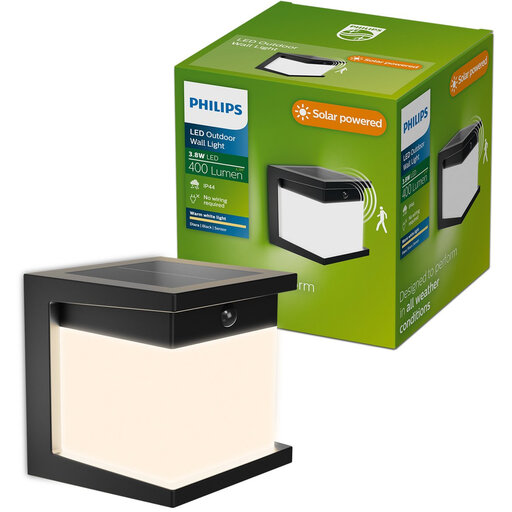
Why it suits this profile: This outdoor solar wall light works without fixed wiring, making it suitable for a balcony, garden path or entrance without a power point. According to Philips’ product information, the model features integrated LED lighting with 400 lumens, warm white light at 2700 K and two light settings.
The product information clearly states that the LED is integrated and that no mains connection is required. With IP44, the fitting is designed for splashing water, not submersion.
Solar power, motion sensor, 400 lumens, 2700 K and a compact size of 12 × 11 × 12 cm.
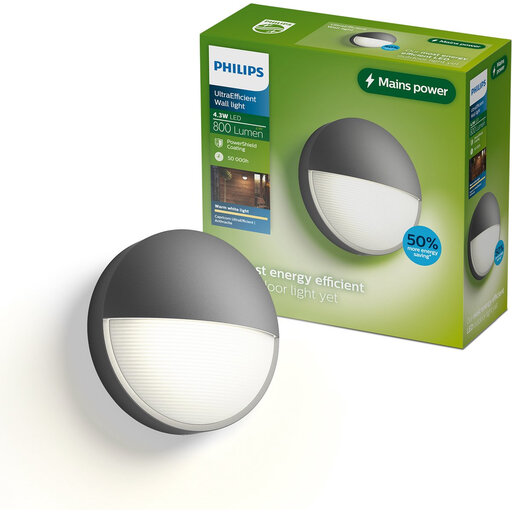
Why it suits this profile: This fixed outdoor LED wall light is ideal for a modern façade or entrance where an even, consistent light source is desired. According to Philips’ product information, the fitting features integrated LED lighting, 800 lumens, 2700 K and an aluminium housing.
The specifications list the light output and colour temperature separately. This means you do not have to rely solely on the term LED or on a general description of the ambience.
800 lumens, aluminium and a stated lifespan of up to 50,000 operating hours according to Philips’ product information. IP44 still only provides protection against splashing water.

Why it suits this profile: This model is designed for a driveway, large façade or grounds where high light output and motion detection are important. According to Philips’ product information, this solar light provides 4000 lumens, has an IP65 rating and offers a sensor range that varies depending on the direction of movement.
The IP65 classification is more specific than simply describing a product as weather-resistant. However, make sure the high light output is suitable for your surroundings and avoid causing nuisance to neighbours.
4000 lumens, 5000 K, solar power, two light settings and IP65 according to the stated product specifications.
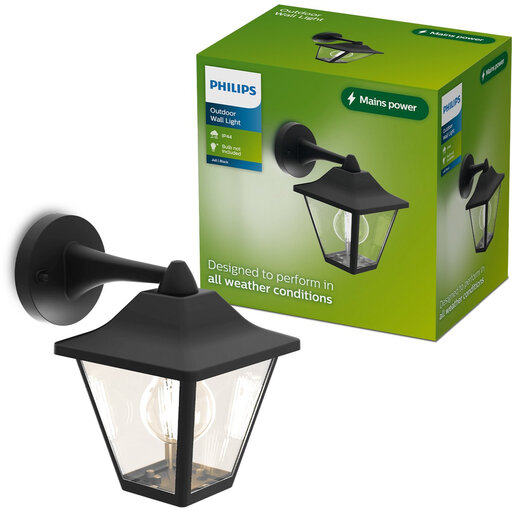
Why it suits this profile: The classic shape suits a house façade, veranda or patio. This fitting has an E27 socket, allowing you to choose your own LED bulb and colour temperature.
The product information states that the light source is not included. This means you can choose a suitable E27 LED bulb in advance rather than being faced with an unexpected extra purchase after ordering.
E27 socket, aluminium housing, classic design and IP44 protection against splashing water.
We have put together a complete, up-to-date list of products that fully meet these strict selection criteria and the applicable European safety regulations.
It depends on the location. IP44 outdoor lights are protected against splashing water and are often suitable for a sheltered entrance, balcony or patio. If you are mounting the light on a completely exposed façade subject to driving rain, look for a higher level of protection, such as IP65 outdoor lighting. Also check the manufacturer’s installation instructions.
Lifespan varies by model and operating conditions. With integrated LED lighting, the manufacturer may state an estimated lifespan, such as 25,000 or 50,000 operating hours. This is a stated specification, not a guarantee that the light will work for exactly that long. With a GU10 or E27 fitting, you can replace the light source when it fails.
An outdoor solar wall light does not use mains electricity while it is lit. Its practical performance does depend on sunlight, panel orientation, temperature and charging capacity. Position the light away from shade and clean the panel regularly. For consistent lighting throughout the night, a fixed connection may be more predictable.
