
Vandaag of morgen in huis

Kwaliteit gegarandeerd

Welkomstaanbiedingen ontgrendelen: GRATIS bezorging | Tot 80% korting | Gratis 30 dagen JoyPlus-proefperiode
Download de app
An outdoor wall light may seem like a straightforward purchase, but many models vary considerably in power supply, light output and installation. A light that appears suitable for a driveway in the product photo may provide too little light in practice. Terms such as “weather-resistant”, “solar” and “security lighting” are also not always interpreted correctly.
Pay particular attention to these three common pitfalls:
The IP code indicates how well a fitting is protected against solid particles and moisture. For many covered entrances, balconies and patios, IP44 is a common choice. Ideally, position an IP44 outdoor wall light in a sheltered location and avoid areas where it will be exposed to heavy rain or direct jets of water for extended periods.
For a more exposed wall or a location with high rainfall, a higher level of protection, such as IP65, may be more practical. Always check the official product specifications and installation instructions. “Weather-resistant” is not a substitute for a specific IP rating.
An integrated LED outdoor wall light is compact and generally does not require a separate bulb. With a fitting such as GU10, you can choose which light source to use. Pay attention to the following:
A GU10 outdoor wall light supplied without a spotlight gives you flexibility, but the total purchase price will include both the fitting and a suitable GU10 LED bulb.
A solar outdoor light works without a mains connection, but its solar panel needs to receive direct light during the day. Shade from a balcony edge, tree or north-facing wall can limit charging time. For a light with a motion sensor, also check the detection distance and the preferred activation duration.
A rechargeable wall light with a battery is handy for rented properties or locations without a socket. Magnetic mounting makes it easy to move, but the surface must be flat, clean and suitable for supporting the light securely.
A fixed 230-volt light will generally need to be connected to existing wiring. Have this carried out by a qualified installer and switch off the power before carrying out maintenance. Also check whether the fixing materials supplied are suitable for your type of wall.
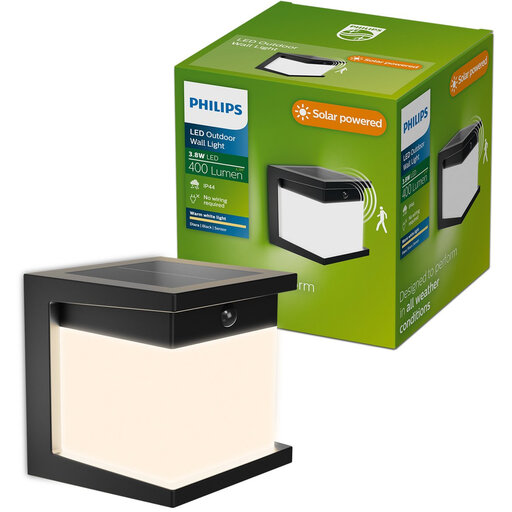
Why it suits this profile: This solar outdoor light does not require fixed wiring and offers two light modes, a motion sensor and 400 lumens at 2700 K. That makes it suitable for an entrance, garden path or balcony where easy installation is important.
The product information clearly states IP44, 400 lumens and an integrated battery. However, make sure it receives sufficient direct sunlight for charging.
Solar power, 2700 K warm white light, two modes and motion detection.
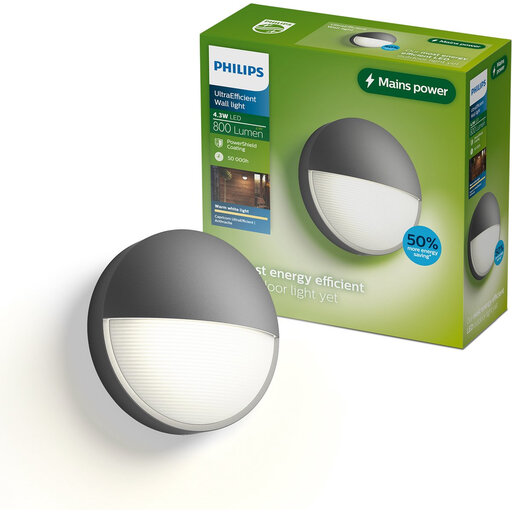
Why it suits this profile: This fixed outdoor wall light combines an aluminium housing, integrated LED, 800 lumens and warm white light at 2700 K. It is suitable for homeowners looking for a permanent solution for a wall, entrance or balcony.
The IP44 rating is clearly stated, so you will not accidentally use the light as if it were waterproof. Mains installation must be carried out by a qualified installer.
800 lumens, 2700 K, an aluminium housing and a stated lifespan of up to 50,000 operating hours according to the product information.

Why it suits this profile: For a wide driveway, garage or large garden area, the stated light output of 4,000 lumens could be a good option. According to the product specifications, the light has an IP65 rating, a motion sensor and an adjustable light head.
The higher IP rating makes it suitable for a wider range of applications than IP44. However, check that 4,000 lumens will not be too bright for your immediate surroundings.
4,000 lumens, IP65, an adjustable head and a stated detection range of up to 8 metres forwards and 16 metres to the sides, according to the product description.
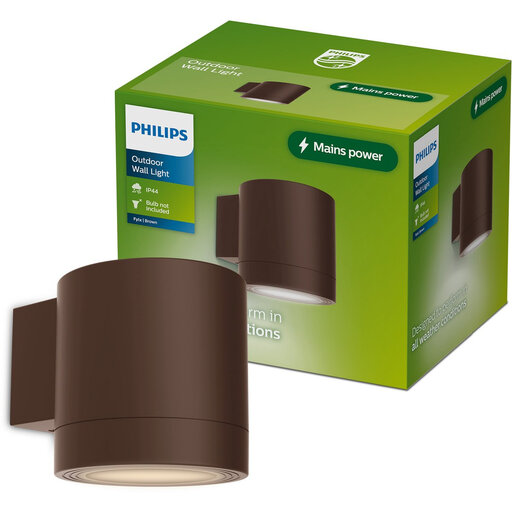
Why it suits this profile: This compact outdoor wall light has a GU10 fitting and is supplied without a spotlight. You can therefore choose the colour temperature, brightness and, if desired, a smart light source for wall-mounted garden lighting.
The fitting and maximum load of 5 W per light point are specified. Remember that you will need to purchase a GU10 LED bulb separately and arrange fixed installation.
Replaceable light source, GU10 fitting, compact design and IP44 for sheltered outdoor locations.
We have put together a complete, up-to-date list of products that fully meet these strict selection criteria and the applicable European safety regulations.
Before drilling, check that the wall is strong enough and that there are no pipes or cables running through it. For a fixed outdoor wall light, the connection must be suitable for outdoor use. A loose cable or unused seal can cause moisture problems.
When installing a solar outdoor light, position the panel where it will receive as much direct sunlight as possible. Clean the panel and sensor regularly with a soft cloth. For a rechargeable light, check the charge level before using it as permanent entrance lighting.
When mounting with magnets, pay attention to the load capacity. A magnet will not work on every wall or surface. According to the product information, the Brilliant Iseo models are suitable for magnetic mounting, but the mounting plate must be firmly secured and the surface must be flat and clean.
For a sheltered entrance, balcony or patio, IP44 is often suitable. This rating provides protection against splashing water, but not against submersion or direct jets of water. For a more exposed location, IP65 may be a more suitable specification, provided the installation instructions support it.
During normal use, a solar outdoor light does not draw electricity from the mains. Its battery is charged via the solar panel during the day. Performance depends on the amount of sunlight, positioning, season and selected lighting programme.
Lifespan varies depending on the model and operating conditions. Some product descriptions state, for example, 25,000 or 50,000 operating hours, but this is a stated product specification and not a guarantee that the light will function for exactly that long. With integrated LED, the complete fitting will generally need to be replaced when the light source reaches the end of its lifespan.
