
Vandaag of morgen in huis

Kwaliteit gegarandeerd

Welkomstaanbiedingen ontgrendelen: GRATIS bezorging | Tot 80% korting | Gratis 30 dagen JoyPlus-proefperiode
Download de app
An outdoor wall light can make an entrance, patio, balcony or driveway easier to see. However, the difference between a suitable outdoor wall light and a poor purchase often only becomes clear after a few weeks. A light might provide enough illumination, for example, but respond incorrectly to movement. Or a model may look weatherproof, even though its protection rating isn’t suitable for the place where you want to install it.
Joybuy Product Recommendation Officer filters the key product specifications and highlights the most common pitfalls. This helps you compare outdoor wall lights based on how you’ll use them, their protection and installation, rather than just their appearance or marketing claims.
A high lumen rating doesn’t automatically mean the light will be comfortable or suitable. Lumens measure the total light output, but the light distribution, beam angle and mounting height determine how the light falls in practice.
For a front door or balcony, 180 to 500 lumens is often focused and manageable. A wider driveway or large garden may need more light. However, a powerful solar outdoor light with a wide beam can cause uncomfortable glare if it’s mounted at eye level.
An IP44 outdoor light is protected against solid objects larger than 1 millimetre and splashing water from different directions. This makes it suitable for many sheltered walls, balconies and entrances, but not for prolonged exposure to direct water jets or immersion.
An IP65 outdoor light offers greater protection against dust and water jets. This can make it a more practical choice for an exposed wall, driveway or garden wall. Always check that the light is installed correctly: its IP protection only works as intended when the seals and connections are fitted properly.
A solar-powered outdoor light needs enough daylight to charge its battery. A north-facing wall, a spot beneath a balcony or a location with lots of shade can limit how long the light stays on. Charging conditions in the Netherlands also differ in winter compared with a sunny summer’s day.
So check the position of the panel, the battery capacity and the selected lighting mode. An outdoor solar wall light is especially useful when wiring is difficult, but not every location is suitable for a solar panel.
Colour temperature is measured in kelvin (K):
Also compare the lumen rating. An integrated LED outdoor wall light often has a fixed light output. With a light that has a fitting, such as GU10 or E27, you can choose the light source yourself and change its colour temperature or brightness later.
An outdoor light with a motion sensor can switch on when someone passes the driveway, front door or garden. Check its detection range and angle. A sensor with a wide angle isn’t automatically better: its performance is affected by its position, the direction people walk in and any obstacles.
Also look for adjustable lighting duration and a dusk sensor, if needed. A light with motion detection only may switch on unnecessarily during the day if its sensor doesn’t respond properly to the ambient light.
Solar models and rechargeable lights are generally suitable for installation without fixed wiring. For a hard-wired 230 volt exterior light, installation by a qualified electrician is advisable and may sometimes be required by local regulations.
If you’re buying a light with a fitting, check whether the bulb is included. The Brilliant Jelani and Philips Juli, for example, use GU10 and E27 fittings respectively, but the product information states that they’re supplied without a bulb. This gives you more choice, but also means you’ll need to buy the right LED bulb separately.
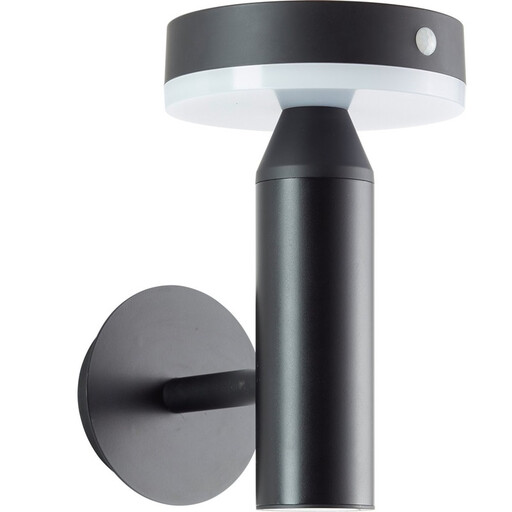
Why it suits this profile: This compact solar wall light has an integrated LED, 350 lumens, a motion sensor with a 120° detection angle and two lighting modes. That makes it a practical choice for a balcony, patio or sheltered entrance without fixed wiring.
The product information clearly states the IP44 rating, light output, detection angle and integrated battery. So you don’t have to rely on general claims such as “weather-resistant”.
Solar-powered, 350 lumens, integrated motion sensor and a metal/plastic housing.
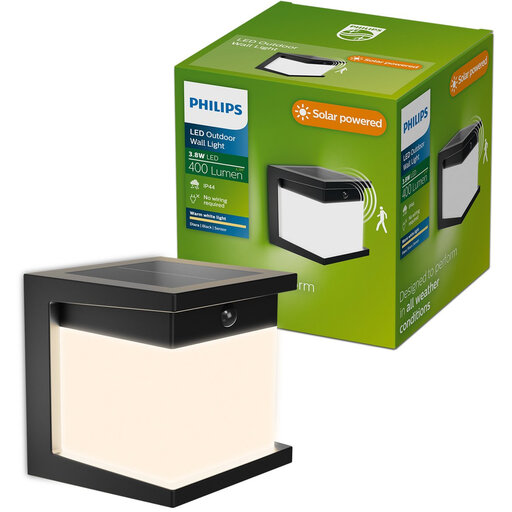
Why it suits this profile: A good choice if you value a refined design, warm light and clear product specifications. The specifications state that the light produces 400 lumens at 2700 K and has two lighting modes.
The IP44 rating is clearly stated. This makes it clear that the light is protected against splashing water, not direct water jets.
400 lumens, 2700 K, integrated LED, solar-powered and an integrated motion sensor.

Why it suits this profile: This model is designed to provide wide coverage for a driveway, large garden or garage area. Its three adjustable heads and stated 270° light coverage are practical features for a large area.
The product specifications state a detection range of 60 feet, a 180° angle and an IP65 rating. When installing it, check that the stated range suits your situation.
302 LEDs, stated 3000 lumens, three lighting modes, three light heads and IP65 protection.
We’ve put together a complete, up-to-date list of products that meet these strict selection criteria and the applicable European safety regulations.
Choose a sturdy wall where the solar panel will get as much direct daylight as possible. Use suitable fixings for brick, concrete, wood or another surface. Keep the sensor window and panel clear of branches and dirt. Have a qualified electrician connect a hard-wired 230 volt outdoor wall light.
Lifespan varies depending on the model, how long it’s used, the temperature and the quality of its power supply. Integrated LED models sometimes state an estimated lifespan, but this isn’t a guarantee of a specific number of years. With a GU10 or E27 light, you can replace the bulb when it stops working.
A solar-powered light doesn’t use mains electricity, but it relies on enough daylight and a charged battery. A hard-wired LED outdoor light mainly uses electricity while it’s on. A motion sensor can limit the number of hours the light is on, provided the detection angle and lighting duration are set correctly. Before buying, check the wattage and, where stated, the energy consumption per 1,000 hours.
