
Vandaag of morgen in huis

Kwaliteit gegarandeerd

Welkomstaanbiedingen ontgrendelen: GRATIS bezorging | Tot 80% korting | Gratis 30 dagen JoyPlus-proefperiode
Download de app
An outdoor wall light can make an entrance feel safer, create an atmospheric glow on a patio or make a dark façade more practical. Yet many people end up buying a light that disappoints in practice. The problem often isn’t the appearance, but details such as positioning, IP protection or the type of light source.
These points will help homeowners, tenants and garden enthusiasts compare products more effectively and avoid paying for features that don’t suit their situation.
A black outdoor light or modern model may complement your façade beautifully, but you should also check its dimensions and light distribution. A compact light with downlighting is suitable for a front door or balcony, while a model with a wider spread is better suited to a patio or garden path.
Pay attention to the mounting surface too. A heavy metal wall light requires suitable wall plugs and a solid wall. In a rented property, a wireless solar wall light or rechargeable wall light may be more practical.
The term weather-resistant outdoor lighting doesn’t tell you much on its own. Check the IP rating. Many models in this category have IP44. This means protection against solid particles larger than 1 millimetre and splashing water from different directions. An IP44 outdoor light is therefore suitable for normal outdoor use, but it should not be submerged or exposed to powerful water jets for extended periods.
Ideally, don’t install IP44 lights where rainwater can collect. For a very exposed façade, a higher level of protection, such as IP65, may be more practical.
An outdoor light with a motion sensor doesn’t always switch on in the same way. Check the detection range, the intended mounting height and whether it has a dusk or daylight sensor. A sensor aimed at a busy footpath may switch on more often than you’d like.
With a solar outdoor light, the amount of direct sunlight also plays a major role. A shady north-facing wall, tree or canopy can limit charging performance. A light without a mains connection is easy to install, but it still needs a suitable position for the solar panel.
IP44 is a common rating for an outdoor wall light at an entrance, balcony or covered patio. As well as checking the rating, read the manufacturer’s instructions. A light may be splash-resistant without being suitable for direct water jets.
For more demanding use in an exposed garden, a model with IP65 may be worth considering. According to the product description, the Philips UltraEfficient Zyren has an IP65 rating and is designed as a powerful solar security light.
The number of lumens indicates how much light the lamp produces. As a guide:
Colour temperature determines the overall appearance of the light. 2700K produces warm white light, while 3000K looks slightly brighter. 5000K is cooler and whiter. When choosing an LED outdoor wall light, also consider the direction of the light: downlighting mainly illuminates the section of wall below the fitting, while a diffuser spreads the light more widely.
An integrated LED light is generally easy to use, but the light source cannot be replaced on some models. With a GU10 outdoor light or E27 outdoor light, you choose the light source yourself. This gives you flexibility in terms of brightness, colour temperature and, in some cases, dimming.
Always check whether the light is supplied without a fitting or without a bulb. For example, the Philips Fylx is a GU10 fitting supplied without a GU10 bulb. The Philips Juli uses an E27 fitting and is also supplied without a light source.

Why it suits this profile: This solar outdoor light works without wiring and features an integrated 400-lumen LED, warm white 2700K light and a motion sensor. That makes it suitable for an entrance, balcony or small garden wall.
The product description clearly states that it has two light settings, a daylight sensor, a motion sensor and IP44 protection. However, position the light where the panel receives direct sunlight.
No mains connection required; 400 lumens; two light modes; warm 2700K light.

Why it suits this profile: According to the product description, this solar model is designed to provide powerful lighting around a driveway, large garden or wide façade. It produces 4000 lumens, has IP65 protection and an adjustable light head.
The higher IP65 rating helps prevent you from choosing a standard IP44 light for a very exposed location. Even so, check the installation instructions.
4000 lumens; IP65; motion detection; adjustable light head; solar power.
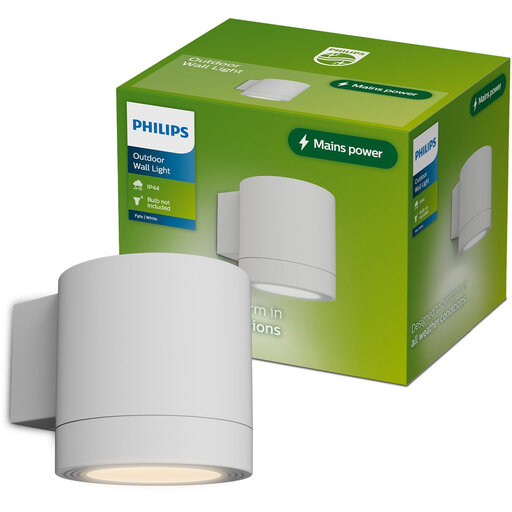
Why it suits this profile: If you want to choose the colour, brightness or smart features yourself, you can select a suitable GU10 bulb. This model is a good fit for façades, balconies and gardens with a fixed mains connection.
The fitting is clearly specified as GU10 and the light is supplied without a light source. This helps avoid any confusion when making your purchase.
GU10 fitting; replaceable light source; IP44; downward light distribution; aluminium housing.
We’ve put together a complete, up-to-date list of products that fully meet these strict selection criteria and the applicable European safety regulations.
A fixed outdoor light operating at 230 volts must be connected safely. Switch off the electricity and, if in doubt, have the installation carried out by a qualified electrician. Use wall plugs suitable for brick, concrete or another type of wall.
With a solar outdoor light, positioning is particularly important. Place the panel where it will receive as much direct daylight as possible, and keep it clear of leaves and dirt. A rechargeable light with magnetic mounting is flexible, but check that the mounting plate is secure enough. With IP44 models, remember: do not submerge them or expose them to powerful water jets.
For a front door or balcony, around 150 to 400 lumens is often sufficient. A larger driveway or wide façade may require 800 lumens or more. Don’t choose based on lumens alone: the beam angle, mounting height and colour temperature also affect how bright the space appears.
An IP44 outdoor light is protected against splashing water and can be used outdoors under normal conditions. IP44 does not mean that the light is waterproof. Therefore, don’t install the fitting where it could remain underwater for an extended period or be exposed to direct high-pressure water jets.
Lifespan varies depending on the model, usage and conditions. Some product descriptions, for example, state 25,000 or 50,000 hours of operation for integrated LED lighting. This is a stated product specification, not a guarantee of the same number of calendar years. Keep the fitting clean and follow the installation and maintenance instructions.
