
Vandaag of morgen in huis

Kwaliteit gegarandeerd

Welkomstaanbiedingen ontgrendelen: GRATIS bezorging | Tot 80% korting | Gratis 30 dagen JoyPlus-proefperiode
Download de app
An outdoor wall light can make an entrance feel safer, create a cosier atmosphere on a patio or make a dark driveway easier to see. However, not every outdoor wall light is suitable for every location. A light that works well beneath a canopy may be more exposed to rain when installed on an unprotected façade. And an outdoor solar wall light will not perform at its best if the solar panel is in the shade for much of the day.
So don’t focus only on colour and shape. The key differences lie in the IP protection rating, light source, power supply and installation.
IP44 means that a light is protected against solid objects larger than 1 millimetre and against splashing water from various directions. This makes an IP44 wall light suitable for many everyday outdoor applications, such as a sheltered façade, balcony or patio. It does not mean that the light is waterproof.
For this reason, do not install an IP44 outdoor light where a garden hose, pressure washer or direct jet of water could hit the housing. For a very exposed location, a higher IP rating, such as IP65, may be more practical.
More lumens mean more light, but not necessarily a more pleasant result. A light producing 800 lumens may be suitable for a façade or path, while 300 to 400 lumens may be enough for a front door or balcony. Also consider the colour temperature:
Also consider the direction of the light. A downlight shines mainly downwards. A light that shines upwards and downwards creates a decorative pattern on the façade.
With a GU10 wall light or an E27 wall light, you will often need to buy the bulb separately. This is not a disadvantage if you want flexibility, but it does increase the total purchase price. You can then choose a dimmable LED bulb, warm white light or a smart light source yourself.
With an outdoor wall light with integrated LED, the light source is usually already built in. Check whether the LED can be replaced. For several models in this category, the integrated light source cannot be replaced by the user.
Match the level of protection to the installation location:
An outdoor water-resistant light is therefore not automatically suitable for immersion or direct, powerful water jets. Also check that connection points and cable entries are properly sealed.
A wired outdoor light runs on mains electricity and is suitable when you want reliable, long-lasting illumination. Models operating at 230 V must be installed by a qualified electrician. This applies, for example, to various fittings with an E27 socket and integrated LED.
An outdoor solar wall light does not require a permanent electrical connection. However, the solar panel must receive enough direct daylight. In winter or on a shady north-facing wall, the available operating time may be shorter. A dusk sensor switches the light on when ambient light levels are low, while a motion sensor activates the light when movement is detected.
An E27 fitting accepts many commonly available bulbs and makes replacement straightforward. GU10 is compact and suitable for spotlight-style lighting. Always check:
Clean an outdoor light according to the product instructions, usually with a soft, dry cloth. Do not use harsh cleaning products and switch off wired lighting before carrying out maintenance.

Why it suits this profile: This outdoor solar wall light does not require a permanent electrical connection. The product information lists an integrated LED, 400 lumens, warm white light and two lighting modes.
The specifications mention IP44 and a motion sensor. Position the light so that the panel receives direct daylight; IP44 protects against splashing water, not immersion.
No mains cable required; 400 lumens; choice of Auto and On modes; motion sensor included.
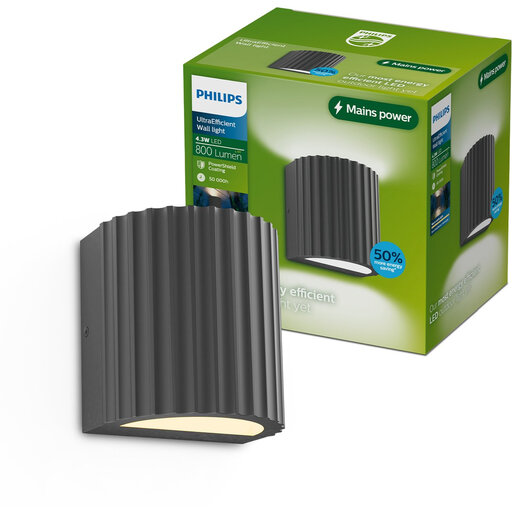
Why it suits this profile: For fixed façade lighting with a sleek look, this model offers 800 lumens, 2700 K, aluminium construction and light directed in two directions, according to the product specifications.
The colour temperature, brightness and light direction are clearly specified. Bear in mind that it requires a fixed 230 V connection and consider the IP44 classification when choosing where to install it.
800 lumens; warm white light at 2700 K; aluminium and plastic construction; light emitted in two directions.
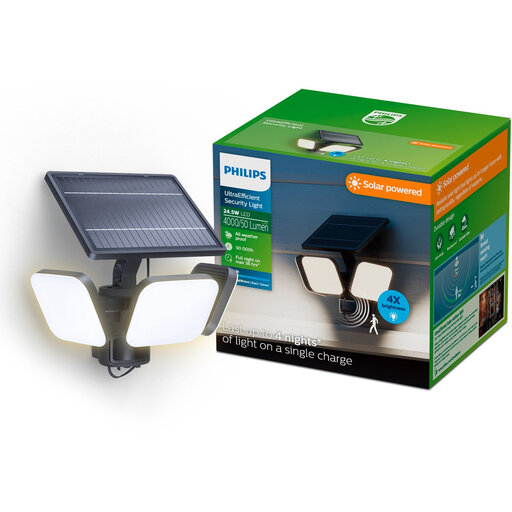
Why it suits this profile: This solar outdoor light is designed to provide powerful, functional illumination. The product information lists 4000 lumens, IP65, 5000 K, a motion sensor and an adjustable lamp head.
The higher IP65 classification is more clearly defined than a general claim such as “suitable for all weather conditions”. However, check whether 5000 K is right for the atmosphere you want to create.
4000 lumens; IP65; motion detection; adjustable lamp head; solar power.
We have put together a complete, up-to-date list of products that fully meet these strict selection criteria and the applicable European safety regulations.
A solar or rechargeable light can usually be mounted on a suitable wall using the supplied fixing materials. A wired outdoor wall light must be connected to the mains electricity supply. Have this carried out by a qualified electrician and switch off the power before installation or maintenance.
This varies by model, usage and conditions. The stated service life of integrated LED modules is a manufacturer’s product specification, not a guarantee of a fixed operating period in every situation. With a GU10 or E27 bulb, you can replace the light source separately, which can be practical for long-term use.
An outdoor solar wall light does not use mains electricity during normal operation. The battery charges during the day via the solar panel. The available operating time depends on factors including sunlight, the season, shade and the selected lighting mode. Check the installation position carefully and keep the panel free from dirt.
