
Vandaag of morgen in huis

Kwaliteit gegarandeerd

Welkomstaanbiedingen ontgrendelen: GRATIS bezorging | Tot 80% korting | Gratis 30 dagen JoyPlus-proefperiode
Download de app
An outdoor wall light can provide practical illumination for an entrance, balcony, patio, veranda or driveway. However, the available options are not always easy to compare. A low price says little about whether a light is suitable for an exposed wall, while an integrated motion sensor does not automatically mean that the light will work well everywhere.
The following pitfalls are common:
The IP code consists of two digits. The first digit relates to protection against solid particles, while the second refers to water.
For example, an IP44 outdoor wall light is suitable for a sheltered entrance, balcony or covered patio. If you are mounting the light on a wall fully exposed to rain and wind, check the installation instructions and consider a model with a higher level of protection. No IP rating makes a fitting suitable for immersion unless this is explicitly stated.
An LED outdoor wall light with an integrated LED is ready to use straight away, but the light source is often not replaceable. With a fitting featuring a GU10 or E27 socket, you can choose which bulb to use.
When using a separate light source, always check the fitting’s maximum wattage. A socket that supports a maximum of 10 watts of LED power is not the same as a fitting that can accommodate any bulb up to 10 watts without further conditions.
A wired outdoor wall light runs on mains electricity and requires a fixed connection. Have work on the electrical installation carried out by a qualified electrician. Switch off the power before removing or replacing an existing light.
A model with an integrated battery, USB charging or a solar panel can be installed without a fixed power connection. This is useful for rented homes, sheds or locations without existing cabling. However, pay attention to:
An outdoor light with a motion sensor is practical for a driveway or front door. However, the sensor may react to passing pedestrians, pets or traffic. So check the detection range and adjustment options. Manufacturer information about, for example, operating time, detection distance or battery performance should be treated as a manufacturer’s specification, not as a guaranteed result in every situation.
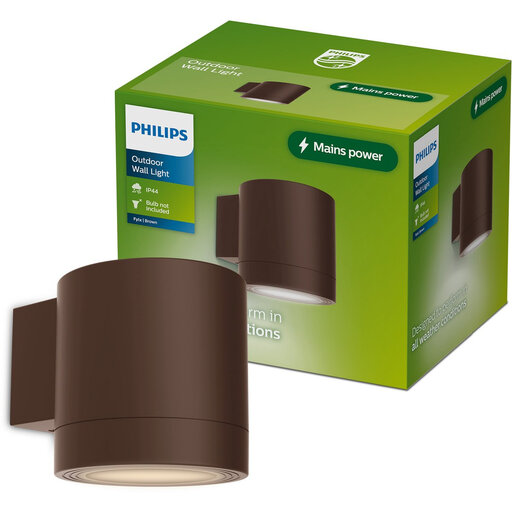
Why it suits this profile: This compact garden wall light has a GU10 fitting, allowing you to choose a suitable LED spotlight yourself. The fitting has one light point, measures 8.9 × 11.6 × 9 cm and is designed for outdoor use.
The product information clearly states that the GU10 spotlight is not included. This allows you to estimate the cost of the fitting and light source separately in advance.
GU10 fitting, aluminium housing, downward light emission and IP44 protection for sheltered outdoor applications.

Why it suits this profile: For a driveway, garage or large exterior wall, this solar model is designed to provide high light output. The product specification states 4000 lumens, 5000 K, IP65, a motion sensor and an adjustable light head.
The higher IP65 rating is better suited to a more exposed location than IP44. However, position the solar panel away from shade to give it the best chance of charging sufficiently.
4000 lumens according to the product listing, IP65, solar power and a choice of two lighting modes.
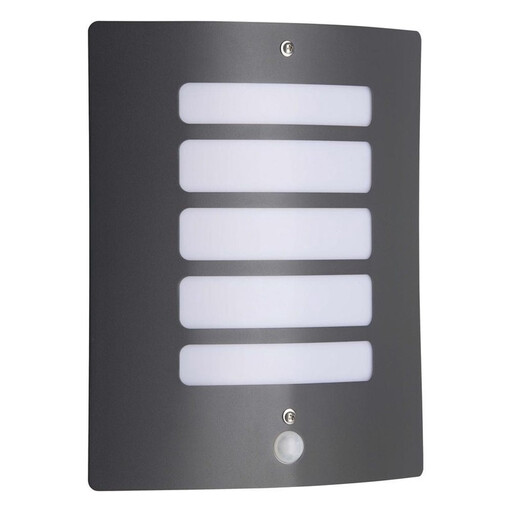
Why it suits this profile: This fixed wall light is designed for an entrance, garden path or driveway where automatic activation is useful. The E27 fitting accepts a suitable standard bulb up to a maximum of 60 watts.
The fitting and maximum load are specified, while the light is supplied without a light source. This means you remain in control of the lumens, colour temperature and any dimming.
E27 fitting, integrated motion sensor, 230V connection and IP44 for sheltered outdoor applications.
We have compiled a complete, up-to-date list of products that fully meet these strict selection criteria and the applicable European safety regulations.
IP44 is generally suitable for a sheltered exterior wall, balcony, veranda or entrance. The fitting is resistant to splashing water, but not powerful water jets or immersion. For a completely exposed location, IP65 outdoor lighting may be more practical. Always follow the manufacturer’s installation instructions.
No, during normal use a solar outdoor light draws energy from its charged battery. Performance depends on the amount of sunlight, the battery capacity and the selected light level. During dark or overcast periods, the operating time may be shorter. A wired LED outdoor light generally uses little electricity, but the exact consumption depends on the wattage and duration of use.
With a fitting that uses a replaceable GU10 or E27 light source, you can replace the bulb when it reaches the end of its service life. With integrated LED, the light source cannot always be replaced by the user, so check this before purchasing. The stated service life in hours is a manufacturer’s product specification and may be affected in practice by heat, moisture, switching frequency and installation.
