
Vandaag of morgen in huis

Kwaliteit gegarandeerd

Welkomstaanbiedingen ontgrendelen: GRATIS bezorging | Tot 80% korting | Gratis 30 dagen JoyPlus-proefperiode
Download de app
An outdoor wall light may seem like a simple purchase, but small differences can determine whether it works well in practice. A light may look sturdy in the product photo, yet the fitting might not be suitable, the light output may disappoint or the casing may not be right for where you want to install it.
Look out for these three common pitfalls:
An outdoor wall light usually serves one of these purposes:
A fixed LED outdoor wall light is practical if you do not want to replace the bulb. A model with a GU10 or E27 fitting gives you more freedom to change the light colour and brightness later.
IP44 is a common rating for many covered exterior walls, balconies and sheltered entrances. The first 4 indicates protection against solid particles larger than 1 millimetre; the second 4 indicates protection against splashing water from different directions.
Do not install an IP44 outdoor light where water constantly runs from a roof edge onto the casing. Also check that water cannot collect around the wall plate. For a fully exposed location, a higher IP rating may be more practical, depending on the product specifications.
With a GU10 outdoor light or E27 outdoor light, the bulb is often replaceable. This makes it easier to switch later between warm white, neutral white or a smart bulb. Always check:
An integrated LED outdoor wall light does not need a separate bulb, but the light source is usually not user-replaceable. So check the stated lifespan and warranty terms.
A light with a motion sensor can be useful by a front door or garage. Check whether the product also has a dusk sensor. For example, the Philips Capricorn is listed as having an integrated motion and dusk sensor, with a light output of 800 lumens according to the product specifications.
A solar wall light does not need a fixed mains connection. However, its performance depends on the amount of daylight, the position of the panel and the battery capacity. The Aigostar model is listed with a charging time of 4 to 6 hours and a battery life of up to 24 hours. Treat these as product specifications under the stated conditions, not as a guarantee for every Dutch winter’s day.
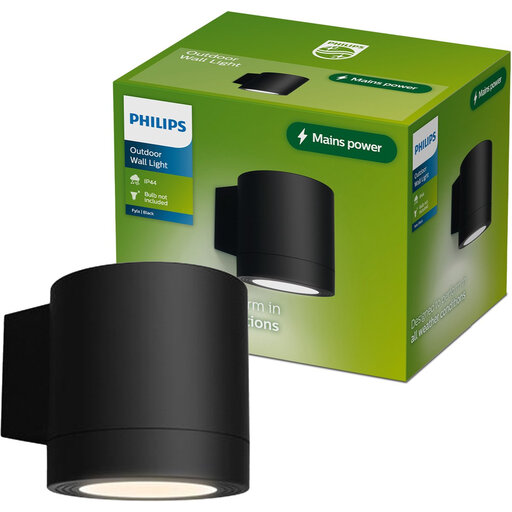
Why it suits this profile: This compact outdoor wall light has a GU10 fitting, so you can choose a suitable LED bulb for your exterior wall, balcony or garden.
The product information clearly states that the GU10 spotlight is not included. This means you can factor the extra purchase into your budget in advance.
GU10 fitting, aluminium casing, compact dimensions of approximately 8,9 × 11,6 × 9 cm and an IP44 rating.
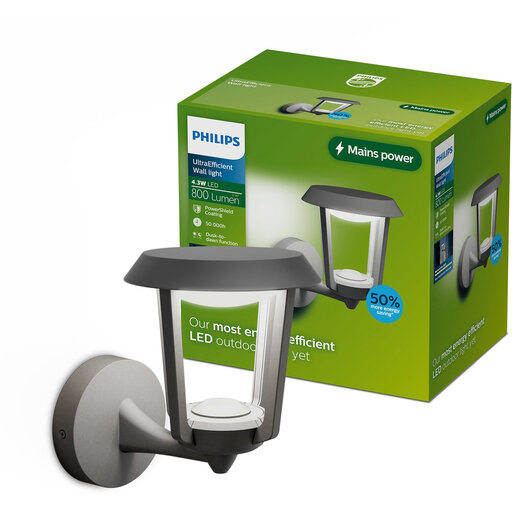
Why it suits this profile: This outdoor wall light combines an integrated LED light source with a classic lantern design, making it a permanent solution for an entrance or patio.
There is no need to choose a separate fitting or bulb. The product specifications list integrated LED, a dusk sensor and IP44 protection.
800 lumens, 2700 K, 4,3 W per light point and a stated lifespan of 50.000 operating hours.
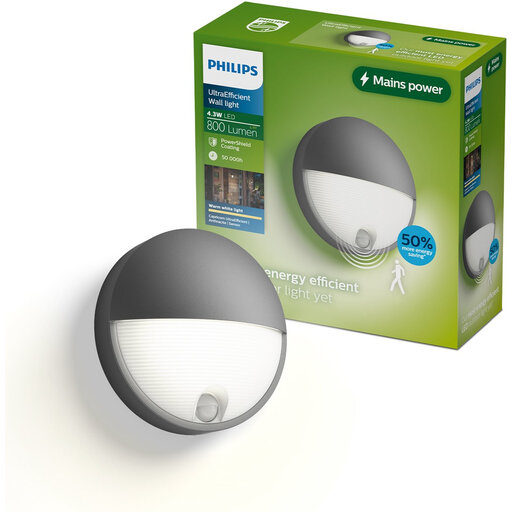
Why it suits this profile: A practical choice for entrances, back doors and garages where you only want the light to come on when movement is detected.
The product description mentions both a motion sensor and a dusk sensor. Depending on the settings and location, these can help prevent the light staying on unnecessarily during the day.
800 lumens, warm white light at 2700 K, integrated LED and IP44 according to the stated product specifications.
We’ve put together a complete, up-to-date list of products that meet these strict selection criteria and the applicable European safety regulations.
Switch off the power at the consumer unit before connecting a fixed outdoor wall light. If you are unsure about the wiring or earthing, it is best to have a qualified electrician install it. Use wall plugs suited to brick, concrete or the relevant surface. After installation, check that the wall plate sits flush and that the cable entries are properly sealed.
A portable light with USB-C or a solar wall light requires a different approach. Secure the mounting plate firmly, and if you have a solar panel, consider shade from trees, fences and roof edges. Clean the fittings with a soft cloth and follow the manufacturer’s care instructions.
Not necessarily. IP44 protects against splashing water, but not direct jets of water or submersion. Install the light according to the product instructions and, for a fully exposed location, consider choosing a model with a higher IP rating.
That depends on the wattage, the number of hours it is on and the controls. One of the integrated models in the examples is listed at 4,3 W per light point. A motion or dusk sensor can reduce the time the light stays on. Work out the cost by multiplying the power in kilowatts by the number of hours the light is on and your current electricity tariff.
Lifespan varies depending on the light source and conditions of use. Product information may state, for example, 30.000 or 50.000 operating hours, but this is not a guarantee for every installation. With a GU10 or E27 model, you can replace the bulb; with integrated LED, the whole fitting usually needs to be replaced if the light source fails.
