
Vandaag of morgen in huis

Kwaliteit gegarandeerd

Welkomstaanbiedingen ontgrendelen: GRATIS bezorging | Tot 80% korting | Gratis 30 dagen JoyPlus-proefperiode
Download de app
An outdoor wall light may seem easy to choose, but small differences can determine whether it’s right for your home. A light that looks great in a product photo may not provide enough light on a dark wall, while a solar-powered outdoor light in a shady spot may not stay lit for as long as you expect.
Pay particular attention to these three common pitfalls:
The IP rating indicates how well a light fitting is protected against solid particles and moisture.
An IP rating doesn’t make a light suitable for use underwater. Correct installation, a well-sealed light source and suitable wiring are still essential.
Lumens indicate how much light a fitting produces. A lower lumen output may be enough for atmospheric wall lighting. At an entrance, on a driveway or against a dark side wall, a brighter light is more practical.
Colour temperature is measured in kelvin:
Pay attention to the direction of the light, too. A light with dual-direction lighting casts light upwards and downwards, helping to highlight a wall. An adjustable sensor light offers more flexibility if you want to light a particular path or entrance.
An outdoor wall light with an integrated LED is ready to use straight away and doesn’t need a separate bulb. Check whether the LED module can be replaced and what lifespan is stated.
With a fitting, you can choose your own light source:
So, check before buying whether an E27 or GU10 bulb is included. According to the product information, the Philips Fylx and Juli models are supplied without a bulb.
For a flat, size, installation and wiring are often the deciding factors. A compact light with an integrated LED can be practical for a balcony or shared walkway. For a detached house, it’s more important to compare brightness, materials and coverage. Aluminium has a sturdy feel, while plastic is often lighter.
An outdoor light with a motion sensor is useful by an entrance, garage or rear door. It switches on automatically when movement is detected. With solar lighting, there’s no need to run a power cable to the wall, but the panel still needs plenty of sunlight. According to Philips product information, the Swyn has daylight and motion sensors; the Aigostar light is listed as switching on automatically in the dark and offering Bluetooth Mesh control.
Bear in mind that claims by manufacturers about lifespan, energy use or operating time come from the brand’s product information. Treat them as product specifications, and take the installation location, temperature, usage time and maintenance into account.
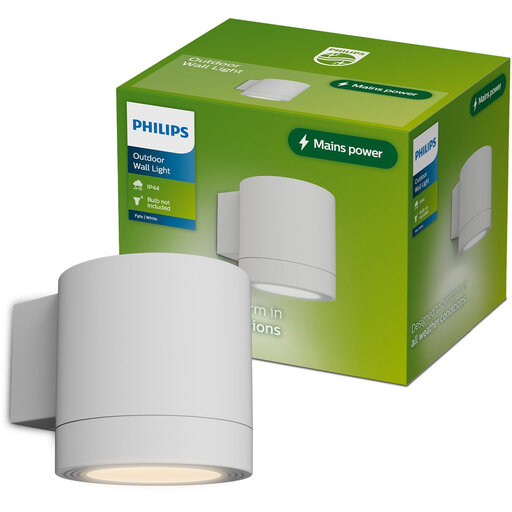
Why it suits this profile: This compact outdoor wall light has a GU10 fitting, so you can choose a suitable LED spotlight and colour temperature. It’s a straightforward option if you already have a GU10 bulb.
The IP44 rating is clearly stated. Do check separately whether a GU10 bulb is included with your order; according to the product information, it isn’t supplied.
Aluminium housing, one GU10 fitting and a length of around 8.9 cm. Suitable for a garden, wall or balcony.
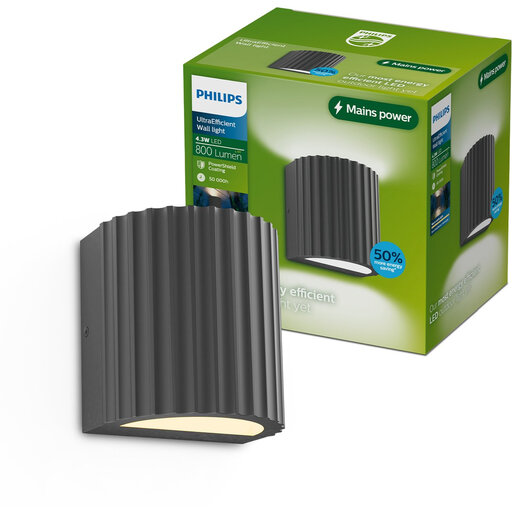
Why it suits this profile: The integrated LED and two-way light distribution are ideal for a modern wall where appearance and practical lighting need to go hand in hand.
The colour temperature, light output and energy use are clearly specified. According to Philips, it produces 800 lumens at 2700 K and uses 4.3 W.
IP44, integrated LED, warm white light at 2700 K and two-way lighting.
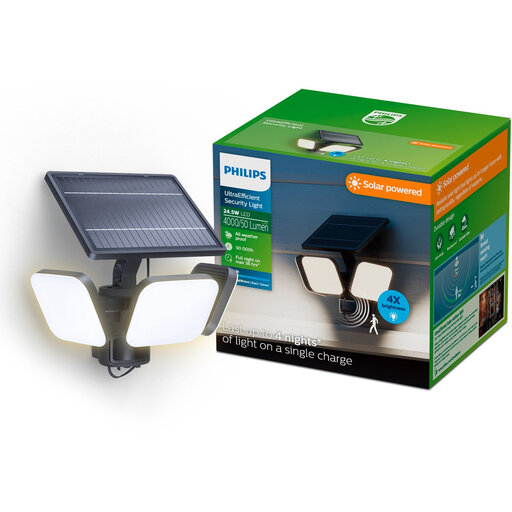
Why it suits this profile: This solar-powered outdoor light is designed for practical lighting on a driveway, at a rear entrance or against a dark wall, where bright light and automatic switching are useful.
The IP65 rating and lack of fixed mains wiring are clearly stated. For effective charging, make sure the panel is positioned out of the shade.
According to Philips product information, it offers 4000 lumens, 5000 K, a PIR motion sensor and an adjustable light head.
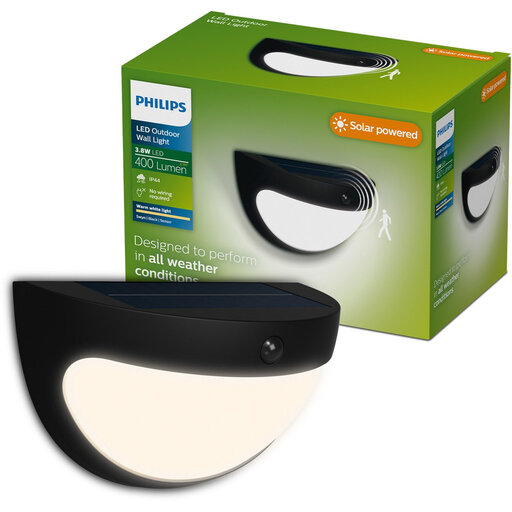
Why it suits this profile: A good choice for a balcony, garden path or patio where you want atmospheric lighting without running a power cable to the wall.
The light has two lighting modes, a motion sensor and an IP44 rating. Positioning it in direct daylight is still important for effective charging.
Integrated LED, warm white light at 2700 K, 400 lumens and installation without a mains connection.
We’ve put together a complete, up-to-date list of products that meet these strict selection criteria and the applicable European safety regulations.
For a sheltered wall, balcony or patio, IP44 may be suitable if the light is installed correctly. For a spot more exposed to dust and water, IP65 offers a higher level of protection. Always check the installation instructions and make sure water can’t collect around the connections.
It can be, but positioning matters. Place the solar panel somewhere it will get as much direct daylight as possible, and keep it clear of leaves and dirt. In darker or overcast periods, it may not stay lit for as long. A mains-powered LED outdoor wall light will provide more consistent results if you want to use the light for long periods every day.
An LED light generally uses less power than traditional light sources. Compare the wattage and the length of time you want the light to stay on. A 4.3 W light used for a few hours each day needs considerably less energy than a more powerful fitting that stays on all night. A motion or dusk sensor can help limit how long it’s in use.
