
Vandaag of morgen in huis

Kwaliteit gegarandeerd

Welkomstaanbiedingen ontgrendelen: GRATIS bezorging | Tot 80% korting | Gratis 30 dagen JoyPlus-proefperiode
Download de app
An outdoor wall light can make your entrance, balcony, patio or façade more practical. However, many models are less suitable than the product photo might suggest. A light may have a modern appearance, for example, but be supplied without a light source. Or a product may be described as water-resistant, while its IP rating only indicates protection against splashing water.
As a Joybuy Product Recommendation Officer, I therefore focus mainly on verifiable details: the IP rating, the type of light source, the installation requirements and the intended use. This helps you avoid having to arrange a suitable bulb, transformer or additional fittings after your purchase.
An IP44 wall light is protected against solid objects from 1 millimetre and splashing water from various directions. This does not mean that the light can withstand a direct jet of water, immersion or prolonged exposure to extreme weather conditions.
IP44 can be suitable for a sheltered entrance, balcony or covered patio. If you are mounting the light on a façade that is exposed to a lot of rain, carefully check the installation location and the manufacturer's instructions. A higher rating, such as IP65, offers greater protection against dust and water jets according to the product classification.
Many fittings for a GU10 outdoor light or E27 outdoor light are supplied without a bulb. This gives you flexibility, but it also increases the actual purchase price. You need to check:
A GU10 spotlight usually provides more focused lighting. E27 bulbs are often suitable for a wider spread of light and a range of decorative shapes.
A wall light with motion sensor does not always switch on at exactly the moment or within the range you expect. Pay attention to the stated detection angle, distance and mounting height. A sensor may also respond to passing people, pets or traffic.
With an outdoor solar wall light, operating time depends on the amount of direct sunlight, its positioning and the season. According to Philips' own information, the Fyns can operate without a mains connection, for example, but the manufacturer recommends positioning it where the solar panel receives direct light. In the Dutch winter, output may be lower than on long, sunny days.
Do not just look for the term “weather resistant”; check the specific IP rating. A water-resistant wall light with IP44 is suitable for splashing water, not direct water jets. Mount the fitting on a stable surface and prevent water from collecting around the connection.
For an exposed façade or a location where you expect greater exposure, IP65 may be a practical choice. Also check whether the cable entry and wall box are suitable for outdoor use.
The number of lumens indicates the amount of light produced. Ambient lighting for a patio generally requires a different light output from that needed for a dark driveway. An integrated LED is easy to use, but on some models it cannot be replaced separately.
An LED outdoor wall light producing around 2700 to 3000 K gives a warm white light. This often suits an entrance or patio. Around 4000 K, the light looks more neutral; 5000 K is described as bright white in the product details of some models and can be useful for a driveway or shed.
A fixed 230 V light must be connected safely. The product information for various Brilliant models states that installation must be carried out by a qualified electrician. Switch off the power before working on existing wiring.
A cordless, rechargeable wall light avoids fixed cabling, but it requires a battery. Check the charging connector, charging time, mounting method and whether the light source can be replaced. A magnetic system is flexible, but it must be securely attached to a flat, suitable surface.
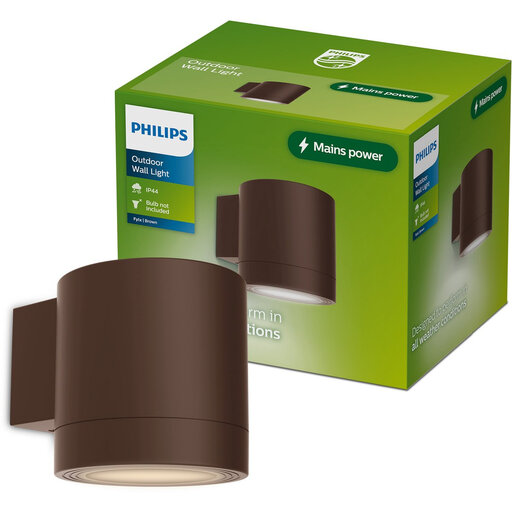
Why it suits this profile: This compact fitting, measuring 8.9 × 11.6 × 9 cm, lets you choose your own GU10 light source. The light is supplied without a spotlight, so you can select the colour temperature and brightness separately.
The GU10 fitting is clearly stated, while the IP44 rating makes it clear that this is protection against splashing water, not a fully waterproof fitting.
Replaceable light source, aluminium housing and a choice of several colours according to the product information.
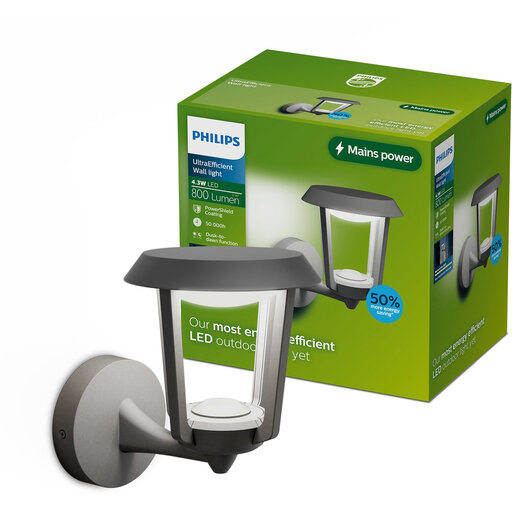
Why it suits this profile: According to the product specifications, the integrated LED produces 800 lumens at 2700 K. The light is designed for outdoor use in a garden, on a balcony or in another outdoor area.
The light output, colour temperature and integrated light source are specified in advance. This means you do not need to select a separate bulb.
Integrated LED, 800 lumens, 2700 K and IP44. According to Philips' own information, the stated lifespan is up to 50,000 hours of operation.

Why it suits this profile: This model is designed for those who need plenty of light and wide detection coverage, for example on a driveway, by a shed or in a large garden area.
The product specifications state IP65 rather than just IP44. The detection distances and solar panel are also described in advance.
4000 lumens, integrated LED, solar power and a stated detection range of 8 metres straight ahead and 16 metres to the sides, according to Philips.
We have compiled a complete, up-to-date list of products that fully meet these strict selection criteria and the applicable European safety regulations.
IP44 protects against splashing water and is suitable for many sheltered outdoor locations. It does not protect against strong water jets or immersion. Therefore, check the mounting location and follow the manufacturer's installation instructions.
Consumption depends on the wattage and the number of hours the light is switched on. A 4.3 W light that is on for 1,000 hours uses approximately 4.3 kWh. An outdoor solar wall light does not use mains electricity, but its performance depends on sunlight, battery condition and sensor settings.
You can usually install a rechargeable or cordless light without fixed wiring. For a 230 V fitting, safe connection is essential. Have fixed electrical installations carried out by a qualified electrician if you are not completely familiar with outdoor wiring and local regulations.
