
Vandaag of morgen in huis

Kwaliteit gegarandeerd

Welkomstaanbiedingen ontgrendelen: GRATIS bezorging | Tot 80% korting | Gratis 30 dagen JoyPlus-proefperiode
Download de app
An outdoor wall light can make an entrance feel safer, create a welcoming atmosphere on your patio or make your balcony more usable. But it’s not wise to choose based on appearance or lumen output alone. A light that looks great in a product photo may be too dim in practice, difficult to install or not sufficiently protected against rain.
The most common purchasing mistakes are:
An IP44 outdoor light is suitable for many sheltered walls, balconies and patios. The first 4 indicates protection against solid particles of a certain size; the second 4 means protection against splashing water from different directions. This makes an IP44 model a weather-resistant wall light for normal outdoor use, but not one for a spot exposed to constant heavy rain or direct jets of water.
For an exposed wall or one that catches a lot of wind and rain, a higher protection rating, such as IP65, may be more suitable. Also check that the cable entries, screws and wall plugs are suitable for the surface.
An integrated LED outdoor light is ready to use straight away, but the light source usually can’t be replaced. With a fitting for a GU10 or E27 bulb, you can choose the brightness and colour temperature yourself. This gives you more flexibility, but the fitting is sometimes supplied without a bulb.
Bear these practical guidelines in mind:
The values shown are product specifications. According to the brands’ own product information, the actual light appearance and operating time may depend on installation, surroundings and use.
A wired outdoor wall light needs a suitable power connection and safe installation. Switch off the circuit before working on the installation. If you’re unsure about the wiring, it’s best to use a qualified electrician.
An outdoor wall light with a motion sensor only switches on when movement is detected. So check the detection range and adjustment options. A solar outdoor light doesn’t need mains power, but it should be positioned so that the panel receives direct sunlight. A battery-powered model, such as a portable LED wall light, will need regular charging.
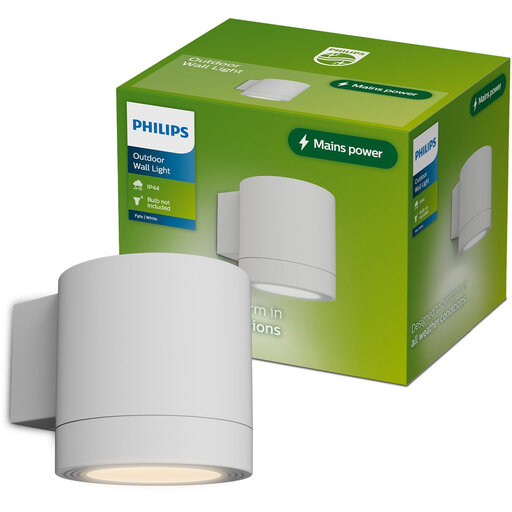
Why it suits this profile: This compact model has a GU10 fitting, so you can choose your own LED bulb. That lets you set the colour temperature and brightness to suit your wall, balcony or garden.
The fitting is clearly specified as GU10 and the light source is replaceable. Bear in mind that the GU10 bulb is not included.
Aluminium housing, 1 light point, GU10 fitting and IP44 protection. Dimensions: approx. 8,9 × 11,6 × 9 cm.
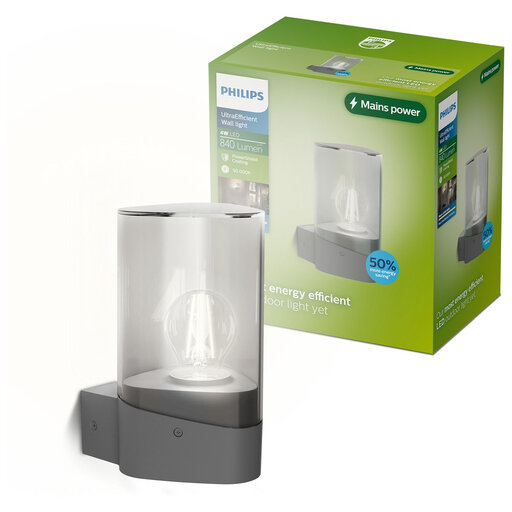
Why it suits this profile: This anthracite aluminium light is designed for a permanent wired installation by an entrance or on an exterior wall, and gives off warm white light at 2700 K.
The specifications list both the E27 fitting and the included LED bulb. Before installation, check the maximum load and connection requirements.
E27 fitting, 840 lumens, 2700 K, aluminium and IP44. The product information mentions a PowerShield coating and 230 V connection.

Why it suits this profile: This solar model is designed to light up a driveway, back path or large area of the garden, where a higher light output is needed.
The IP65 rating offers greater protection than IP44. For reliable charging, place the solar panel somewhere it will receive direct sunlight.
4000 lumens, 5000 K, integrated LED, solar power and a motion sensor. The product information states a detection range of up to 8 metres when approached directly.
We’ve put together a complete, up-to-date list of products that meet these strict selection criteria and current European safety regulations.
Before buying, check how the light is mounted on the wall. A heavy fitting needs a solid surface and suitable wall plugs. For a wired garden wall light, switch off the power at the consumer unit. With a solar or battery-powered model, choose a spot where the panel or charging port will remain accessible.
Clean the housing with a soft, dry cloth and keep solar panels free of dirt. Don’t point a sensor towards a busy road or moving branches, as this could cause it to switch on unnecessarily. For a magnetic model, attach the mounting plate to a flat, solid surface.
IP44 is often suitable for sheltered walls, balconies and patios. The rating means protection against splashing water, not complete waterproofing. For a very exposed spot, a higher IP rating may be a better choice.
For atmospheric balcony lighting, around 180–400 lumens may be enough. For an entrance or patio, 800–1000 lumens is a good choice. If you want to light a large path or driveway, consider a more powerful model. Also think about how the light is distributed: more lumens don’t automatically mean a more pleasantly lit space.
A solar outdoor light doesn’t use mains electricity during normal operation. Its solar panel charges an internal battery. Performance depends on sunlight, the season, placement and battery capacity. So don’t just check the claimed operating time; also consider the sensor, brightness and charging conditions.
