
Vandaag of morgen in huis

Kwaliteit gegarandeerd

Welkomstaanbiedingen ontgrendelen: GRATIS bezorging | Tot 80% korting | Gratis 30 dagen JoyPlus-proefperiode
Download de app
An outdoor wall light can make an entrance feel safer, highlight a façade or provide extra light on the patio. However, the range is not as straightforward as it may seem. An attractive product photo says little about whether a light is suitable for a Dutch exterior wall.
Three common pitfalls come up time and again:
The IP code consists of two digits. The first digit indicates protection against solid particles, while the second refers to water.
A water-resistant wall light is therefore not automatically suitable for every location. Also check whether water could collect around the fitting or housing.
Light output is usually stated in lumens (lm). A moderate light output may be enough for a front door or pathway. A wider driveway or back garden requires more light.
Colour temperature is measured in kelvin (K):
Also consider the light distribution. A light that shines upwards and downwards creates a different effect on the façade from a fitting that provides diffuse light all around.
A fixed outdoor wall light connected to 230 volts generally provides consistent lighting, but requires a suitable connection. Switch off the power and have work on the electrical installation carried out in accordance with local regulations. If in doubt, it is advisable to use a qualified electrician.
A solar model avoids fixed wiring. When choosing one, consider:
A wall light with motion sensor only switches on when movement is detected. This can help prevent unnecessary use, but the sensor angle and detection range determine how reliably the light responds.
With a GU10 outdoor wall light or E27 outdoor wall light, the light source can be replaced. Check the maximum wattage and use an LED bulb suitable for the fitting. An integrated LED, as found in some Philips outdoor wall lights, gives the product a compact design but cannot always be replaced separately.
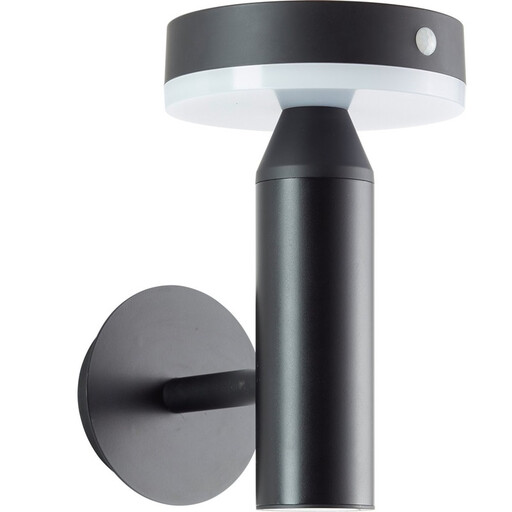
Why it suits this profile: This solar outdoor light with sensor does not need a fixed power connection and is intended for patios, balconies or garden paths. The stated light output is 350 lm at 4000 K.
The product information clearly states that it uses solar power, has an integrated battery, offers 120° motion detection and has an IP44 rating. However, place the panel somewhere with sufficient daylight.
Solar power, integrated LED, 350 lm, 4000 K and a motion sensor. According to the product specification, the housing has an IP44 rating.
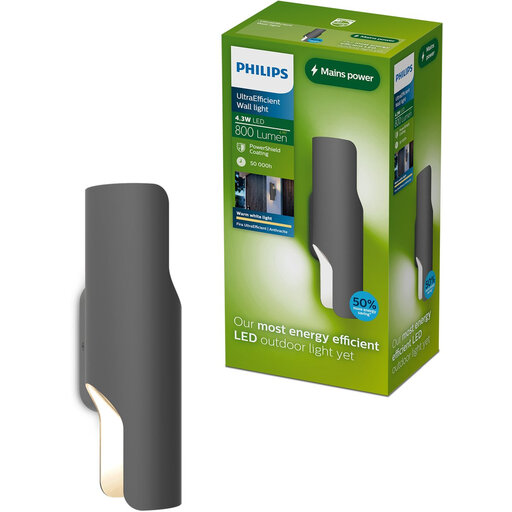
Why it suits this profile: For fixed façade or garden lighting with a sleek appearance, this light offers an integrated LED, warm white light at 2700 K and light directed in two directions.
The light source and colour temperature are stated in the product details. The fitting has an IP44 rating, so choose a sheltered installation location and follow the installation instructions.
800 lm, 2700 K, 4,3 W, integrated LED and two-way light distribution. According to Philips, the stated service life is up to 50.000 operating hours.
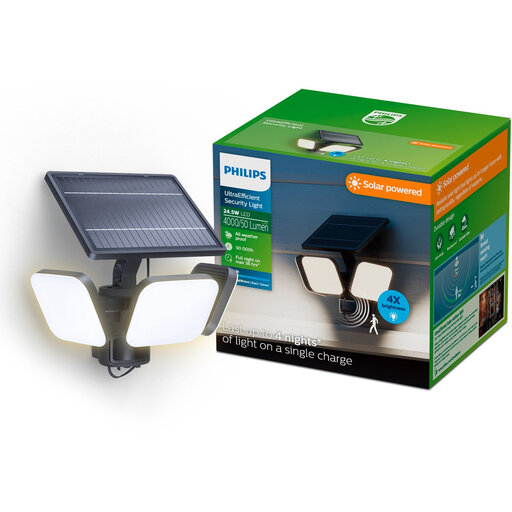
Why it suits this profile: This solar spotlight is designed for large outdoor areas where wide detection and a high stated light output are desirable, such as a driveway or spacious garden.
The stated IP65 rating is suitable for a location with greater exposure to dust and water. For good solar performance, the panel must receive direct sunlight.
The product specification states 4000 lm, IP65, a dusk sensor, two lighting modes and a PIR detection range of up to 8 metres straight ahead and 16 metres to the sides.
First, measure the available space on the façade. Then check that the surface is sturdy enough and that the cable, adapter or mounting plate is suitable for the chosen installation.
For fixed outdoor wall lighting:
With a portable or magnetic light, the mounting method is particularly important. A magnetic model can be useful on a balcony or patio, but do not mount the base on a dusty, porous or unstable surface.
Also consider the total cost of ownership. An LED outdoor wall light generally uses little electricity, but a solar model does not require a mains connection and does need periodic maintenance of the panel and battery. A GU10 or E27 model makes replacement easier, but buying a suitable LED bulb should be included in your budget.
We have put together a complete, up-to-date list of products that fully meet these strict selection criteria and the applicable European safety regulations.
IP44 is suitable for splashing water and sheltered outdoor locations. For a façade exposed to heavy rain, wind or splashing water, an IP65 outdoor light may be more practical. Always check the full installation instructions.
A lower lumen output may be sufficient for atmospheric lighting by a door. A driveway, shed or wide garden wall requires more light. As well as lumens, consider the beam angle and colour temperature.
The running costs of solar lighting are limited because the fitting uses solar energy. Clean the panel regularly, check the battery and position the light where it receives enough direct sunlight during the day. In darker winter periods, the operating time may be shorter.
