
Vandaag of morgen in huis

Kwaliteit gegarandeerd

Welkomstaanbiedingen ontgrendelen: GRATIS bezorging | Tot 80% korting | Gratis 30 dagen JoyPlus-proefperiode
Download de app
An outdoor wall light may seem simple to choose, but the differences between models often come down to the details. A light may look sturdy, while its IP rating is only suitable for a sheltered entrance. A product may also be advertised as solar-powered, but in practice it may not charge as well on a north-facing wall or beneath a covered area.
So, pay particular attention to these three common pitfalls:
The IP rating indicates how well a product is protected against dust and moisture. For a garden wall light, you’ll often see:
Also look out for conflicting information. An Aigostar model is described as IP65 GU10 in the product name, while the accompanying description states IP44. This is exactly the kind of detail you should check with the seller or on the packaging before buying.
An E27 outdoor light gives you flexibility: you can choose an LED bulb with your preferred colour temperature and brightness. With a GU10 fitting, you can use a spotlight to direct the light downwards or forwards. Always check:
An LED outdoor wall light with an integrated light source is often compact and ready to use straight away, but the light source can’t be replaced in some models. With a fitting, it’s easier to replace the bulb or change the colour temperature later.
A wired outdoor wall light typically runs on 220–240 V or 230 V and must be connected safely. Have fixed installations carried out by a qualified electrician, particularly if you’re installing new wiring or connecting the light to an existing circuit.
A wireless outdoor light with a rechargeable battery is more practical for a balcony, shed or rented home. Check how it charges, its battery capacity, how it is mounted and how much it weighs. A magnetic light must be securely attached to a flat surface; don’t position it above a walkway if it could cause damage or injury should it fall.
For solar lighting, the position of the panel is important. A light on a north-facing wall, beneath a deep overhang or between tall fences may receive less sunlight for charging. So the stated run time isn’t guaranteed to apply to every garden or season.
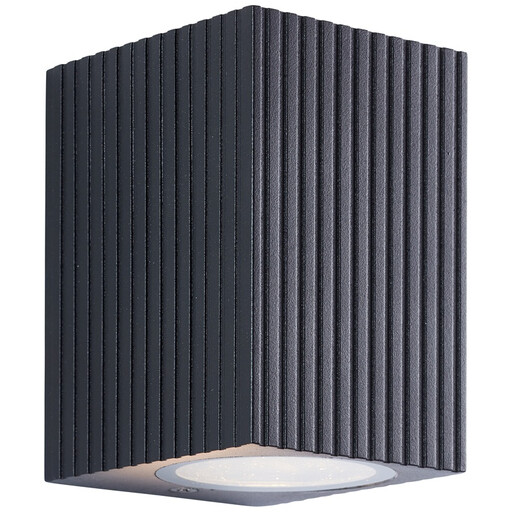
Why it suits this type of buyer: This compact black outdoor light is ideal for an entrance, balcony or smaller wall where you want focused light without a bulky fitting.
The GU10 fitting means the light source can be replaced. The product specifications state IP44 and a maximum of 10 W, making a sheltered location the right choice.
Aluminium, glass and plastic construction; compact dimensions of around 10 × 7 × 8 cm; downward-facing light.
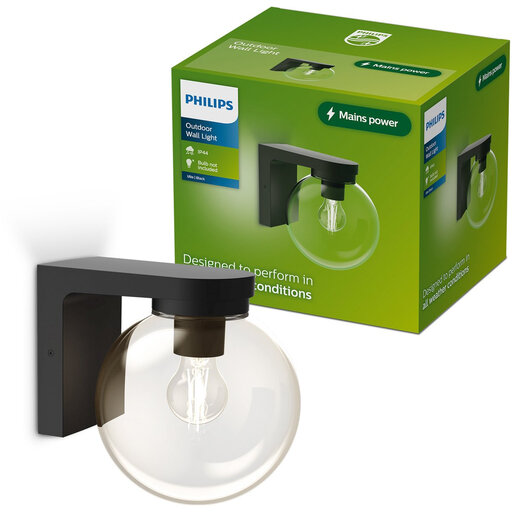
Why it suits this type of buyer: The aluminium and glass construction, along with the classic design, works well on walls, by doors and on patios where style and a replaceable light source matter.
The E27 bulb isn’t included, but this is clearly stated in the product information. You can choose a suitable LED bulb and colour temperature in advance.
IP44, one E27 light point and diffused lighting; suitable for an LED bulb up to a maximum of 60 W according to the product specifications.

Why it suits this type of buyer: This model is ideal for a spot without an existing power connection, such as a shed, garden path or side wall that gets plenty of direct daylight.
The light has a built-in battery, solar charging and a motion sensor. Bear in mind, though, that it relies on sunlight and has an IP44 rating.
According to the product specifications: 1000 lumens, 3000 K, two lighting modes and installation without a mains cable.

Why it suits this type of buyer: This rechargeable light with magnetic mounting is handy if you don’t want to install permanent wiring or might want to move the light later.
The product information specifies USB-C charging, an integrated LED and a sensor. Its IP44 rating means you should avoid direct jets of water and immersion.
300 lumens, 3000 K, a motion sensor and a battery with two 18650 cells, according to the product information.
We’ve put together a complete, up-to-date list of products that meet these strict selection criteria and the applicable European safety regulations.
For a sheltered entrance, veranda or balcony, IP44 is often a practical choice. If you’re putting the light somewhere that will be directly exposed to rain and jets of water, compare models with a higher IP rating, such as IP65. Always check that the stated rating applies to the complete fitting and that it is installed correctly.
No. The solar panel needs enough daylight to charge the battery. So don’t automatically install the light beneath a roof edge, in deep shade or on a wall that doesn’t get direct sunlight. A wired outdoor light with a motion sensor is a better choice if you need a reliable source of light every evening.
An LED light typically uses very little electricity, but consumption depends on its wattage and how long it is switched on. A 4 W light that is on for 1,000 hours uses around 4 kWh. A solar-powered or wireless outdoor light doesn’t use mains electricity, but you’ll still need to consider charging and eventually replacing the battery or integrated light source.
