
Vandaag of morgen in huis

Kwaliteit gegarandeerd

Welkomstaanbiedingen ontgrendelen: GRATIS bezorging | Tot 80% korting | Gratis 30 dagen JoyPlus-proefperiode
Download de app
An outdoor wall light can make a dark entrance, façade or patio more practical. But many shoppers run into the same problems: a light turns out to be less suitable for rainy weather than expected, the bulb isn’t included, or a solar outdoor light with a motion sensor barely works on a shady wall.
Use this guide to compare outdoor lighting based on practical details such as the fitting, brightness, IP rating, installation and placement. That way, you can choose a wall-mounted outdoor light that suits your home and how you plan to use it.
An IP44 outdoor light is protected against solid objects larger than 1 millimetre and splashing water from different directions. This doesn’t mean it’s suitable for submersion, direct jets of water or a completely exposed spot where rain stays on the housing for a long time.
So check not only the IP rating, but also the installation instructions. IP44 is often suitable for a covered entrance, balcony, veranda, garage wall or sheltered façade. If the wall is constantly exposed to driving rain, pay extra attention to the light’s position and sealing.
Many models with a GU10 outdoor light or E27 outdoor light are supplied without a bulb. This gives you the freedom to choose the colour temperature and brightness, but you’ll need to buy the right bulb separately. Always check:
An integrated LED outdoor wall light doesn’t need a separate bulb, but the light source can’t be replaced on some models. This is an important difference when it comes to long-term maintenance.
A solar outdoor light with a motion sensor doesn’t need a mains connection. That’s handy for a garden shed, fence or balcony where wiring would be tricky. However, performance depends on direct sunlight, the position of the panel and the time of year. The battery may not charge as well on a north-facing wall, under a balcony or behind a tall fence.
So don’t choose solar garden wall lighting based on looks alone. Consider how much sun the panel will get, the sensor function and how long you want the light to stay on.
A GU10 fitting is practical if you’d like to change the light colour or brightness later. For example, the Brilliant Jelani and Keola have a GU10 fitting and a maximum output of 10 W per light point. According to the product information, both fittings are supplied without a bulb.
An E27 fitting is larger and gives you a wide choice of standard LED bulbs. It works well with classic lantern-style models such as the Philips Juli or Philips Ulio. For an E27 fitting, check the bulb’s dimensions and the fitting’s maximum load.
For an entrance, you’ll usually want light directed towards the door and keyhole. A downward-facing outdoor wall light may be enough. For a patio or seating area, diffused light is often more comfortable. A product with 400 lumens is best suited to ambient or localised lighting; 800 to 1000 lumens provides more practical light.
A motion sensor can be useful by a driveway, back door or dark passageway. Check whether the sensor can be adjusted and whether the light responds only to movement or also has a dusk sensor.
Aluminium, glass and plastic are commonly used for weather-resistant outdoor lighting. The material alone doesn’t determine whether a light is suitable for every location. Check the IP rating, mounting method and whether it’s suitable for the surface where you plan to install it.
Wired models operating at 220–240 V must be connected by a qualified electrician. Switch off the power before installation or maintenance. Solar models are easier to install, but the wall still needs to be sturdy, and any cables or fixing points must be secured properly.
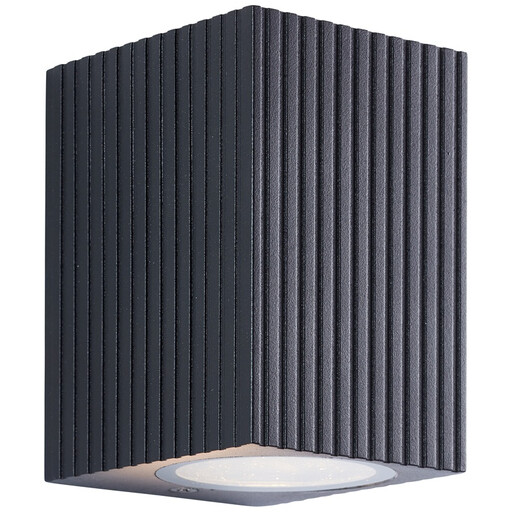
Why it suits this profile: The compact black Jelani is suitable for an entrance, balcony or sheltered façade. The GU10 fitting lets you choose a suitable LED bulb.
The product information clearly states the IP44 rating and maximum output of 10 W. Bear in mind that the bulb isn’t included and that connecting it to the mains requires professional installation.
Aluminium, glass and plastic; dimensions of approximately 10 × 7 × 8 cm; downward light distribution.
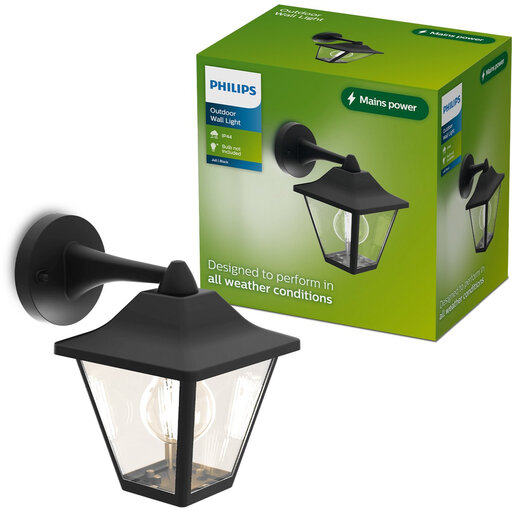
Why it suits this profile: The classic lantern shape suits a front garden, veranda or façade where appearance and a replaceable light source are important.
The E27 fitting lets you choose your own LED bulb. According to Philips product information, the fitting is IP44; make sure it’s installed and sealed correctly.
E27 fitting, aluminium and glass, dimensions of approximately 15 × 22 × 22 cm and diffused light distribution.

Why it suits this profile: This solar outdoor light with motion sensor is ideal for a driveway, garden shed or back door where there’s no mains cable.
The product information lists an integrated battery, sensor and solar power. Make sure you position the panel in direct sunlight; otherwise, the running time may be reduced.
1000 lumens according to the product specifications, 3000 K warm white light, two lighting modes and IP44.
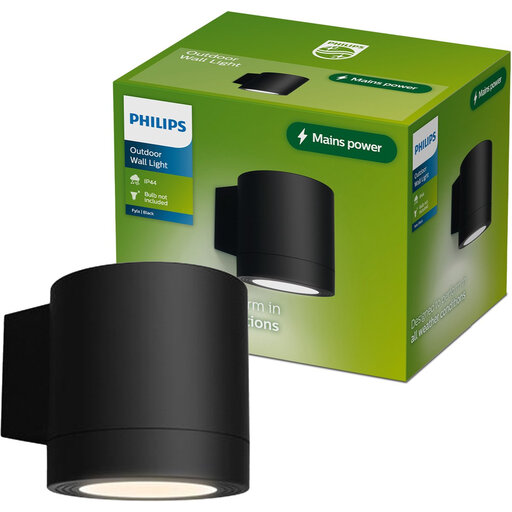
Why it suits this profile: A compact black outdoor light for a modern façade, balcony wall or garden wall, with a GU10 bulb you can choose yourself.
The fitting and IP44 rating are listed in the product details. The GU10 bulb isn’t included, so you can factor in its cost in advance.
Aluminium housing, downward-facing light, compact dimensions of approximately 9 × 12 × 9 cm and a replaceable GU10 bulb.
We’ve put together a complete, up-to-date list of products that meet these strict selection criteria and current European safety regulations.
IP44 is suitable for splashing water and many sheltered outdoor locations, such as a balcony, veranda, covered entrance or garden wall. The rating doesn’t mean the light is waterproof. Avoid submersion, direct jets of water and places where water can collect around the fitting.
First, switch off the power at the consumer unit. Attach the light to a sturdy surface using suitable fixings, then connect the wiring according to the instructions. A model operating at 220–240 V must be connected by a qualified electrician in accordance with local regulations.
A solar outdoor wall light doesn’t use electricity from the mains during normal operation. However, how well it works depends on sunlight, battery capacity and sensor settings. Keep the solar panel clean and position the light so the panel receives as much direct daylight as possible.
