
Vandaag of morgen in huis

Kwaliteit gegarandeerd

Welkomstaanbiedingen ontgrendelen: GRATIS bezorging | Tot 80% korting | Gratis 30 dagen JoyPlus-proefperiode
Download de app
An outdoor wall light can make the entrance, façade, balcony or patio feel more welcoming and safer. However, it is unwise to base your choice solely on colour, shape or a low price. An outdoor light mounted on the wall has to cope with rain, wind, moisture and changing temperatures in the Netherlands. What is more, not every fitting or sensor is suitable for every situation.
The following pitfalls are common:
For many façades, balconies and sheltered patios, IP44 is a common specification. The light can withstand splashing water, but ideally do not install an IP44 outdoor wall light where rainwater falls directly onto it. Also check that the wall is strong enough and that the supplied fixings are suitable for brick, concrete, wood or another surface.
For a more exposed location or one subject to heavy rainfall, a higher IP rating may be relevant. Look at the product specifications rather than relying solely on terms such as “weather-resistant” or “suitable for all weather conditions”.
A GU10 fitting is suitable for a compact spotlight. You can choose the colour temperature, brightness and, if required, smart features yourself. An E27 fitting accommodates a larger LED bulb and often suits a classic lantern shape.
Pay attention to the following:
An integrated LED outdoor light is compact and ready to use straight away, but check in advance whether the light source can be replaced. With some models, the entire fitting must be replaced when the LED module reaches the end of its service life.
A mains-powered light provides a constant source of illumination, but requires wiring and usually installation by a qualified electrician. A solar wall light works without a connection to the mains. This makes installation easier, but its performance depends on sunlight and battery capacity.
Outdoor lighting with a sensor is practical by a front door, garage or garden path. Check whether it has a motion sensor, dusk sensor or both. Also pay attention to how adjustable it is. A light that switches on whenever a passing cat triggers it may be less practical than the product description suggests.
The following models were selected based on verifiable specifications such as fitting, IP rating, lumens, power supply and sensor function.
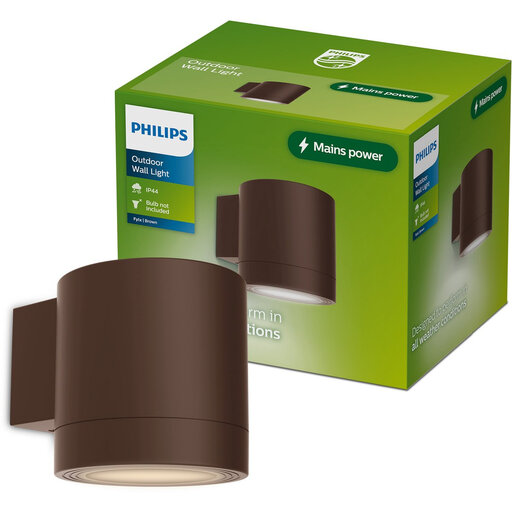
Why it suits this profile: This compact wall light features a GU10 fitting and, according to the product information, is supplied without a spotlight bulb. This means you can choose your own LED bulb for warm or cooler light.
The fitting and the fact that no light source is included are clearly stated. This allows you to factor in the cost of a suitable GU10 LED bulb in advance.
Aluminium housing, one light source, GU10 fitting and IP44 protection. Dimensions: approximately 8.9 × 11.6 × 9 cm.
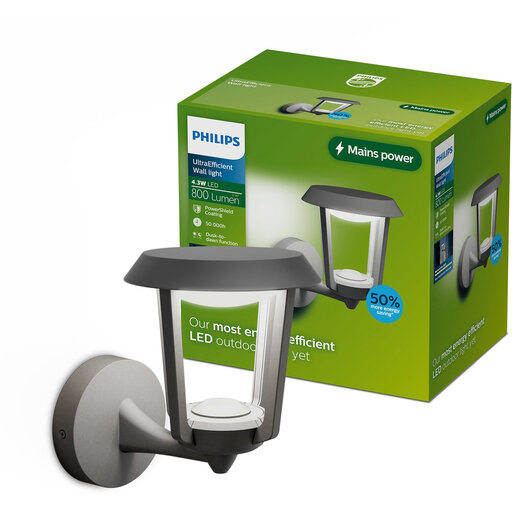
Why it suits this profile: The Nuvy is designed for anyone who wants a complete, fixed LED fitting without having to select a separate bulb. The specified light colour is warm white at 2700 K.
The product information states that it has an integrated LED, 800 lumens, 4.3 W and IP44 protection. You therefore do not need to order a missing fitting or bulb afterwards.
Integrated LED, 800 lm, 2700 K, 4.3 W and a stated service life of 50,000 hours according to the product description.
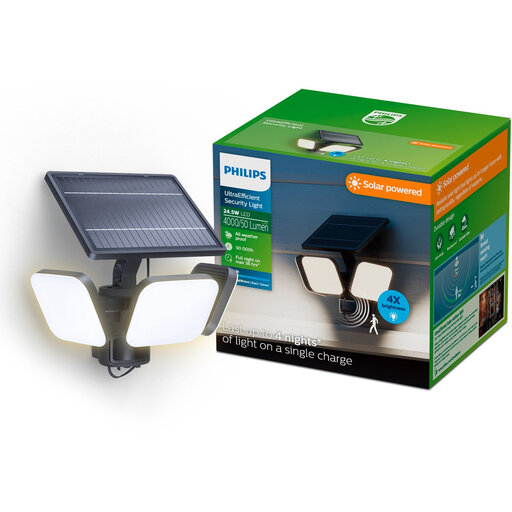
Why it suits this profile: This model is designed for a façade, shed or driveway where high light output and wide motion detection are desirable. The light is solar-powered and has an adjustable light head.
The specifications state IP65 rather than IP44, along with a detection range of up to 8 metres when approached directly and 16 metres from the side, according to the product description.
Stated light output of 4000 lm, 5000 K, solar power supply, dusk sensor and two lighting modes.

Why it suits this profile: This wireless light uses a magnetic mounting system and a rechargeable battery. It is ideal for a balcony or rented property where you do not want to install permanent wiring.
The light is IP44 rated and charged via USB-C. Bear in mind that it needs charging regularly, and attach the magnetic plate to a flat, sturdy surface.
Integrated 4 W LED, approximately 300 lumens, 3000 K, motion sensor and wireless installation.
We have put together a complete, up-to-date list of products that fully meet these strict selection criteria and the applicable European safety regulations.
A fixed outdoor wall light running on 230 volts should be connected by a qualified electrician. Switch off the power at the consumer unit and use fixings suitable for the wall. With a solar wall light, positioning is particularly important: point the panel towards a spot with as much direct daylight as possible and keep the surface free from dirt.
Do not position a sensor directly opposite a bright light or somewhere with constant passing traffic. After installation, test the detection distance and check whether the beam actually reaches the entrance, path or steps.
An IP44 light is designed to protect against splashing water. This makes the rating suitable for many sheltered outdoor locations, but not for immersion, direct high-pressure jets or places where water collects. Always follow the installation instructions for the specific model.
That depends on its wattage and how long it is on. A 4.3 W LED light switched on for four hours a day uses less energy than a 20 W light used for the same length of time. A sensor or dusk switch can limit the time the light is on. Solar lighting does not use mains electricity, but its battery still needs to be charged sufficiently.
The service life varies depending on the light source, housing, installation location and usage. Manufacturers may state a number of operating hours; this is a product specification, not a guarantee for every situation. With a separate GU10 or E27 LED bulb, you can replace the light source. With integrated LED lighting, check whether the module can be replaced.
A wireless or solar wall light is usually easier to install. A fixed mains-powered light requires an electrical connection. Have this carried out by a qualified electrician and check the local installation regulations beforehand.
