
Vandaag of morgen in huis

Kwaliteit gegarandeerd

Welkomstaanbiedingen ontgrendelen: GRATIS bezorging | Tot 80% korting | Gratis 30 dagen JoyPlus-proefperiode
Download de app
An outdoor wall light can make an entrance more visible, add ambience to a patio or provide practical illumination for a dark exterior wall. However, it's not wise to base your decision solely on looks or eye-catching marketing claims. A light that seems suitable for outdoor use might not have enough protection against rain, could distribute light in an unhelpful way, or may be supplied without the necessary bulb.
With this selection guide, you can compare outdoor lighting based on verifiable features. This will help you avoid a bad purchase and choose more effectively between an LED outdoor wall light, a wall light with a motion sensor, a solar-powered outdoor light or a model with a replaceable fitting.
An IP44 outdoor light is protected against solid objects larger than 1 millimetre and against splashing water from various directions. This makes IP44 suitable for many house fronts, balconies and sheltered patios. It does not mean the light can be submerged or withstand a direct, powerful jet of water.
Therefore, you should check the placement. An IP44 light is often easier to use under a canopy than on a completely exposed wall where rainwater will fall directly onto the housing.
The colour temperature determines the tint of the light. 2700K typically gives a warm, yellow impression of light, while 3000K looks slightly more neutral. For warm white outdoor lighting, the number of lumens is also important. A 180-lumen light is mainly suitable for accent or orientation lighting, whereas 800 lumens can provide more light for an entrance or the front of your house.
Also, pay attention to the direction of the light. A light with two-way light emission casts light upwards and downwards. A fixture with a shade, on the other hand, diffuses the light more evenly all around.
With an integrated LED light, the light source is built-in. This can keep the installation simple, but according to the product information, replacing just the LED is not always intended. A GU10 outdoor light or E27 outdoor light gives you more freedom of choice: you can select an LED bulb yourself with your desired light colour, brightness or dimming function.
Always check whether the light source is included. The Philips Nayl has an E27 fitting and, according to its product specifications, comes with an E27 LED bulb. The Philips Fylx models have a GU10 fitting but are supplied without a GU10 spot.
Don't just look for the words "for outdoor use", but check the stated IP rating. IP44 is a common classification for a garden wall light or a wall light for the front of your house. Aluminium housings, plastic components and a protective coating can contribute to its suitability for outdoor use, but the final mounting location remains important.
For products with a brand claim about corrosion resistance, note that according to Philips' own information, its PowerShield coating is designed to protect the housing against weather and wear. You should also assess the light based on its specific IP rating, dimensions and maintenance instructions.
Compare lumens, kelvin and wattage together. Here are a few examples from the product specifications:
The energy label class can vary from product to product. The Brilliant Iseo is listed with energy class G, with a stated consumption of 4 kWh per 1,000 hours. So, when comparing, look at the current product specifications and not just the term "energy-efficient".
A fixed 230V outdoor wall light must be correctly connected to the mains voltage. For models like the Brilliant Todd, Brilliant Newport and Philips Capricorn, installation by a qualified electrician is mentioned. Switch off the power before working on an existing connection.
A solar-powered outdoor light doesn't need a fixed power cable, but its solar panel requires enough direct daylight. A rechargeable light, such as the Brilliant Iseo, can be placed flexibly thanks to a magnetic mount and USB charging function. With a magnetic attachment, check that the surface is flat, sturdy and suitable to bear the weight.

Why it's a good match: This wireless light is ideal for renters, balconies and places where there's no fixed power connection. The magnetic mount and USB-C charging function make it practical to move and recharge.
The specifications state IP44, a motion sensor and 300 lumens. This makes it clear that it offers splash protection and targeted lighting, rather than being a fully waterproof light.
Integrated LED, 3000K, motion sensor, USB-C charging and magnetic mounting.
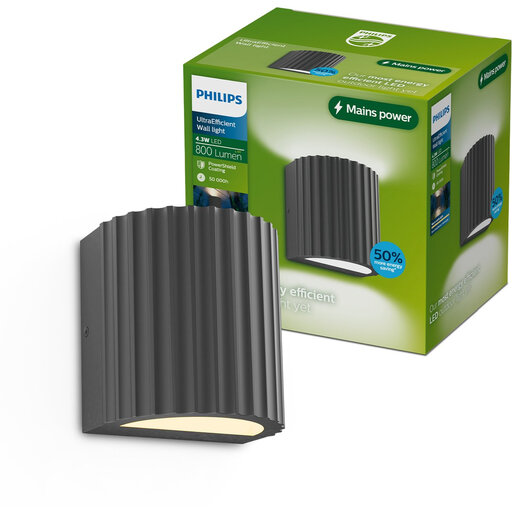
Why it's a good match: This anthracite outdoor light suits a modern exterior and provides up-and-down lighting. The combination of an integrated LED and 2700K colour temperature is suitable for an entrance, patio or balcony.
The product details specifically mention 800 lumens, 4.3 watts, 230V and IP44. This allows you to assess the brightness and connection requirements beforehand.
800 lumens, warm 2700K light, two-way light emission and an aluminium and plastic housing.
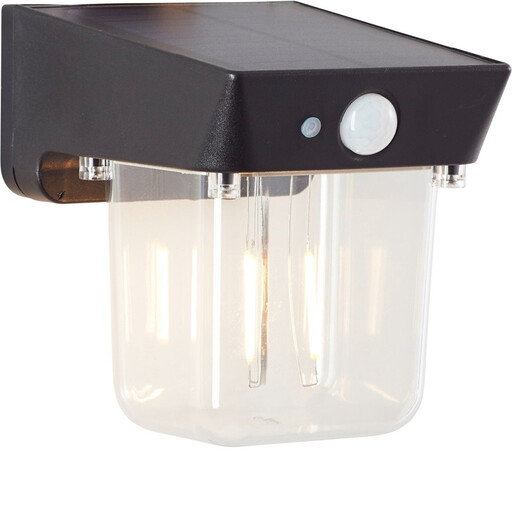
Why it's a good match: This black solar-powered outdoor light is designed for places without mains power, such as a garden path, shed or the back of your house. The motion sensor activates the light when needed.
The specifications state 180 lumens, 2 watts, an integrated battery and IP44. You can therefore expect practical accent lighting, but bear in mind it will need sunlight and regular charging.
Solar-powered, integrated LED, motion sensor, 2700K and two light modes.
We've put together a complete, up-to-date list of products that fully meet these strict selection criteria and comply with current European safety regulations.
For many sheltered outdoor applications, IP44 is used. This classification offers protection against splashing water, but not against submersion or direct, powerful jets of water. Consider the position of the light and follow the manufacturer's installation instructions.
That depends on the wattage, the number of hours it's used and the price of electricity. A 4.3-watt light will use less electricity than a 60-watt light over the same number of hours. Solar lighting doesn't use mains electricity, but its operation depends on sufficient sunlight and battery capacity.
For various Philips models, the product information states a lifespan of up to 50,000 hours of use. This is a manufacturer's estimate and not a guarantee for every usage scenario. With an integrated LED, you usually don't just replace the bulb, whereas a GU10 or E27 model uses a replaceable light source.
