
Vandaag of morgen in huis

Kwaliteit gegarandeerd

Welkomstaanbiedingen ontgrendelen: GRATIS bezorging | Tot 80% korting | Gratis 30 dagen JoyPlus-proefperiode
Download de app
Hanging up solar string lights outdoors seems like a simple way to add ambiance to your garden, patio, or balcony. No fussing with cables, no extra electricity costs. Yet, an impulse buy often leads to disappointment. Many string lights don't survive the first autumn storm or stop working after a single cloudy day.
Before you invest in solar-powered garden lighting, it's wise to know what to look for. We'll discuss the 3 most common pitfalls and how to avoid them, ensuring you choose a product that truly performs.
Marketing promises sound great, but the reality of unpredictable weather is often different. These are the problems many buyers encounter:
To avoid a bad purchase, you can focus on a few concrete specifications. These objective characteristics say more than any marketing text.
You can identify a waterproof string light by its IP (Ingress Protection) rating. This code indicates how well a product is protected against dust and water.
For a string light that hangs outdoors year-round, IP65 is a sensible minimum.
The performance of your solar lighting depends directly on the combination of the battery and the solar panel. A larger solar panel captures more light, even on cloudy days. A battery with a higher capacity (expressed in mAh) can store that energy for longer. Manufacturers who are confident in their product often list these specifications clearly.
The ambiance is largely determined by the light color, expressed in Kelvin (K).
garden mood lighting.Consciously choose warm white if you are looking for a cozy atmosphere.
Based on these objective criteria, we have selected a number of products that suit different needs and outdoor spaces.
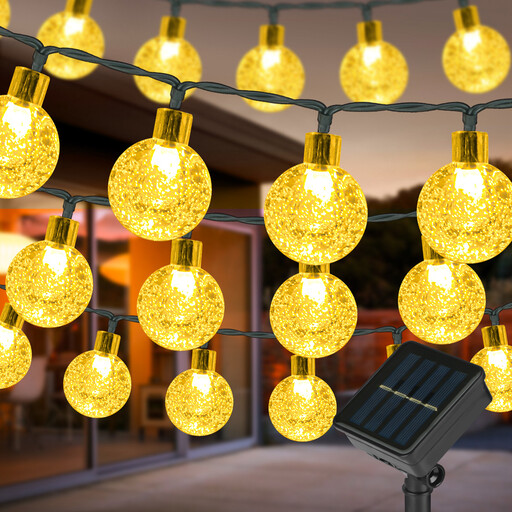
Why This Fits Their Persona: The 7-meter length is ideal for a balcony railing or a cozy seating area. The warm white light color instantly creates the desired cozy atmosphere without being overpowering.
With an IP65 rating, this string light is resistant to the elements, thus avoiding the 'not truly waterproof' pitfall. The focus on an efficient solar panel addresses the problem of unreliable runtime.
The combination of warm white light and 8 different lighting modes gives you complete control over the atmosphere. Installation is simple and requires no tools.
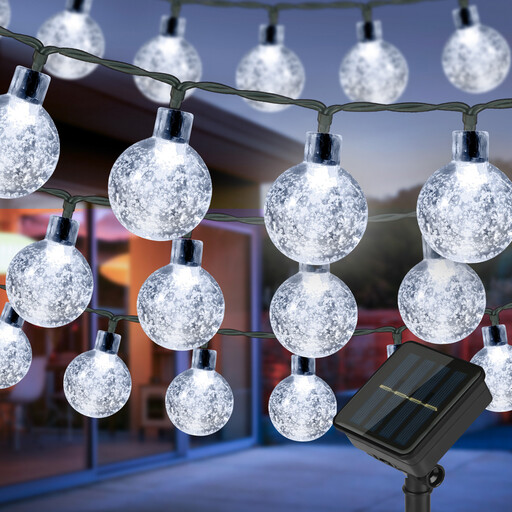
Why This Fits Their Persona: With a length of nearly 12 meters and 100 LEDs, this string is perfect for illuminating a fence, pergola, or large tree. It creates a striking and festive effect in a spacious garden.
The manufacturer specifies that the product is designed for "all-weather use" and utilizes "advanced solar cell technology," which addresses the typical issues of water resistance and charging efficiency.
The considerable length makes it possible to decorate a large area at once. The 8 lighting modes offer flexibility for different occasions.
Why This Fits Their Persona: This shorter, nearly 5-meter version is perfect for adding a subtle accent. Think of wrapping it around a planter, decorating a small fence, or framing a doorway.
Like the other models in this series, it is designed for all-weather outdoor use and features an efficient solar panel, making it more reliable than standard options.
Its compact length makes it an accessible choice for a quick, decorative addition. Ideal for anyone looking for a small, focused touch of light.
We have compiled a complete, up-to-date list of products that fully meet these strict selection criteria and safety standards.
This depends heavily on the battery capacity, the panel's efficiency, and the number of hours of direct sunlight. In winter, expect a shorter runtime of 3-5 hours on average, compared to 8 hours or more in the summer. For better winter performance, it's best to choose a model with a larger battery and a high-quality outdoor light with solar panel.
Yes, provided it has the correct IP rating. Opt for a minimum of IP65, which means it is dust-tight and protected against water jets. This is generally sufficient for most climates. Products with a lower IP rating (like IP44) are better off in a sheltered location to prevent damage.
For optimal charging, direct sunlight is the best option. Place the panel in a location where it will receive the most hours of sun throughout the day, ideally facing south. Although the panel will also charge on a cloudy day, the output will be significantly lower, resulting in a shorter runtime.
