
Vandaag of morgen in huis

Kwaliteit gegarandeerd

Welkomstaanbiedingen ontgrendelen: GRATIS bezorging | Tot 80% korting | Gratis 30 dagen JoyPlus-proefperiode
Download de app
An outdoor solar string light may seem simple to choose, but differences in length, battery life, light colour and protection have a direct impact on how it performs. A string that works well on a sunny day may stay lit for less time in the shade or rain. Likewise, a description such as “waterproof” does not automatically mean that every component can be submerged.
This guide explains which specifications matter and which type of solar-powered outdoor lighting suits your garden, patio, balcony or event.
Brands sometimes quote a long operating time. Always check the conditions under which it applies. For example, VIVREAL solar lighting specifies a charging time of 6 to 8 hours in direct sunlight and an illumination time of 8 to 14 hours, depending on the weather. In the Netherlands, cloudy days, a low sun and positioning beneath trees can affect charging time.
So do not just look at the maximum battery life. Also consider:
A waterproof string light should have a clear IP rating. IP44 protects against splashing water, while IP65 indicates a higher level of protection against dust and water jets. Neither rating automatically means that the light is suitable for immersion.
So do not place the solar panel in a puddle, and prevent the connections from sitting in standing water for long periods. For products with IP44, such as certain table lamps and the M.TK Meteor Shower Lights, a sheltered position beneath a veranda or canopy is advisable.
More LEDs do not automatically mean more light. The spacing between the lights, the light colour and the design all affect the result. A fine copper-coloured string with lots of small LEDs mainly creates decorative accents. A string light with larger G40 bulbs distributes light differently and is better suited to long fences, pergolas or event venues.
Also pay attention to the difference between warm white, cool white and multicolour. Warm white often suits a patio or dinner setting, while cool white creates a cleaner look on a balcony, around a window or in a modern garden.
A solar string light does not need a socket, but it does require sufficient daylight. This makes installation easy in places without an outdoor socket. A mains-powered model, on the other hand, provides a constant power supply and is practical when the lighting needs to stay on for long periods or every day.
For a large area, a plug-in model such as the 30-metre VIVREAL G40 string may be a better choice. According to the product specifications, this model has a timer, several lighting modes, a dimming function and replaceable bulbs. The string runs on mains electricity and therefore does not use a battery.
First measure the area where you want to hang the garden LED string light. Allow for bends, attachment points and the cable leading to the solar panel. A length of 8 or 10 metres is suitable for a balcony, small tree or planter. For a veranda, fence or event venue, 30 metres is more practical.
With a set containing two strings, check whether the stated length applies to each string. According to the product information, the VIVREAL 2-pack of 49 ft contains two strings of approximately 14.9 metres, each with 75 warm-white LEDs.
A string light with multiple lighting modes can switch between settings such as steady light, twinkling, waves and slow fading. A memory function can save the last selected setting. However, check how the controls work: on some models, pressing the on/off button again can change or reset the selected mode.
A dimmable LED string light is particularly useful for an event or patio where you want more light during the day and a softer effect during dinner.
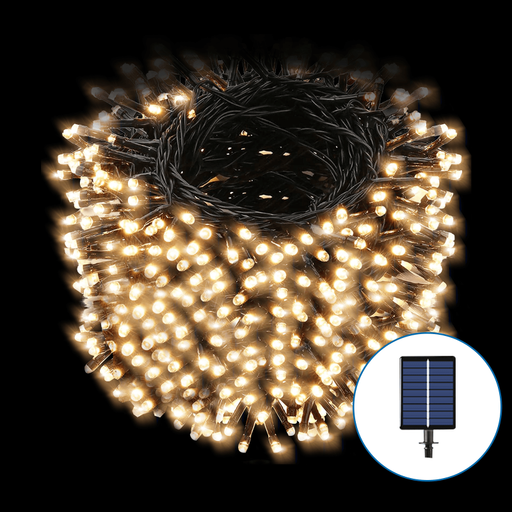
Why it suits this profile: A straightforward 10-metre solar string for a tree, window, balcony or small garden. The product specifications state that it has 100 LEDs, warm light and 8 lighting modes.
The length, battery information and charging time are clearly stated. The IP65 rating makes it suitable for outdoor use, but the panel and string lights must not be submerged.
10-metre length, 100 LEDs, 8 lighting modes and approximately 8 to 12 hours of battery life according to the product specifications.
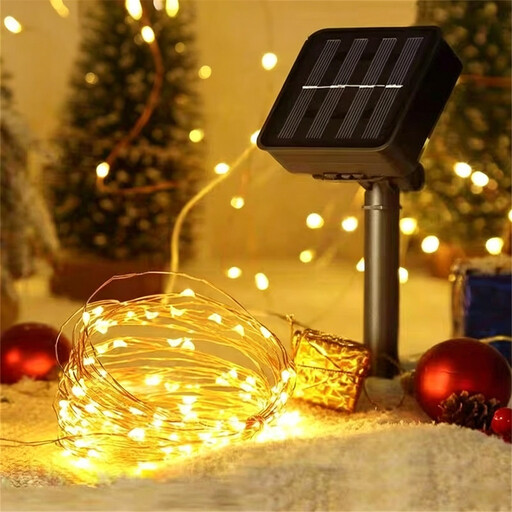
Why it suits this profile: The two long strings are suitable for a patio, fence, tree or garden party where a larger area needs decorative lighting.
The length and number of LEDs are specified for each string. The stated IP rating and warning against immersion make it clear that “water-resistant” has its limits.
2 strings of approximately 14.9 metres, each with 75 warm-white LEDs, 8 lighting modes and a memory function.
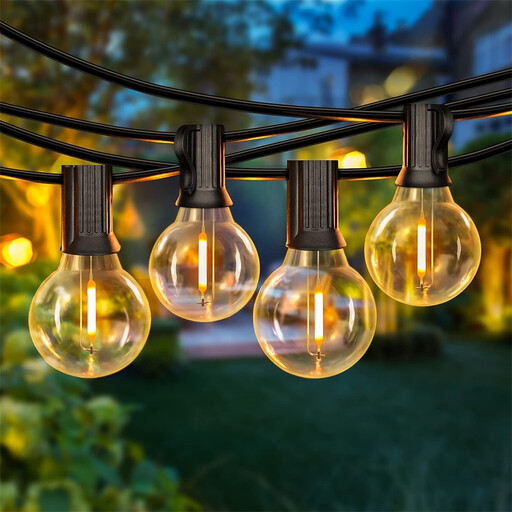
Why it suits this profile: This mains-powered model is designed for longer installations, event venues, pergolas and regular use where a constant power supply is important.
The plug-in connection removes reliance on sunlight. However, check the socket, keep connections away from standing water and do not exceed the maximum connection of 500 lights.
30-metre length, dimmable, multiple lighting modes, timer and replaceable G40 bulbs.

Why it suits this profile: The falling-light effect is ideal for outdoor Christmas lighting, festive occasions and temporary decoration on a façade, tree or window.
The coverage of 5 × 0.3 metres, IP44 rating and 220–240V adapter are stated. When used outdoors, the product should preferably be placed in a sheltered position and not submerged.
192 multicolour LEDs, 8 hanging points, memory function and a supplied 6W adapter.
We have put together a complete, up-to-date list of products that fully meet these strict selection criteria and the applicable European safety regulations.
For a permanent installation, it is advisable to secure cables so that nobody can trip over them. Also take children and pets into account when using loose or low-hanging strings.
This varies by model and weather conditions. Product information for various solar strings states approximately 8 to 14 hours after 6 to 8 hours of direct sunlight. Cloud, shade and a battery that is not fully charged can shorten the operating time.
It can if the battery is sufficiently charged and the stated illumination time allows it. Check the specifications and position the panel away from shade during the day. In winter, the lighting time may be shorter because there are fewer hours of sunlight.
The string lights themselves run on the energy stored in the built-in battery during the day. A plug-in alternative does use mains electricity. When choosing, therefore, consider the power source: solar for flexible positioning without a socket, and mains electricity for constant operation and longer installations.
