
Vandaag of morgen in huis

Kwaliteit gegarandeerd

Welkomstaanbiedingen ontgrendelen: GRATIS bezorging | Tot 80% korting | Gratis 30 dagen JoyPlus-proefperiode
Download de app
Outdoor solar lights may seem easy to choose: a light with a solar panel, a spot in the garden and you’re done. In practice, some models are disappointing. They may give off less light than expected, fail to charge properly in the shade or turn out to be unsuitable for a wall exposed to heavy rain.
With this buying guide, you can compare outdoor solar lighting based on measurable features such as light output, IP rating, sensor range and charging method. This will help you find the right solution for a balcony, garden path, patio, entrance or driveway.
A high number of LEDs does not automatically mean that a light will illuminate a large area brightly. Also check the light output in lumens and how the light is distributed. A decorative solar garden light with a few LEDs is designed to create ambience or mark a location. A solar security light requires a much higher light output.
For example, the UME light lists 302 LEDs and 3,000 lumens. These are relevant specifications for illuminating a wide area. A small path light rated at 0.012 watts serves a different purpose and should not be compared with a floodlight.
IP44 outdoor lighting is protected against solid objects larger than 1 millimetre and splashing water. This makes the light suitable for many sheltered outdoor locations, but not for immersion or direct jets of water.
An IP65 solar light offers greater protection against dust and water jets. Even then, this does not mean that the light can be placed underwater. Always check the installation instructions and position the solar panel so that water cannot remain on it for long periods.
A solar panel behind a fence, under a canopy or on a north-facing wall may receive too little direct sunlight. The light may then store less energy during the day and shine for less time or less brightly in the evening. Trees, dirt and leaves have the same effect.
A solar light therefore relies on more than just battery capacity. Its positioning, the season and the weather also affect the result.
Light output is measured in lumens. Use this guide:
Colour temperature is measured in Kelvin:
An LED solar light is generally energy-efficient, but brightness and runtime depend on the battery, charging time and selected light mode.
An outdoor light with a motion sensor switches to full brightness only when movement is detected. This can save energy compared with leaving the light on continuously. Check the range and detection angle. A sensor with a long range is not always convenient next to a busy path, as the light may switch on unnecessarily more often.
Some models combine a dusk sensor with a motion sensor. Others offer a fixed light setting, an automatic mode or several different modes. Check that the desired setting is clearly described.
Check the battery type, capacity and stated charging and operating times. These figures usually depend on direct sunlight and weather conditions. A light with USB charging, such as a solar table lamp, offers extra flexibility during dark or overcast periods.
Clean the solar panel regularly with a soft, slightly damp cloth. For wall lights, also check that the fixings remain secure. Integrated LEDs and batteries are not designed to be replaced by the user in many models, so do not force the casing open.
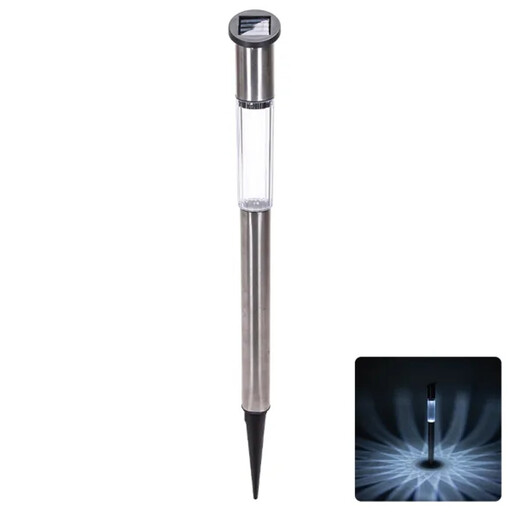
Why it suits this profile: This stake light is designed for a garden path or border and requires no wiring. The stainless steel housing and compact size make it easy to install.
The product information states IP44, a charging time of 4–6 hours and an operating time of 8–12 hours. This makes it clear that it is primarily intended for path and ambient lighting, not security lighting.
6500 K bright white light, 550 mm high, stainless steel and a NiMH battery.

Why it suits this profile: For a wall, garage or spacious driveway, broad light distribution is more important than a decorative appearance. This model is designed to provide powerful outdoor lighting with a sensor.
The product specifications list 4,000 lumens, IP65, an adjustable head and a sensor range of up to 16 metres for lateral movement. This makes it easier to tailor the light to a large area.
IP65 protection, 5000 K colour temperature, motion and dusk sensors, and two light modes.

Why it suits this profile: This solar security light is designed for large outdoor areas such as a driveway, garage, back garden or pool area. The three adjustable heads help direct the light.
The description states 3,000 lumens, a 180-degree detection angle, a range of up to 60 feet and IP65. These are more specific details than simply stating a high LED count.
Three light modes, three adjustable light heads, 270-degree coverage and an 1800 mAh lithium-ion battery.
For creating ambience on a balcony or patio, a solar string light, solar torches or a solar table lamp are sensible choices. A string light with warm white light and several modes provides mainly decorative lighting. A table lamp with three dimming levels is practical when you want to adjust the brightness while eating or enjoying drinks.
For an entrance or exterior wall, an outdoor solar wall light is a better fit. Models from Philips and Brilliant, for example, offer integrated LEDs, a motion sensor and IP44 protection. Ideally, position these lights under an overhang if the wall receives a lot of direct rain.
We’ve put together a complete, up-to-date list of products that fully meet these strict selection criteria and the applicable European safety regulations.
Lifespan varies by model and operating conditions. Product descriptions sometimes state an expected LED lifespan, but this is not the same as the lifespan of the battery or housing. Regular cleaning and correct positioning help keep the light working effectively.
Yes, but runtime may be shorter because of shorter days, overcast conditions and the lower position of the sun. Position the panel away from shade and dirt. A model with USB charging may be more practical when little sunlight is available.
During normal use, the light draws energy from the solar panel and internal battery. This means that it does not need to be connected to the mains. For models with USB charging, you can also charge the battery manually when needed.
