
Vandaag of morgen in huis

Kwaliteit gegarandeerd

Welkomstaanbiedingen ontgrendelen: GRATIS bezorging | Tot 80% korting | Gratis 30 dagen JoyPlus-proefperiode
Download de app
Outdoor solar lights are useful when you don’t want to run cables to your garden, outside wall or driveway. They charge via a solar panel during the day and switch on when it gets dark. However, a purchase can sometimes disappoint in practice. A light may not be bright enough after a cloudy day, for example, or it may be installed incorrectly or not be sufficiently weather-resistant.
This guide will help you work out which features really matter and what type of outdoor solar lighting is right for your home.
A high number of LEDs sounds impressive, but it doesn’t tell you everything about the light output. Also check the lumens, which measure the amount of visible light. A decorative solar garden light often has a fairly low light output, while a solar security light for a driveway or garage needs to be brighter.
The colour of the light also affects how it feels. At around 2700 to 3000 K, the light looks warm and cosy. A higher colour temperature can appear whiter or cooler.
IP44 solar lighting is protected against splashes, but it is not designed to be exposed to direct jets of water for long periods. IP65 solar lighting offers greater protection against dust and water jets according to the classification. This makes that type of light more suitable for an exposed outside wall, shed or garden wall, although correct installation is still important.
Always check the IP rating in the product information. The word “waterproof” in a title can refer to different levels of protection in practice.
A solar light won’t necessarily work well in every outdoor location. Shade from a wall, tree or canopy reduces the amount of sunlight the panel receives. Lights may not stay on for as long, particularly on a north-facing balcony or beneath a dense pergola.
Choose a position that gets as much direct daylight as possible. With models that have a separate solar panel, such as some hanging lights, you can hang the light itself in a sheltered spot and angle the panel towards the sun.
Match the light output to what you need it for:
The lumen rating gives you something you can compare, but the actual effect also depends on the mounting height, beam angle and colour of the surface.
IP44 may be sufficient for a sheltered canopy. For an exposed outside wall or a spot where there is more dust and rain, IP65 is a better choice. Never place a light underwater, and follow the manufacturer’s safety instructions.
Plastic housings are often lightweight and easy to install. Metal can give the light a different look, but check that the finish is suitable for outdoor use. Clean the solar panel regularly with a soft, damp cloth. Dirt can affect the light output and charging time.
Run time depends on the battery capacity, the amount of sunlight and the light mode you choose. Product information sometimes gives the run time after a full charge, but this isn’t a guarantee for every night in the UK. Cloudy weather, short winter days and shade all have an impact.
Also check how the light is operated. Some lights have an automatic dusk or motion sensor, while others have an on/off switch or several settings. With a sensor light, you can avoid having bright light on all night.
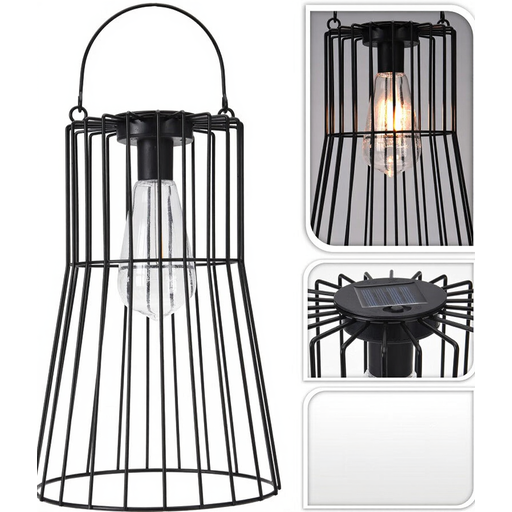
Why it suits this profile: This solar lantern is designed for anyone who wants to brighten up a patio, balcony, windowsill or garden without wiring. You can stand it up or hang it by its handle.
The product information specifies an automatic sensor, a 3V LED and a stated run time of up to 6 hours after a full day of charging. This gives you a clearer idea of what to expect than a general claim about ambient lighting alone.
Powder-coated metal housing, automatic switching on and off, and a height of around 29.5 cm.

Why it suits this profile: A good choice for an entrance, garage or side wall where you want a permanent outdoor solar wall light with a motion sensor.
The specifications list 1000 lumens, a dusk and motion sensor, and two light modes. The IP44 rating makes it clear that the light is protected against splashes, not immersion.
1000 lm, warm white light at 3000 K, an integrated LED and installation without connecting to the mains.

Why it suits this profile: This model is designed for larger areas such as a driveway, garage, back garden or patio, where wide coverage and motion detection are useful.
The product description gives specific figures: 302 LEDs, 3000 lumens, a detection distance of up to 60 feet, a 180° sensor angle and IP65. This makes it easier to compare the model with other solar security lights.
Three adjustable heads, a stated 270° lighting range and three light modes. The listed battery has a capacity of 1800 mAh.
We’ve put together a complete, up-to-date list of products that meet these strict selection criteria and the applicable European safety regulations.
Solar lights don’t use mains electricity while they’re on. This can keep running costs low, but the light still depends on sunlight and its built-in battery. Battery capacity may decrease over time. Always follow the product instructions for replacement or maintenance, and don’t open an integrated battery yourself.
It varies by model, light setting, battery and amount of sunlight. Some decorative models state around 6 hours after a full charge; other product descriptions give a range of 8 to 14 hours. Treat these figures as a guide under the stated conditions.
Yes, as long as the model is designed for outdoor use and its IP rating is suitable for the location. Winter days are shorter and there is often less direct sunlight, so the light may stay on for less time or appear dimmer. After a storm or frost, also check that it is still securely installed.
During normal use, the light gets its energy from the solar panel and doesn’t use electricity from the mains. However, a model with a USB charging function can also be charged via USB. So the total cost includes the purchase price and any future maintenance or suitable replacement battery.
