
Vandaag of morgen in huis

Kwaliteit gegarandeerd

Welkomstaanbiedingen ontgrendelen: GRATIS bezorging | Tot 80% korting | Gratis 30 dagen JoyPlus-proefperiode
Download de app
Lighting a garden, balcony, driveway or entrance without cables sounds simple. Yet many buyers find themselves disappointed after a few weeks by poor light output, a flat battery or rust. With outdoor solar lights, it is therefore not just about the number of LEDs or a low price. The location, intended use and technical specifications determine whether a light is suitable for your situation in the Dutch outdoors.
A light with a high lumen output can potentially produce a lot of light, but that does not automatically mean the entire garden will be lit evenly. The beam angle, number of light heads and mounting height are at least as important. A bright solar security light is suitable for a driveway, but may be too intense next to a patio or bedroom window.
Also watch out for contradictory product details. Check whether the stated light output applies to the complete light or is given per light source.
The IP rating indicates how well a product is protected against solid particles and water. IP44 includes protection against splashing water. This is suitable for a sheltered wall, balcony or patio, but it is not the same as being fully waterproof or suitable for immersion.
IP65 offers greater protection against dust and water jets. Even then, you need to install the light correctly and prevent water from remaining in openings for long periods. When choosing a waterproof solar outdoor light, therefore, look beyond the word “waterproof” in the title.
A solar light does not run indefinitely on solar energy. Shade from a fence, tree or canopy reduces the amount of energy collected. In winter, the days are shorter and the sun is less powerful. A light that stays on all evening in June may run for less time during a darker period.
So check whether the panel receives direct sunlight during the day. A larger battery can provide more reserve, but it cannot compensate for a solar panel that is permanently in the shade.
For atmospheric lighting around a lounge set, 100 to 200 lumens may be sufficient. An entrance or pathway often requires more. An outdoor solar wall light with a motion sensor does not need to shine brightly all night either: it can switch on only when movement is detected.
The colour temperature indicates the tint of the light:
A solar light with a motion sensor saves energy because it does not operate continuously at full brightness. Check the detection distance and detection angle. A wide angle is useful for a driveway or side path, while a narrower angle may be sufficient by a front door.
Several modes can be practical, such as dimmed light in standby mode and brighter light when movement is detected. Remember that “sensor” does not always mean that the light also switches on automatically at dusk; check whether it combines a motion sensor with a dusk sensor.
Check the battery type and capacity if these are stated. A larger capacity can provide more reserve, but the actual operating time also depends on light output, temperature and charging conditions. Some models include a USB charging option, which is useful when there has been little sunshine for several days.
For a solar garden light, solar spike light or path light, positioning is more important than it is for a wall-mounted model. Push the light firmly into the ground and keep the panel clear of leaves. A wall light must be securely attached to a suitable surface and positioned so that the panel does not face north or a permanently shaded area.
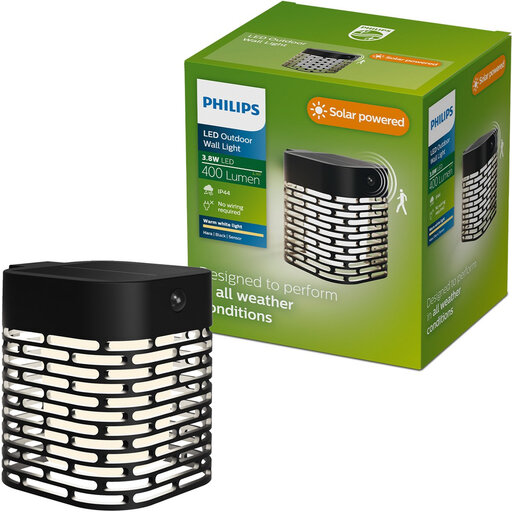
Why it suits this profile: This outdoor solar wall light is designed for general lighting by a wall, balcony or entrance. According to the product information, the model provides 400 lumens, warm white light at 2700K and two light modes.
The specifications clearly state the colour temperature, light output and IP44 rating. This makes it easier to understand that the model is intended for splashing water and general outdoor use, not immersion.
No cabling, two light modes, integrated LED and a compact size of 12,7 × 11,2 × 13 cm.
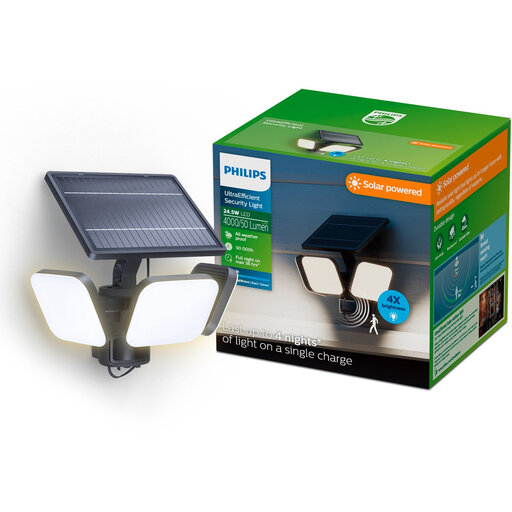
Why it suits this profile: This model is designed for anyone looking for a broad, powerful beam to illuminate a driveway, garage or large garden area. The product information states 4000 lumens, IP65 and a motion detection range of up to 8 metres when approached directly and 16 metres when approached from the side.
The stated IP65 rating, adjustable light head and sensor ranges provide more useful information than a general claim about brightness alone.
4000 lumens, IP65, motion and dusk sensor, adjustable head and, according to the product description, up to four nights of lighting after a full charge.

Why it suits this profile: For a wide driveway, back garden or garage, a model with three light heads and broad coverage may be more practical. According to the product information, this solar security light has 302 LEDs, 3000 lumens, three modes and a detection angle of 180 degrees.
The three adjustable heads and stated 270-degree coverage help illuminate areas to the side as well as directly in front of the light. IP65 makes its suitability for outdoor use clearer than an unspecified claim of water resistance.
3000 lumens, 180-degree sensor detection, three light modes, three light heads and wall mounting without a fixed power connection.
We have compiled a complete, up-to-date list of products that fully meet these strict selection criteria and the applicable European safety regulations.
Even good outdoor lighting without mains power requires little maintenance, but it should be carried out regularly:
Yes, but operating time may be reduced by shorter days, a lower sun position and cloudy weather. Position the panel as far from shade as possible and clean it regularly. A model with a USB charging option can be practical during longer periods of darkness.
The service life depends on the battery, LED module, choice of materials, installation and exposure to the weather. Product descriptions may, for example, state an operating life for the light source, but this is not the same as the total service life of the battery or housing. You should therefore also check the warranty and the availability of technical information.
During normal use, a solar light gets its energy from the built-in solar panel. Some models, such as certain solar table lamps, can also be charged via USB. The light does not then use a fixed power connection, but charging it via USB naturally still requires energy from the adapter or power bank being used.
